
‘The Idea Here Is to Go Big’: Galleries at the Art X Lagos Fair Work to Cultivate Africa’s Largest Economy
From a purely statistical
standpoint, Lagos seems like a perfect destination for an art fair.
It is the largest city in Nigeria, a country that is home to more
black billionaires than any other. It also has one of the largest
populations of young people in the world. But it has unique
challenges, too: electricity turns on and off without warning, an
indication of Nigeria’s energy supply crisis, and its economy has
struggled against the backdrop of new measures intended to limit
the amount of cash circulating to encourage electronic
transactions.
Against this backdrop—and a
vibrant street scene of music, dance, and continuous
hospitality—Art X Lagos opened its fourth edition in a bid to make
its name as Africa’s leading art fair. The event, which ran from
November 1 to 3, hosted 22 galleries from across the continent and
Europe, up from 18 last year.
“I wanted a bigger space because
thousands of people have been coming to Art X Lagos over the last
few years,” said the fair’s founder and director
Tokini Peterside. “This is a part of the world where it is very
difficult to do an art fair and because it doesn’t get done,
thousands of people miss out on experiences to do with culture and
uplift. This is not just a fair.”
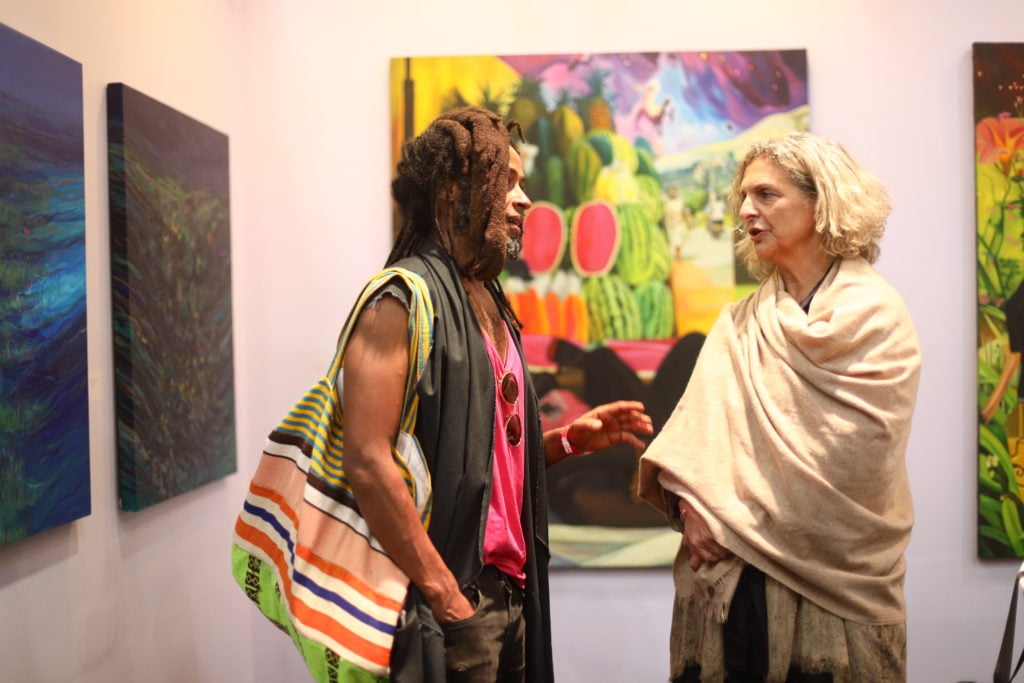
Installation view of ART X Lagos, 2019
edition. Courtesy of ART X Lagos
Located this year in Federal
Palace on Victoria Island under white-tipped tents that have earned
the event the nickname “the Frieze of West Africa,” this year’s Art
X Lagos marked a break from its previous location in the Civic
Centre. It also boasted a new section dedicated to modern art,
where Accra’s Gallery 1957 made early sales of the work of Ghanaian
artist Ablade Glover. His abstract paintings—which had not been
shown in the country for 15 years—were priced between $10,000 and
$15,000 and sold to both Nigerian and international
collectors.
“It was important to have a
modern section to reinforce to our audience that today’s
contemporary artists stem from respected artists and art movements
of the past—and to link the contemporary moment to our heritage,”
Peterside said.
Prominence of Painting
In a sign of local appetites,
the most expensive work at the fair—Purple Prose (2018), a large, expressionist portrait of a
young girl wearing a cloth around her head by South African artist
Nelson Makamo—sold at the stand of first-time participant South
African gallery Everard Read for $38,000. “We want to support what
is happening here,” said the gallery’s Grace O’Malley. “People here
want good work.”
(Everard Read was one of a
handful of South African galleries in attendance, an increase from
last year. The rise is surprising, given the recent xenophobic
attacks of Nigerians in South Africa. At the recent Art Joburg
fair in September, three Nigerian galleries were invited to
participate but only one managed to get a
visa in time due to the closure of the South African embassy in
Nigeria amid violent protests in retaliation.)
Makamo’s top-priced painting was
indicative of the demand—as true in Nigeria as in most other art
markets around the world—for bold, colorful abstract and figurative
works on canvas. Particularly in vogue here were works
incorporating abstract figures that reference those in traditional
Yoruba objects. At first-time participant Dakar-based
Galerie Cécile Fakhoury, a
large abstract figurative work by Brooklyn-based artist Abdoulaye Diarrassouba,
also known as Aboudia, sold for $28,000 to a Nigerian
collector.
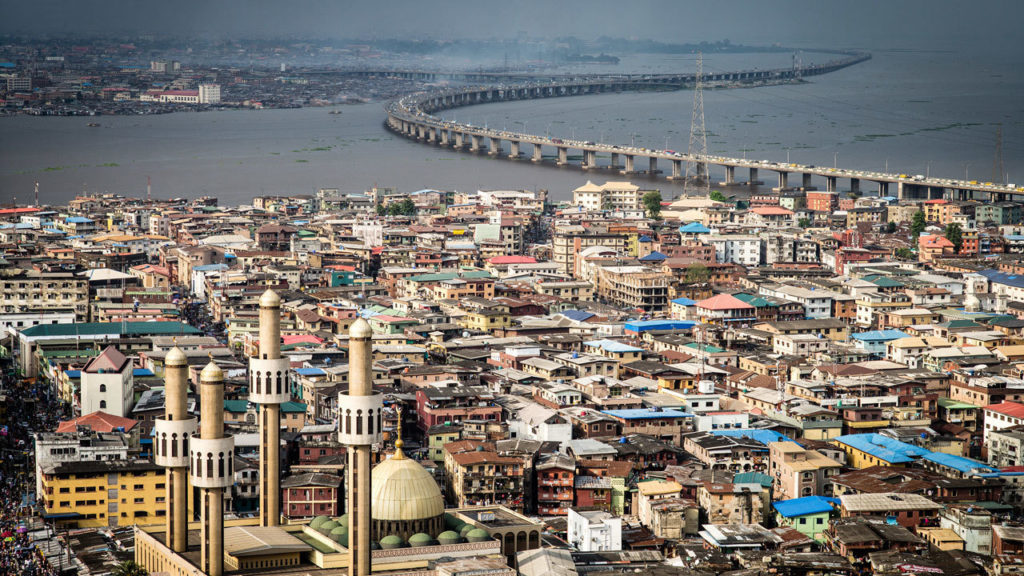
An aerial view of Lagos, Nigeria. Photo:
Michael Kraus/Getty Images.
Hardly any conceptual or
minimalist works could be found except for rising star
Emeka Ogboh’s two-channel video Ala (2014), which pairs detailed images of Lagos
with sound.
“The idea here is to go
big,” Kimberley Cunningham of Goodman Gallery said. “Nigerian
art collectors generally have very big homes with lots of wall
space. In Nigeria, through its fashion and art more is more—it’s
always been that way.”
Dealers were divided, however,
over whether the buying power was coming primarily from Nigeria or
internationally. Goodman, which was returning to the fair after a
three-year hiatus with a solo presentation of mixed-media works by
Sam Nhlengethwa priced at $10,000 each, sold more than half of its
stand—but all to international collectors, not to
Nigerians.
At Abuja-based Retro Gallery, on
the other hand, works by Nigerian pop artist Williams Chechet all
sold to Nigerian collectors for $4,000 each. Meanwhile,
Addis Ababa-based Addis Fine Art
sold all eight works on canvas by 28-year-old Ethiopian painter
Tizita Berhanu priced between $4,500 and $5,500 to mostly local
collectors.
Nigerian Buying Power?
The mixed reviews of Nigerian
buying power are particularly significant considering that Africa’s
largest economy is experiencing a period of slow economic growth.
Following new guidelines for a cashless policy in the country
released in September by the Central Bank of Nigeria, it continues
to be difficult to know just how much the currency, called the
Naira, is worth.
The policy, which dates back to
2012, stipulates a cash handling charge on daily withdrawals that
exceed N500,000 ($1,381) for individuals and N3,000,000 ($8,287)
for corporations in an effort to reduce the amount of physical cash
circulating in the economy and encourage more electronic-based
transactions.
Danda
Jarolimek, director of
Circle Art Gallery in Nairobi, says the guidelines may have
affected sales at the fair. “This year we only sold to foreigners either
living in Nigeria or who had come especially to visit the fair so
they all paid in foreign currency,” she said.
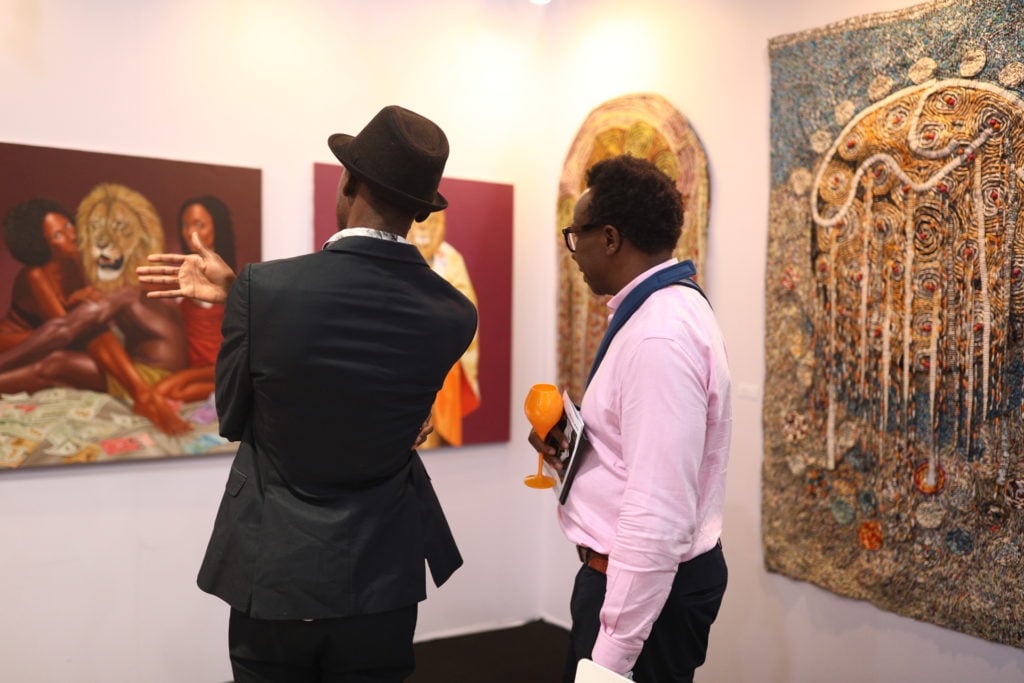
Installation view of ART X Lagos, 2019
edition. Courtesy of ART X Lagos.
But Kavita Chellaram, owner of
Arthouse – The Space, said that despite the cash crunch, “this was
the best year we’ve had,” having exhibited at the fair since its
inception. Sales included an oil painting by Peju Alatise for
$15,000, a screen print by Diana Ejaita for $850, and works by
Ngozi Schommers in the range of $5,000 to $10,000.
Nigeria is often touted for its
many collectors, but thanks to multiple simultaneous art events in
the city, including the Lagos Biennial and Lagos Photo Festival,
this year marked the largest number of international institutions
in attendance at the fair, including representatives from the Tate,
the Smithsonian, the Centre Pompidou, and Zeitz
MOCAA.
“I hope fairs like this will
help us drop the term ‘African’ in front of ‘artist,’” said Lee
Burgers of the Cape Town-based gallery SMAC. “Why can’t we just
talk about artists from Africa? Why do we still need to call it an
‘African art fair?’ I feel fairs like this are leading us to a
place where we can finally stand on our own two feet and say, ‘This
is contemporary art and these are contemporary
artists.’”
The post ‘The Idea Here Is to Go Big’: Galleries at the Art X Lagos
Fair Work to Cultivate Africa’s Largest Economy appeared first
on artnet News.
Read more https://news.artnet.com/market/art-x-lagos-2019-1695999
Further reading


Leave a comment