
A Masterful Charles White Painting Could Smash the Artist’s Auction Record, But Let’s Not Forget That He Was Devoted to Making Art for the Masses
One of the key points that Barbara Jones-Hogu made in her 1973
manifesto for the influential group that went by the unforgettable
name African Commune of Bad Relevant Artists Work (or AFRI-COBRA
for short) was that black artists should ensure that their work was
accessible to their audiences. She didn’t just mean what artists
drew, printed, painted or sculpted; she also meant artists ensuring
that their work, or reproductions of it, were within easy reach of
the people with whom it was intended to dialogue.
Jones-Hogu stressed the importance of “modes of expression, that
lend themselves to economical mass production techniques such as
‘Poster Art’ so that everyone who wants one can have one.”
Jones-Hogu may well have been mindful of the strategies of audience
engagement pioneered by the renowned American artist Charles White,
whose work is becoming ever more celebrated, as two current
exhibitions on the campus of the University of Texas at Austin
attest.
Relatively speaking, White’s work has consistently achieved
respectable prices at auction. How could they not? With his work
widely reproduced in print, and featuring in so many published or
exhibited histories of African American art, the chance to own a
Charles White original is something many collectors are keen to do.
Even so, this month’s auction at Christie’s New York of one of the
artist’s lesser known works, Banner for Willie J., a 1976
oil painting, will be something of a milestone, because the work
carries an estimate of between $1 million and $1.5 million.
No doubt the escalation in appreciation of White’s work, in part
a consequence of his major exhibition that traveled from Chicago to
New York to Los Angeles, has helped increase valuations of his
originals, but we still might be tempted to think that such
financial appraisals are overdue. Banner for Willie J. is
a beautiful, hugely engaging work, instantly recognizable as coming
from the artist’s mid-1970s period, and it’s a work that has wider
stylistic similarities with Homage to Sterling Brown,
produced a few years earlier. Both have a lyricism, a deep
affection for the black male figure, and White’s characteristic
attachment to depicting human anatomy. The price that Banner
for Willie J. might realize could significantly exceed the
handsome prices his work has already been achieving at auction in
recent years.
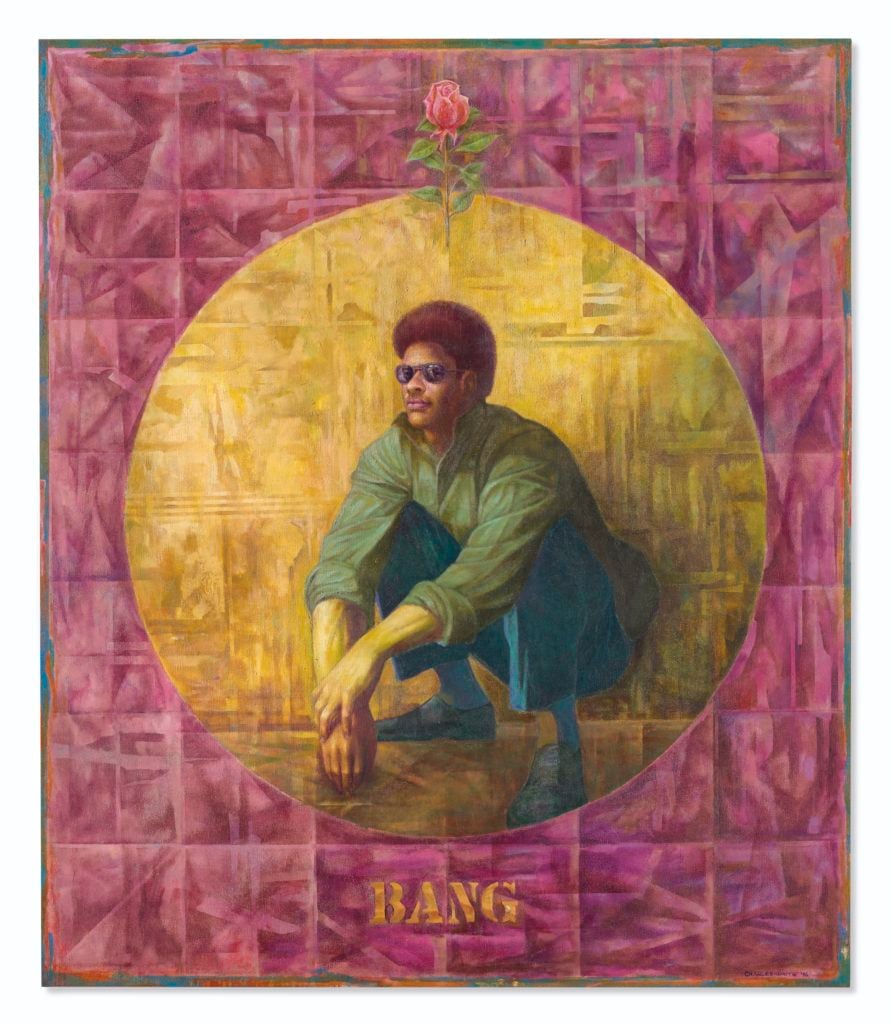
Charles White, Banner for Willie
J. (1976). Courtesy of Christie’s Images, Ltd.
Yet we shouldn’t let the excitement over this high-profile work
obscure one the most salient aspects of White’s practice: that he
was steadfastly committed to making art accessible to all, a
pursuit he achieved by mass-producing his images on book jackets,
record sleeves, and other printed materials.
Born in Chicago in 1918, White, who died at the relatively young
age of 61, was a highly accomplished draughtsman, painter,
printmaker, and muralist. He dedicated his life to his art, which
was characterized by his commitment to depicting African Americans
as dignified, resilient survivors, and to this end, his drawings of
black Americans resonated with hope, fortitude, humanity, and
pride.
With a highly distinctive drawing style, White’s recent
exhibitions have firmly, though belatedly, established him as one
of the most respected and admired American artists of the 20th
century. His drawings, though in some respects hugely accessible,
were nuanced creations embodying many layers of meaning, history,
and culture. One of White’s strategies was to produce folios
of reproductions of his drawings, and he saw to it that at least
six different folios were brought into existence over the course of
a career cut short by illness. These folios attested to his
determination to see his work brought within reach of those who
could ill afford gallery prices and may well have been somewhat
alienated from the world of art galleries and museums.
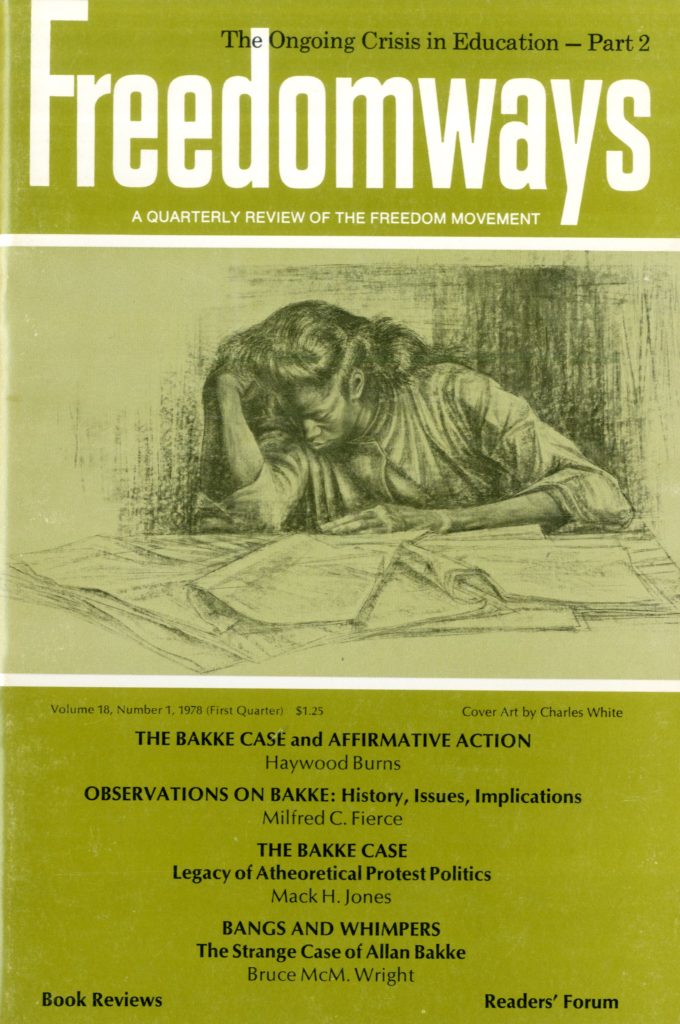
Charles White’s Awaken from the
Unknowing (1961) on the cover of
Freedomways journal, “a quarterly review of the
freedom movement.” Collection of Eddie Chambers.
The first of these folios was issued in 1953 and contained
reproductions of what were already widely regarded as classic works
by White. Remarkably, the folio cost a mere $3, which even in
today’s money is somewhere in the region of just $30. The other
folios, published over the next couple of decades, were similarly
modestly priced. It is, however, White’s prolific work as an
illustrator of record sleeves, book jackets, and so on that is
perhaps the least remembered or appreciated aspect of his work,
even though such reproductions were the means through which many
African Americans came to know and love the artist. Poet Nikki
Giovanni perfectly expressed the affection many people have for
White’s images, in her poem named for the artist: “Charles White
and his art were introduced to me through magazines and
books—that’s why I love them.”
No other artist lent more reproductions of their work to book
jackets, magazine covers, and record sleeves than White. With their
potency, articulation, and awesome visual beauty they are an
absolute pleasure to behold. Given White’s particular appreciation
of black culture in its many forms, including black American music,
his evocative, poetic drawings were perfect for the sleeves of the
jazz records they frequently came to adorn. Make no mistake, these
were beautifully crafted images that not only functioned perfectly
as distinct drawings (at a time when photography and graphic design
were increasingly being deployed in the service of record sleeve
illustration), but also managed to directly dialogue with the music
of the records themselves.
White supplied drawings for a number of Vanguard label records,
for the most part with 10-inch sleeves. Now, in 2019, seeing the
record sleeves of these jazz and blues recordings we can appreciate
just how wonderful a draughtsman White was, and just how committed
he was to bringing his work to wider audiences. Though White’s work
gained widespread appreciation from the 1940s onwards, he took time
during his particularly productive mid-20th century years to
undertake these record sleeve commissions.
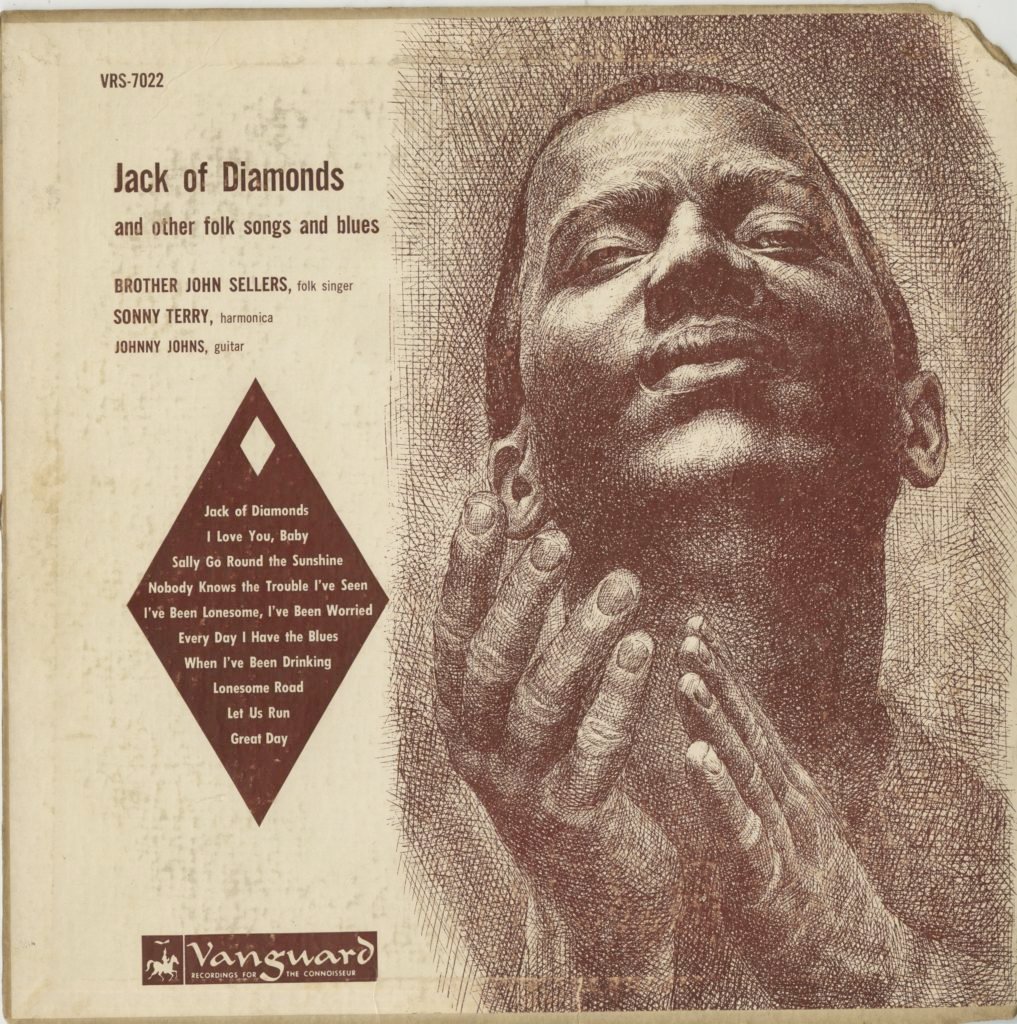
Drawing by Charles White on the cover of
Brother John Sellers, Jack of Diamonds (ca. 1954) record.
Collection of Eddie Chambers.
Not infrequently, his successes as an artist were noted on the
backs of the record sleeves he had illustrated, with words such
as:
“The drawing on the cover is one of a series commissioned by
Vanguard Recording Society, Inc., from the distinguished American
artist, Charles White, for use on its Jazz Showcase and classical
releases. Aside from our belief that it takes a creative artist to
capture the full human feeling of creative music, we hope by this
means to bring to the public a knowledge of contemporary American
art such as this, which has only to be seen to be loved. Charles
White won the Julius Rosenwald Fellowship in 1942, an Academy of
Arts and Letters Award in 1952, and a National Prize of the
Metropolitan Museum of Art in New York. His work is represented in
the Whitney Museum, Library of Congress, and other famous
collections.”
Like White’s art itself, his record sleeve illustrations were
every bit as committed to portraying African Americans as dignified
and resilient, with his images resonating with hope, fortitude,
humanity, and culture. And because what I refer to as White’s 10-
and 12-inch messages came directly into people’s homes, individuals
could appreciate the crosshatching, exquisite draughtsmanship, and
perfect compositions of his drawings, without having to stand
behind a gallery barrier, or be separated from a drawing or print
by glazing. Within the Charles White exhibitions on the University
of Texas at Austin campus, seeing a work such as Awaken from
the Unknowing (a drawing of a young African American woman,
studying, her copious papers spread across the table at which she
reads) and, a short distance away, being able to see the same
drawing, reproduced in miniature, on the cover of
Freedomways journal is indeed a special experience in
which a remarkable dialogue is created between the two images, one
an original, the other a much smaller reproduction.
Would that more artists of the present time had such a singular,
broad-based commitment to sharing their work with multiple
audiences. It is perhaps extraordinary that such a dynamic aspect
of White’s practice has received relatively little scholarship.
Perhaps that will change.
The post A Masterful Charles White Painting Could Smash the
Artist’s Auction Record, But Let’s Not Forget That He Was Devoted
to Making Art for the Masses appeared first on artnet
News.
Read more https://news.artnet.com/opinion/charles-white-mass-production-1692562
Further reading


Leave a comment