
Why the Columbus Monument Should Be Seen as a Monument to the Construction of Whiteness in the United States
Christopher Columbus is coming down across the country. About
time, too.
Protesters are decapitating, toppling, or throwing Columbus
statues into the water across the country this week. In the face of
renewed calls to do
something about Gaetano Russo’s 1892 statue of Columbus in Columbus
Circle, the NYPD is now out guarding it,
and Governor Andrew Cuomo spoke out in its defense on Thursday.
“I understand the feelings about Christopher Columbus and some
of his acts, which nobody would support,” Cuomo said Thursday on a
briefing. “But the statue has come to represent and signify
appreciation for the Italian-American contribution to New
York.”
It’s worth specifying that by “some of his acts,” we are talking
about child sex slavery, systematic torture, and mass murder for
the good of greed and empire. As for Columbus’s value as a larger
cultural icon, his symbolism to Italian-Americans must be weighed
against his symbolism to indigenous peoples. Any honest accounting
of the real historical facts must see the epoch he opened up as one
of genocide and suffering.
But I feel I am being redundant.
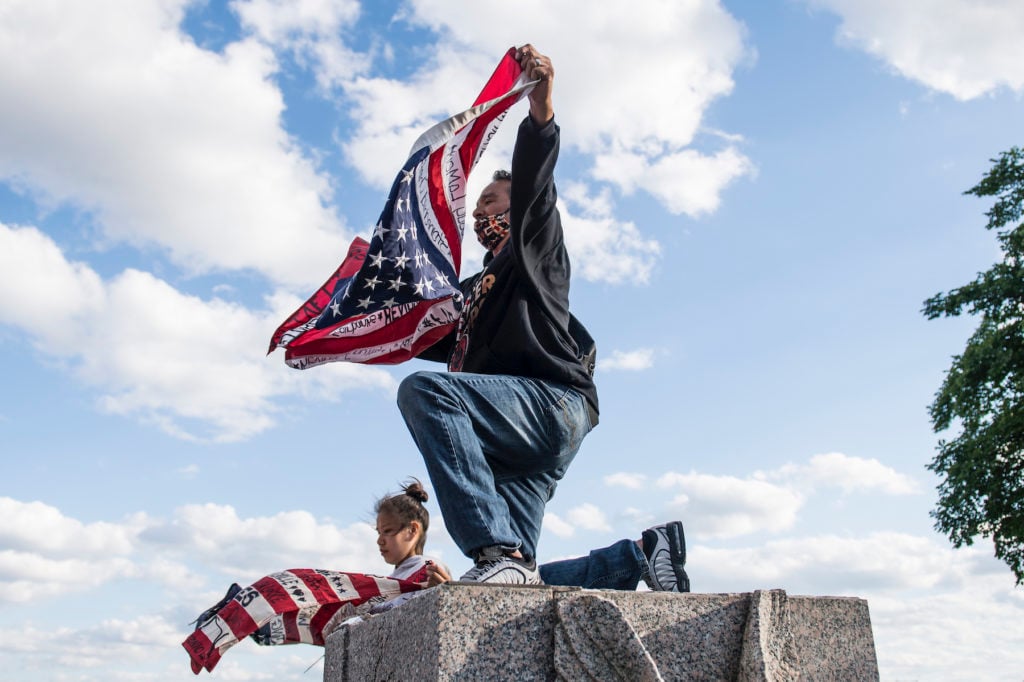
Two people hold up flags, noting the
names of Native American people who have been killed, on the spot
where a statue of Christopher Columbus stood on the grounds of the
State Capitol on June 10, 2020 in St Paul, Minnesota. Photo by
Stephen Maturen/Getty Images.
Certainly, I was taught the cheerful folklore about the voyage
of the Niña, the Pinta, and the Santa Maria as a kid, and when I
first encountered the darker side of Columbus in Howard Zinn’s
People’s History of the
United States, it still felt like samizdat. But there have
been decades of Native-led activism and by now a much broader
public is likely to be aware that the real Columbus was more devil
than saint. Columbus statues only became a target so quickly
because the sense that his myth is past its sell-by date is so
widespread.
In the wake of the Unite the Right rally in Charlottesville in
2017, New York City ordered an audit of its monuments. In the end,
the commission decided to remove only the monument to J. Marion Sims, once
remembered for his contribution to gynecology, now infamous for having
experimented on enslaved Black women. Cuomo then had the
Christopher Columbus statue designated a national
landmark in late 2018 to avoid any further attempts to bring it
down.
Richard Alba, a professor of sociology at the CUNY Graduate
Center who was on the special commission that reviewed
controversial monuments, explained to ABC News why the
Columbus Circle monument wasn’t considered for relocation or
removal: “The history of that statue is different from the
Confederate statues of the South, which were put up to symbolize
the triumph of whites over blacks in the South.”
This is what I want to add here: they are not so
different.
After the Unite the Right rally, as Charlottesville’s infamous
Robert E. Lee statue was under siege, I tried to educate
myself about the history of Confederate monuments. In
fact, these went up not right after the Civil War, but many decades
after, after the radical experiments of Reconstruction had been
betrayed and put down. The mythology of the Old South was, scholars
have emphasized, a later invention: “Only in the 1890s did the
Confederacy become an emotional symbol,” Karen E. Fields and
Barbara J. Fields write in Racecraft.
In the era when the reconsolidation of racist and extremely
unequal post-Reconstruction rule in the South butted up against the
explosive cross-race foment of the Southern Populist movement,
Confederate myth-making enforced white supremacy over the Black
population. But the romantic imagery of the Lost Cause also served
a complementary function in constructing a mythological bond
between poor Southern whites and their bosses: “If the faithful
slave was central to the mythic past that justified the Jim Crow
present, then the faithful Confederate soldier might encourage
obedient behavior among the working classes of the New South,” as
one paper puts it.
The context for the Christopher Columbus memorials like Russo’s
1892 sculpture is, clearly, something else altogether: the floods
of immigration that transformed the surging industrial North,
particularly in the latter part of the 19th century. Italian
immigrants faced terrible discrimination in the United States. Like
the Irish, they were demonized as inherently out of place in
Protestant America, shifty and loyal to Rome because of their
Catholicism. They were poor and crowded into ghettos and blamed for
lowering wages and for crime.
And so a movement among Italian-Americans looked to Columbus as
a legitimating figure to invoke. Who could be more “American”
than the guy said to have discovered America (never mind that
Columbus’s life far predates any consciousness of a modern Italian
nation)? And wasn’t Columbus’s Catholicism, then, just as organic a
part of the American story as the Pilgrims’ Calvinism?
If this myth-making was a fairly grassroots attempt at
assimilation, though, it was quickly instrumentalized by the ruling
political powers. Thus, the precursor of Columbus Day, “Discovery
Day,” was very specifically the gambit of embattled
Democrat incumbent Benjamin Harrison, looking to symbolic theater
to court the immigrant vote in his losing 1892 election showdown
with Grover Cleveland.
Later, Franklin Roosevelt would
proclaim “Columbus Day” a day of observance and national
pride in 1934, with very similar aims. The idea of a national
recognition of Columbus Day was an initiative of the Knights of
Columbus and one Generoso Pope, a Tammany Hall kingmaker and
key to delivering Roosevelt the Italian vote in New York. And so
Roosevelt dutifully passed it.
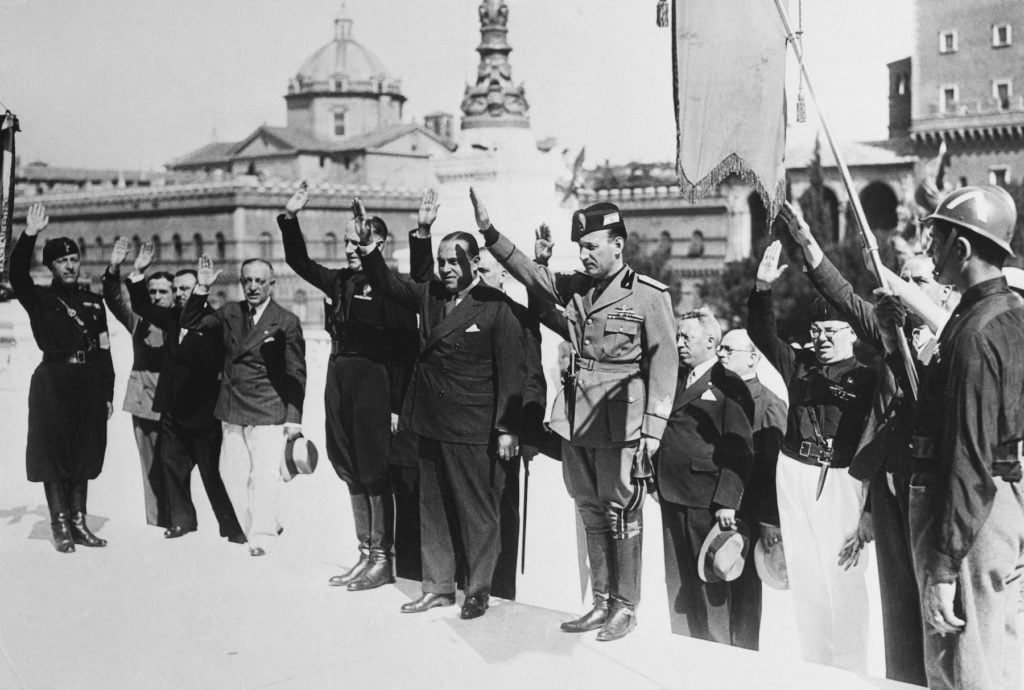
Italian-American newspaper publisher
Generoso Pope, in business suit at center of group, after having
decorated the Tomb of the Unknown Soldier in Rome, Italy. Image
courtesy Getty Images.
As it happens, Pope’s Italian nationalism also led him to be
an ardent supporter of
Mussolini, which then complicated Roosevelt’s
turn against the Axis in WWII. Pope helped bankroll Mussolini’s
invasion of Ethiopia and used his power to lobby
Roosevelt to remain neutral on the matter. Pro-fascist Italians in
the US hailed Mussolini as a
“modern Columbus,” even as street demonstrations of Italian
jingoism inflamed racial tensions, with Black communities rightly
viewing the invasion as fresh evidence of Europe’s history of
domination of African peoples. Columbus Day in New York through the
’30s was very much a pro-Mussolini
event.
In 1940, with Italian-American sentiment taking extreme umbrage
at Roosevelt’s anti-fascist overtures, the administration looked to
his Columbus Day speech to lure them back: “Would it not be helpful
if an indirect reference was made to the fact that Columbus was an
Italian?” Roosevelt’s administrative assistant wrote him. “Reports are
that some of the Italian groups in New York are still shakey
[sic].”
Columbus Day as an actual federal holiday on the second Monday
of October is quite young—it only dates to 1972. And
there, too, you have to see its consolidation in terms of political
fortunes: Richard Nixon’s attempt to construct a new constituency
for the Republican party. With the Jewish and Black votes firmly in
the Democratic camp, his advisers told him that working class
“white ethnics” could be won.
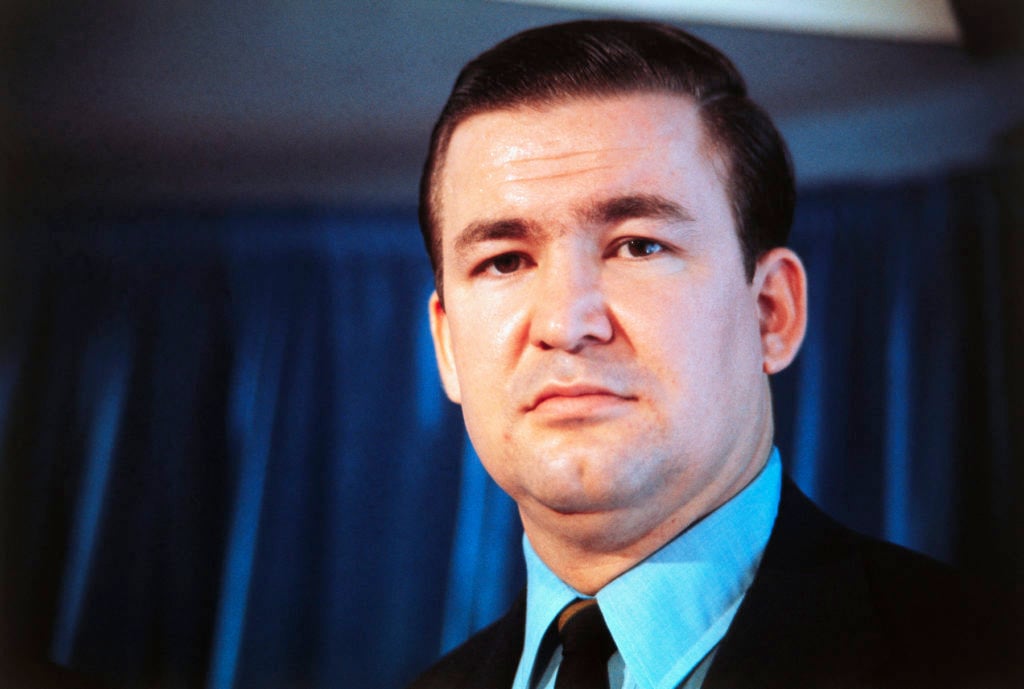
Patrick J. Buchanan, when he was
executive assistant to President-elect Nixon. Image courtesy Getty
Images.
Specifically, Pat Buchanan, the proto-Trump who would coin the
“culture wars” paradigm in the ’90s, had advised that Nixon
specifically
target “union halls, Columbus Day activities, Knights of
Columbus meetings, etc.” Already in a 1969 proclamation, Nixon had
taken it upon himself to affirm
gallantly, “We remember also that Columbus was a man of Italy,
a noble example for the many other men of Italy who have come to
our country and to so many other lands of the new world.”
As Buchanan recalled fondly later,
“Nixon often would talk about how the Italian-American vote was
beginning to move. We had wanted to appoint an Italian-American and
a Southerner to the U.S. Supreme Court, partly with the idea of
recognizing these folks and saying ‘you’re not outside the country
club of America as far as we’re concerned.’”
When people talk, today, about the construction of whiteness,
this is what they are talking about: this idea of gaining entry to
the imaginary “country club of America.” Appealing to the
whitewashed Columbus myth has been precisely a tool of this
operation, yoking together Italian pride and an identification with
defending the innocence of the American project—and that really is
very similar to how the ennobled image of the Confederacy works,
claiming to be just about “heritage” or “Southern pride” while
skating over the actual racist histories its symbols contain.
Cuomo tells us we should turn our eyes from the actual,
historical figures being memorialized to what the heroic
image has meant to people. In this he
unintentionally lays out exactly how whiteness works as an active
ideology: a sense of cultural identity constructed at the price of
willful blindness to the reality of others’ oppression.
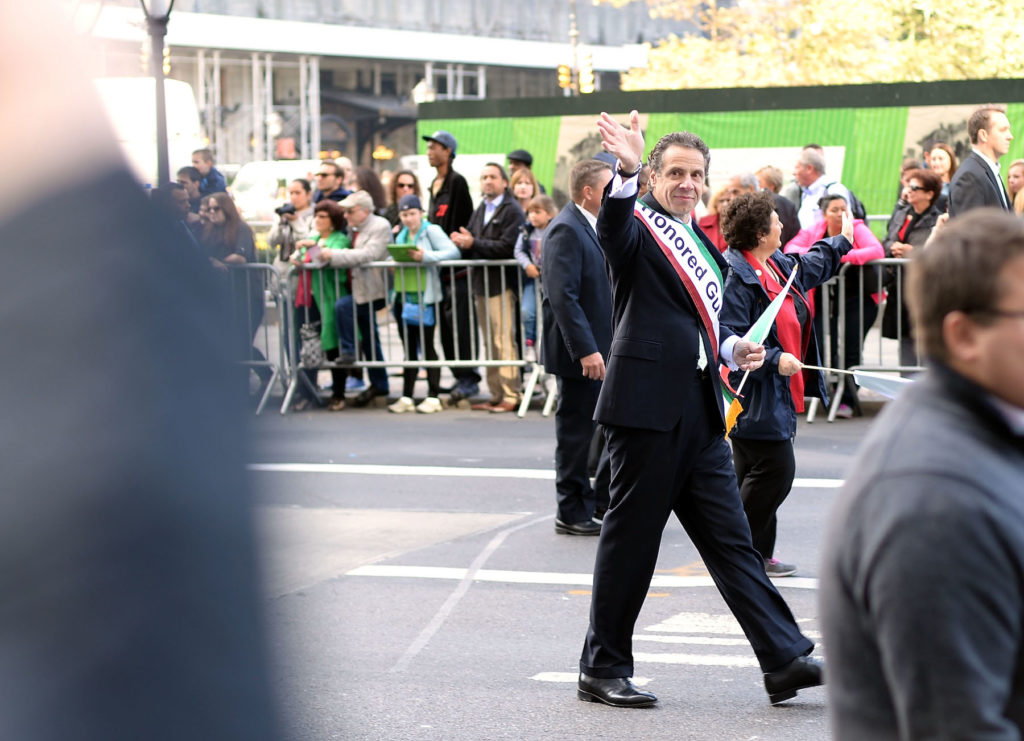
New York State Governor Andrew Cuomo
marches in the annual Columbus Day Parade on New York City’s Fifth
Avenue on October 14, 2013 in New York City. Photo by Andrew H.
Walker/Getty Images.
There are plenty of actually very great Italian-Americans to
celebrate, and people absolutely ought to have dignified depictions
of their heritage and history. If he had spine, Cuomo, as the
country’s most prominent Italian-American politician, could play a
constructive role here in pointing towards new icons in this
pivotal time of reckoning, instead of standing by a homicidal
Genoese adventurer as the indispensable symbol of pride.
And meanwhile, here’s something else that cannot be stressed
enough: as Christopher Columbus towers over Central Park, the
Lenape people who were here before European settlement have only
scant representation in the city.
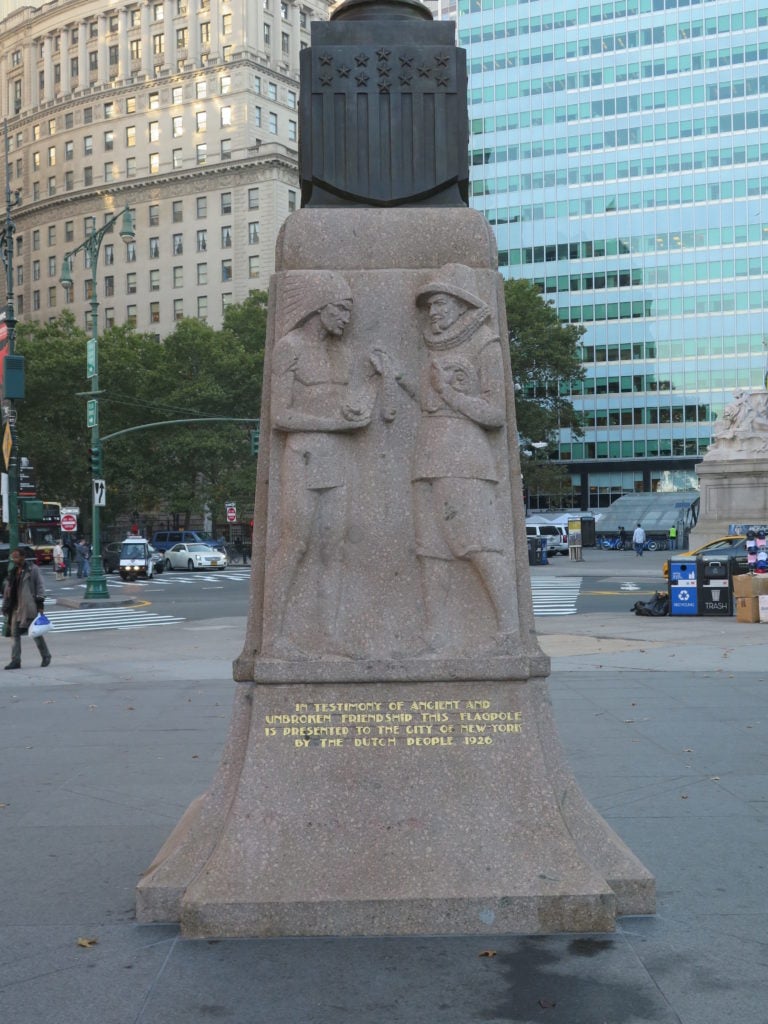
The Netherland Monument in Battery Park.
Image courtesy New York Park Service.
In fact, to my knowledge, there are just two memorials that
feature the Lenape, and both contain historical inaccuracies. Both
speak of the “sale of Manahatta,” which Native activists call a
myth. As David Penney, one of the curators of “Native New
York,” told Smithsonian
magazine, the monument in Battery Park also depicts the
Lenape figure in the dress that is actually associated with Plains
Indians.
That combination of absence and ignorance is the flip side of
the bombast and feigned innocence of the Columbus myth. One way or
another, the latter has to be taken off its pedestal so that the
real history can be given its full dignity—which is, clearly, only
the very beginning of justice anyway.
The post Why the Columbus Monument Should Be Seen as a
Monument to the Construction of Whiteness in the United States
appeared first on artnet News.
Read more https://news.artnet.com/opinion/columbus-monument-whiteness-1886424
Further reading


Leave a comment