
See 8 Intriguing Finds at This Year’s TEFAF New York, From a Greek Suit of Armor to an Ancient Bust Once Owned by Warhol
The fall edition of the
three-year old TEFAF New York fair, which is heavily focused on Old
Masters and other historical works, opened its doors to VIPs at the
Park Avenue Armory on New York’s Upper East Side yesterday. Perhaps
owing to the fact that the preview coincided with Halloween, or
that murmurs of a possible economic recession have been echoing
through the art market of late, the opening night crowd seemed
thinner and a bit more subdued than in years past.
However, the art and objects on
view—ranging from antiquities to Old Masters, rare jewels, and
modern art—were as high-caliber as ever. Another notable element
new to this year’s fair was seven booth-share collaborations on the
second floor, where antiquities dealers blended their wares with
modern and contemporary art. These included London’s Charles Ede,
whose ancient busts sat alongside contemporary offerings from Sean
Kelly Gallery, such as a photograph of Marina Abramovic’s face
plastered with gold.
Artnet News scoured the
multitude of offerings to pluck out some of the rarest and most
intriguing objects at this year’s fair. Here are our top
picks.
Camillo Verno, Death and the Maiden (ca.
1900)
Jack Kilgore (New York)
Price: $62,000
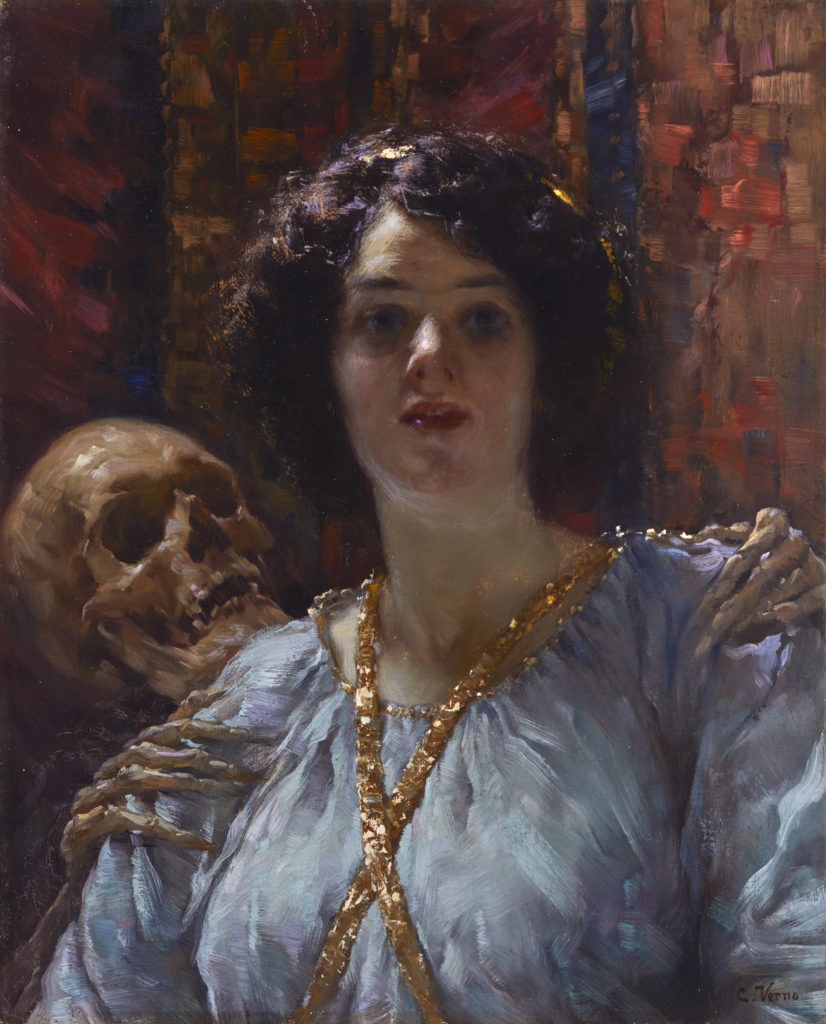
Camillo Verno, Death and the
Maiden (circa 1900). Courtesy of Jack Kilgore.
“Did you see this one, my
Halloween picture?” Jack Kilgore asked a visitor to his booth,
referring to a foreboding canvas of a skeleton leering behind a
beautiful young woman, serving as an eerie reminder of mankind’s
mortality. “I used to deal in Dutch and Flemish 16th and 17th
century paintings, and this motif, death and the maiden, goes back
to antiquity.” The work of northern Italian artist Camillo Verno,
the oil painting likely depicts the artist’s wife.
—Sarah Cascone
Marie Guillelmine La Ville Le
Roulx, Self Portrait (1786)
Wildenstein & Co. Inc. (New
York)
Price:
$750,000
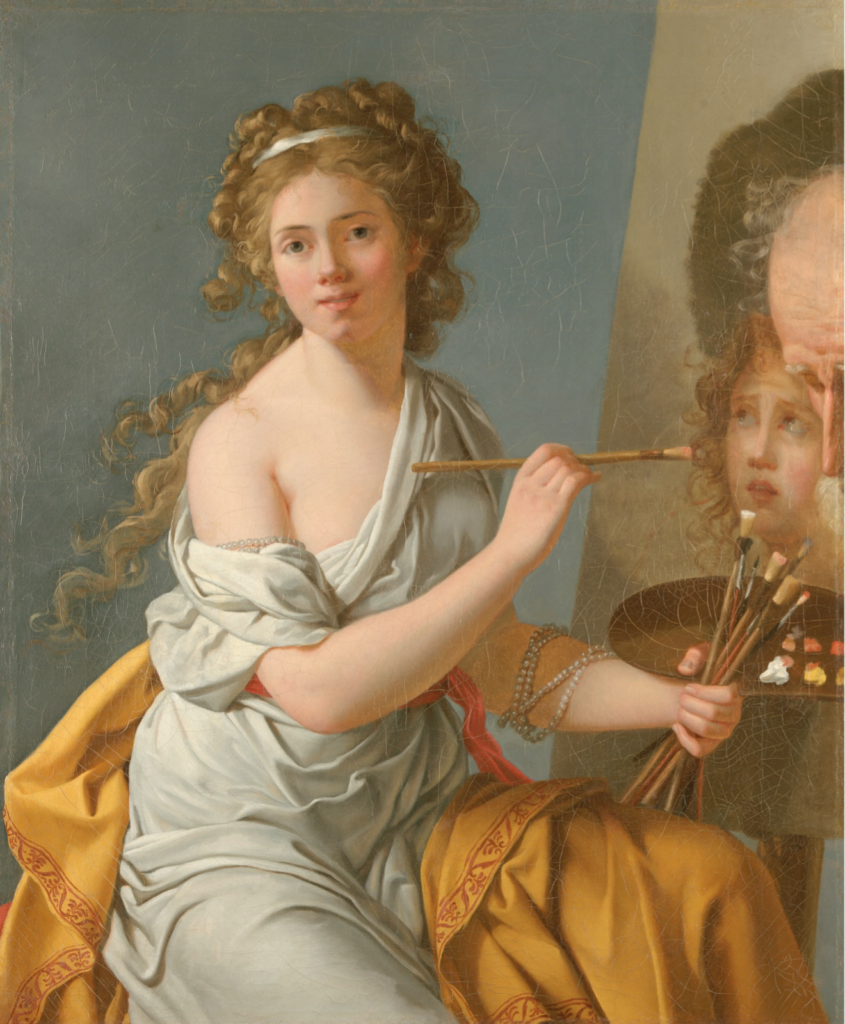
Marie Guillelmine La Ville Le
Roulx, Self Portrait (1786). Courtesy of
Wildenstein & Co. Inc., New York.
The daughter of a French civil
servant, Marie Guillelmine La Ville Le Roulx trained first under
Élisabeth Vigée Le Brun and then Jacques-Louis David, and is
depicted here as a girl of just 18, copying one of David’s
unfinished paintings. Her best-known work, Portrait d’une négresse
(Portrait of Madeleine), is in the collection of the Louvre, where
it was misattributed to David for many years. “It’s the most
beautiful portrait of a black woman in the world,” said Joseph
Baillot, the galley’s senior vice president. “We sold it as a
David, but it was never by David—it was always by her.” This
self-portrait, a rare example of her work, has stayed in her family
for generations. “We’ve had a lot of institutional interest on it,”
added Vanessa Wildenstein, a fifth-generation staffer of the
family-run gallery.”
—Sarah Cascone
Louis Comfort Tiffany, Fireplace
Hood (ca. 1882–85)
Lillian
Nassau (New York)
Price:
$475,000
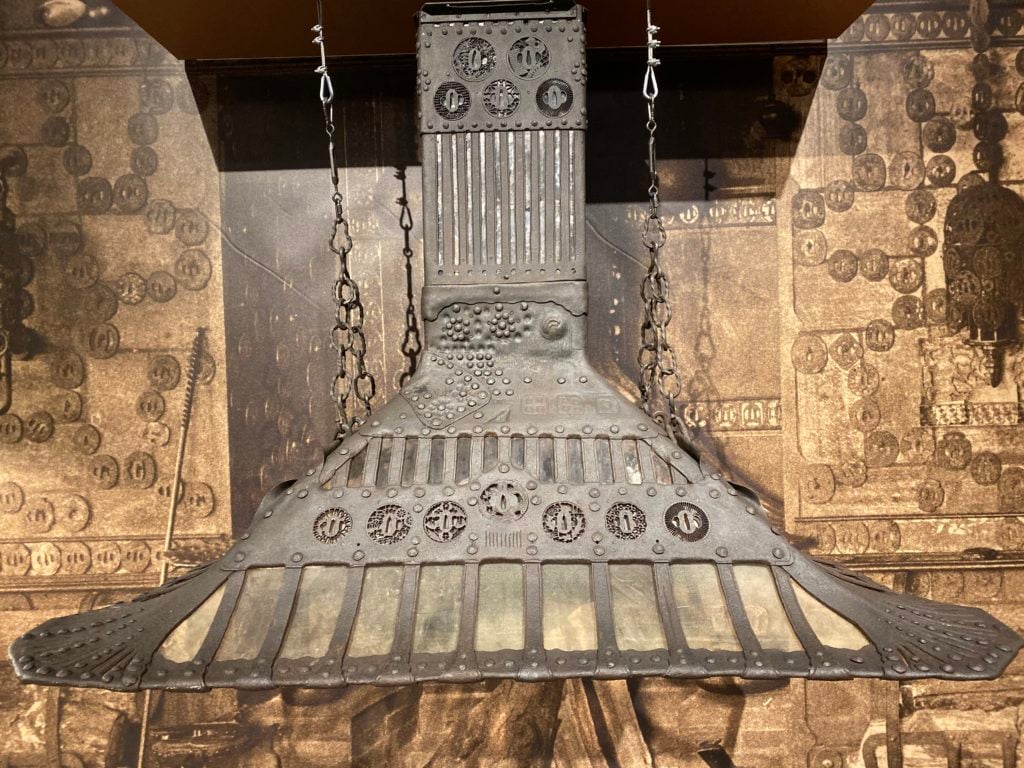
Louis Comfort Tiffany, Fireplace Hood
(circa 1882–85) Photo by Sarah Cascone.
Louis Comfort Tiffany designed
this one-of-a-kind wrought iron fireplace hood for his Stanford
White-designed mansion on East 72nd Street, just a stone’s throw
from TEFAF’s Park Avenue Armory home. Later, he brought the hood to
Laurelton Hall, his Long Island estate, which burned to the ground
in 1957. The fireplace hood was among the artifacts salvaged from
the ashes. The great designer inlaid the metal with antique
Japanese tsube, which were used by the Samurai as sword guards. “In
1878, the samurai had to turn in their swords and their shields and
their armor and tsube came on the market in the United States,”
said gallery owner Arlie Sulka. “Louis Comfort Tiffany had a very
large tsube collection. According to one of the women who worked in
the enameling department, he would carry one of them in his breast
pocket to show his artisans what kind of patina he wanted on his
metalwork.”
—Sarah Cascone
A Greek Bronze Panoply of a
Cavalryman, (ca. 4th century BC)
Kallos Gallery (London)
Price: $775,000
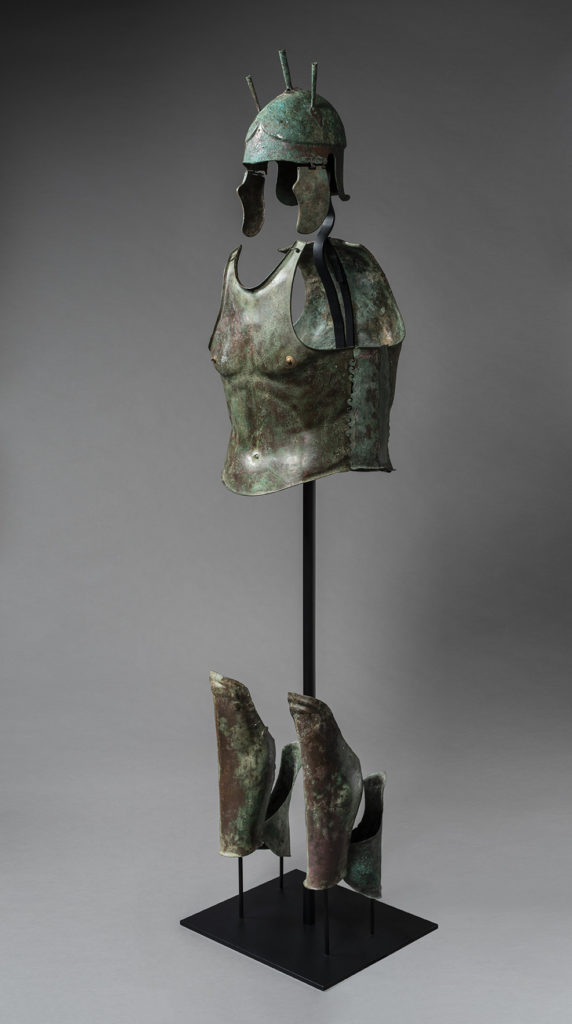
Greek bronze panolply of a cavalryman
(Circa 4th Century BC). Image courtesy of Kallos Gallery,
London.
This rare panoply of a warrior
of the Classical period is one of the most complete to appear on
the market in several decades. Similar examples are already housed
in permanent museum collections. Gallery director Madeleine
Perridge told Artnet News that while it’s not unusual to see
detailed depictions of these warriors on classical Greek vases, it
is far rarer to see actual complete displays of armor together as
in this display.
—Eileen
Kinsella
Archaistic Hermes
Head (Hellenistic 1st
century BC—1st century AD)
Galerie Chanel (Paris)
Price: $95,000
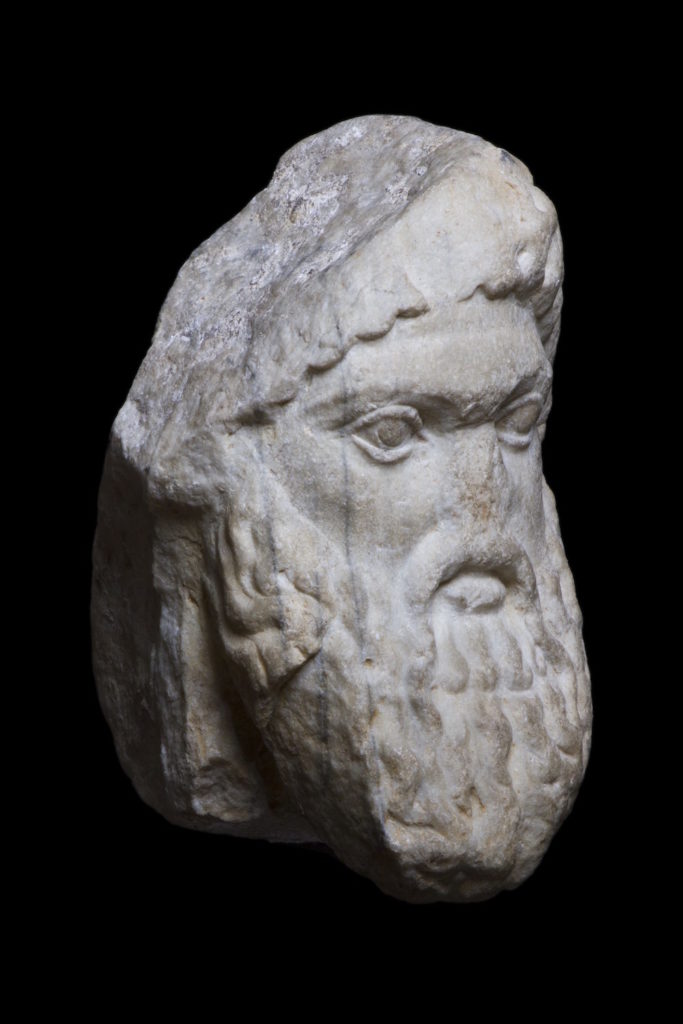
Archaistic Hermes Head (Hellenistic 1st
century BC—1st century AD). Image courtesy of Galerie Chanel,
Paris
As if you needed any more
evidence that today’s savviest collectors are mashing up the old
with the new, this ancient bust of Hermes was formerly owned by Pop
art icon Andy Warhol. Following the artist’s sudden death in 1987
after gall bladder surgery, the bust was sold at Sotheby’s New York
to a Palm Beach collector. Now it can be yours for
$95,000.
—Eileen
Kinsella
Medardo Rosso,
Bookmaker (cast
ca. 1929–1959)
Bottegantica (Milan)
Price: $250,000
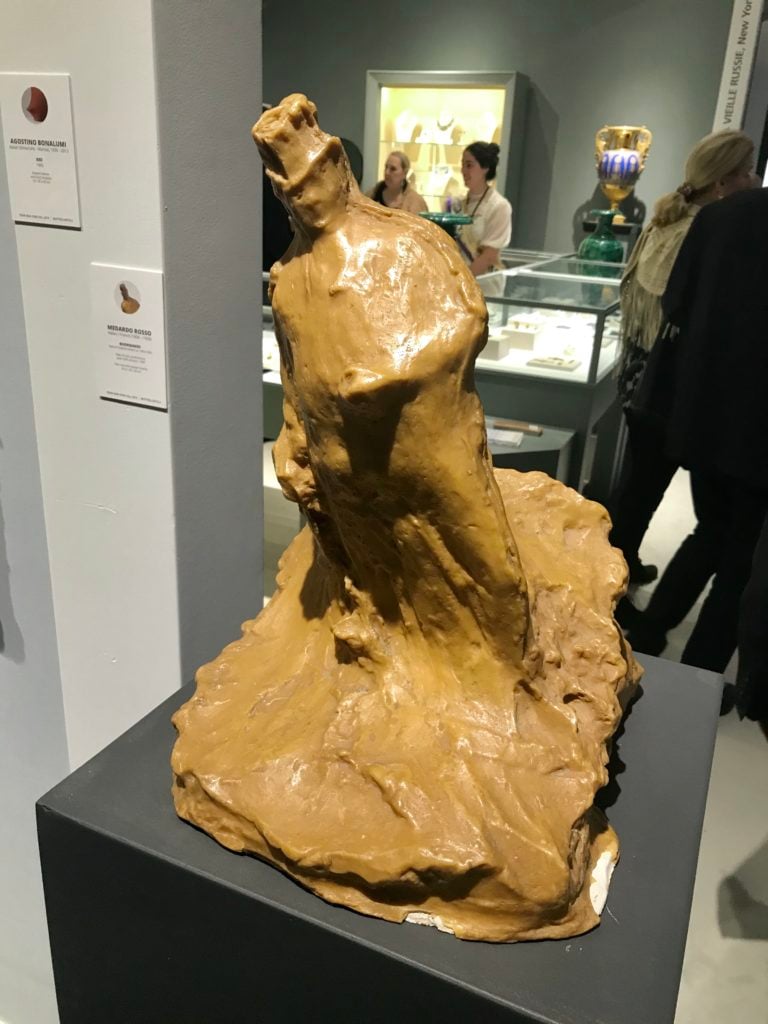
Medardo Rosso, Bookmaker (cast
circa. 1929–1959). Photo by TIm Schneider
This posthumous wax-over-plaster
cast, made decades after Italian sculptor Medardo Rosso forged the
bronze original between 1893 and 1895, still shows why
Bookmaker
is one of the artist’s most famous
works. Roughly modeled as if it were “meant to be melting into
[the] space” around it, according to Tommaso Carletti of
Bottegantica, the cast hits like a rubber mallet amid the
meticulous craftsmanship and ostentatious beauty of so many other
offerings at TEFAF. Rosso’s slanted, drunken bookie didn’t just
capture the volatility of turn-of-the-century Parisian street
culture, either; some critics have also alleged it became the
uncredited inspiration for his contemporary Auguste Rodin’s
Monument to Balzac
(1898), sometimes defined as the
first modernist sculpture––and believed to be the end of Rosso and
Rodin’s friendship.
—Tim Schneider
Willem Kalf, Still
Life With a Chafing Dish and Pilgrims Canteens
(1644)
French & Company,
New York
Price: $6 million
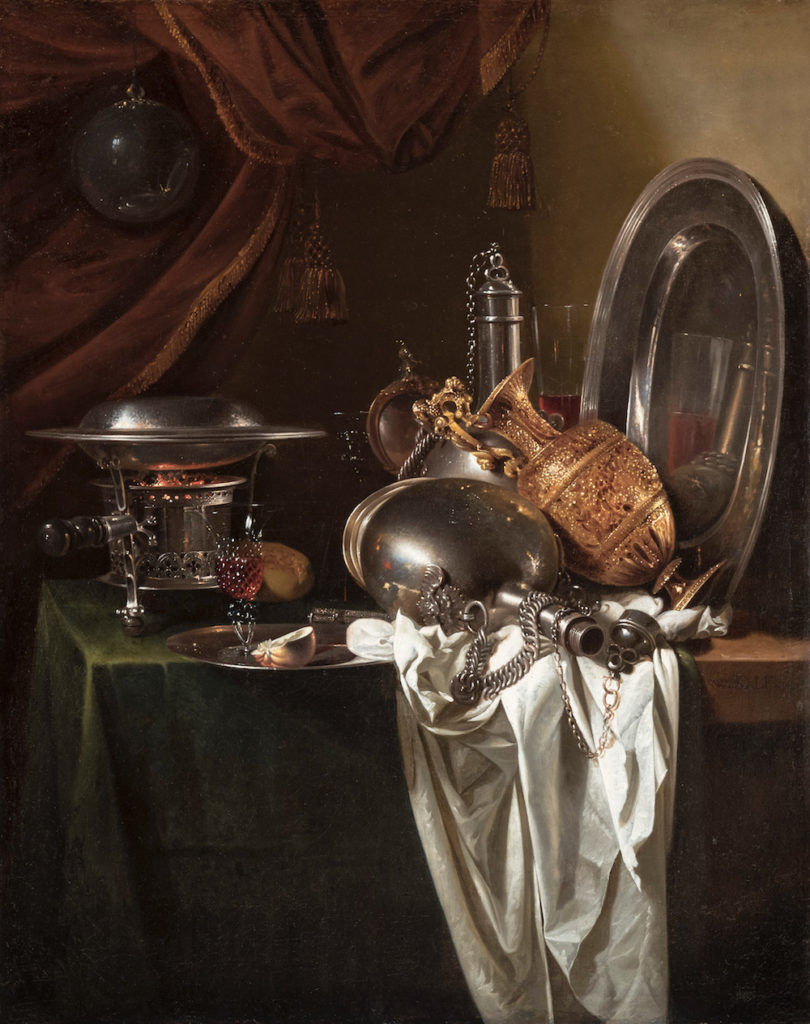
Willem Kalf Still Life With a Chafing
Dish and Pilgrims Canteens (1644). Image courtesy of French &
Company, New York
Although Willem Kalf is hardly a
household name, scholars versed in the Dutch Golden Age have been
known to call him “the Rembrandt of still lifes,” according to
French & Company president Henry Zimet. This virtuosic, almost
Photorealist canvas captures why––and carries the added benefit of
having been held in the same private collection for over half a
century. A mesmerizing combination of glimmering light and
reflections dance across the assorted treasures scattered over the
table, from a UFO-like chafing dish illuminated by flames to an
astonishingly detailed silver-gilt ewer. No wonder, then, that
after viewing a similar still life of Kalf’s in 1797, Johann von
Goethe wrote, “For me, at least, there is no question but that,
should I have the choice of the golden vessels or the picture, I
would choose the picture.”
—Tim Schneider
Gustave Courbet
Jeune Fille Dormant (Young Girl Sleeping)
(1847)
Gallery 19C, Beverly Hills
Price: $525,000
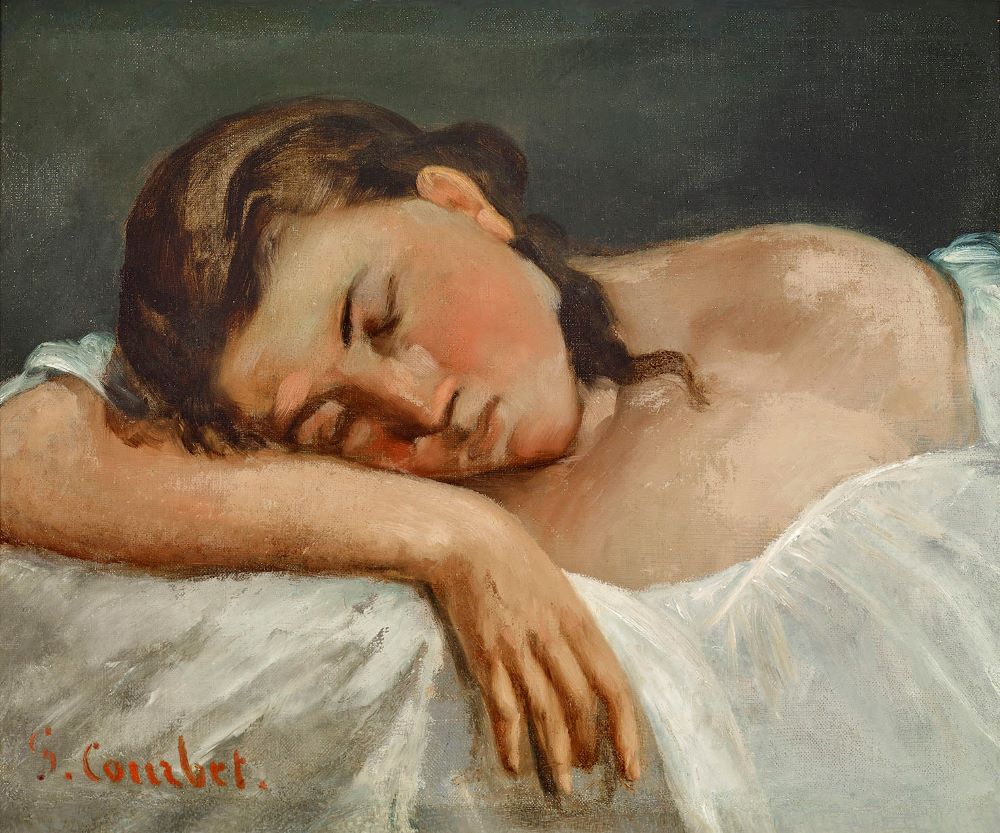 Gustave Courbet, Jeune Fille
Dormant (1847). Image courtesy of 19C Gallery, Beverly
Hills
Gustave Courbet, Jeune Fille Dormant (1847). Image
courtesy of 19C Gallery, Beverly Hills
This is one of Courbet’s
earliest depictions of the theme of a woman asleep (which would
culminate later in his career in his erotic and sensual
painting, The
Sleepers). Courbet
painted this picture when he was just 28 years old and it was
exhibited at the Salon of 1848. The young model appears in a
dream-like state, her head gently resting on her arm. Her
innocence is only matched by her ethereal beauty, yet Courbet has
still managed to capture her nascent sensuality, the folds of the
white drapery concealing, yet subtly emphasizing, the curves of her
body.
—Eileen Kinsella
The post See 8 Intriguing Finds at This Year’s TEFAF New
York, From a Greek Suit of Armor to an Ancient Bust Once Owned by
Warhol appeared first on artnet News.
Read more https://news.artnet.com/art-world/tefaf-new-york-2019-1694988
Further reading


Leave a comment