
Museum Unions Aren’t Just Demanding Higher Pay. They’re Also Fundamentally Questioning the Way Their Institutions Work
As a wave of unionization
efforts has swept across the museum world, employees have faced
plenty of pushback—one case in point being the New Museum’s
hiring of a
union-busting law firm during a recent
labor struggle.
But no institution has responded
with as much drama and chaos as the Marciano Art Foundation (MAF)
in Los Angeles.
The MAF laid off all of its
visitor-service associates in November, days after those employees
announced their intention to unionize. Soon after, the entire
foundation was shuttered for good. The protests, lawsuit, and press that
followed have kept the MAF in an unflattering
limelight.
In a lengthy
Los Angeles Times
report published in mid-February,
Paul and Maurice Marciano, the brothers who started the denim brand
Guess and then later founded MAF to showcase their art collection,
came under scrutiny for, among other things, alleged labor law
violations at Guess (paying under minimum wage or offering no
overtime) and for making Maurice Marciano’s under-experienced
daughter, Olivia, the artistic director of their
foundation.
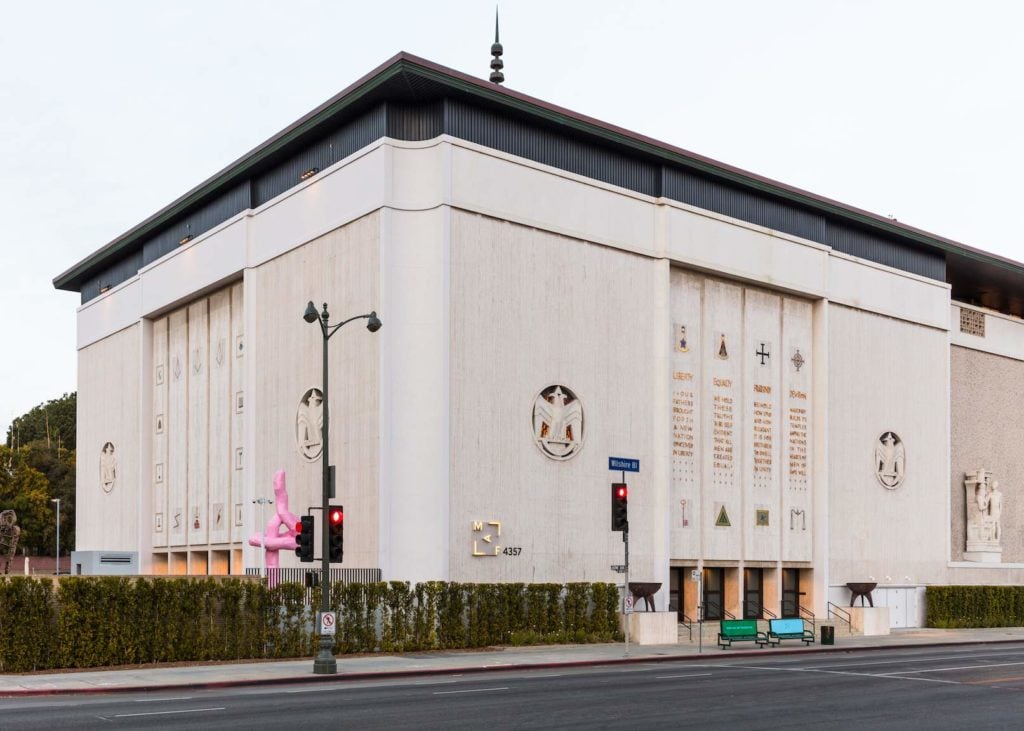
Exterior of the Marciano Art Foundation.
Photo by Julian Calero.
The Marciano debacle was still
fresh and unfolding when workers at MOCA Los Angeles and the Shed
in New York moved to unionize. Both museums chose to voluntarily
recognize their unions, rather than to campaign against them, a
move that set them apart from other art institutions
nationwide.
That decision surprised Maida
Rosenstein, president of UAW Local 2110, the union that represents
workers at the Shed as well as at MoMA, the Bronx Museum, the
Tenement Museum, and the New Museum. “The more standard thing
is for employers to fight unions, conduct anti-union campaign,” she
said. “[They] try to use all the mechanisms to delay
elections.”
An institution that voluntarily
recognizes a union waives its right to insist upon an election, and
to campaign against the union. Instead, an independent third party
verifies that a majority of employees want to
unionize.
Yet even when museums accept
unionization efforts, negotiations don’t always proceed
smoothly.
“Voluntary recognition, it’s a
misnomer in a way,” explained Rosenstein.
“It’s rarely because they’re
embracing a union,” she said. “You would hope… they would also be
amicable at the bargaining table, but I don’t think that’s a
given.”
She cited the neutrality
agreement reached by the Tenement Museum and its union, which kept
the museum from staging an anti-union campaign but did not keep it
from taking hard positions in contract negotiations.
“I don’t think there’s been a
significant change yet at this point,” she added.
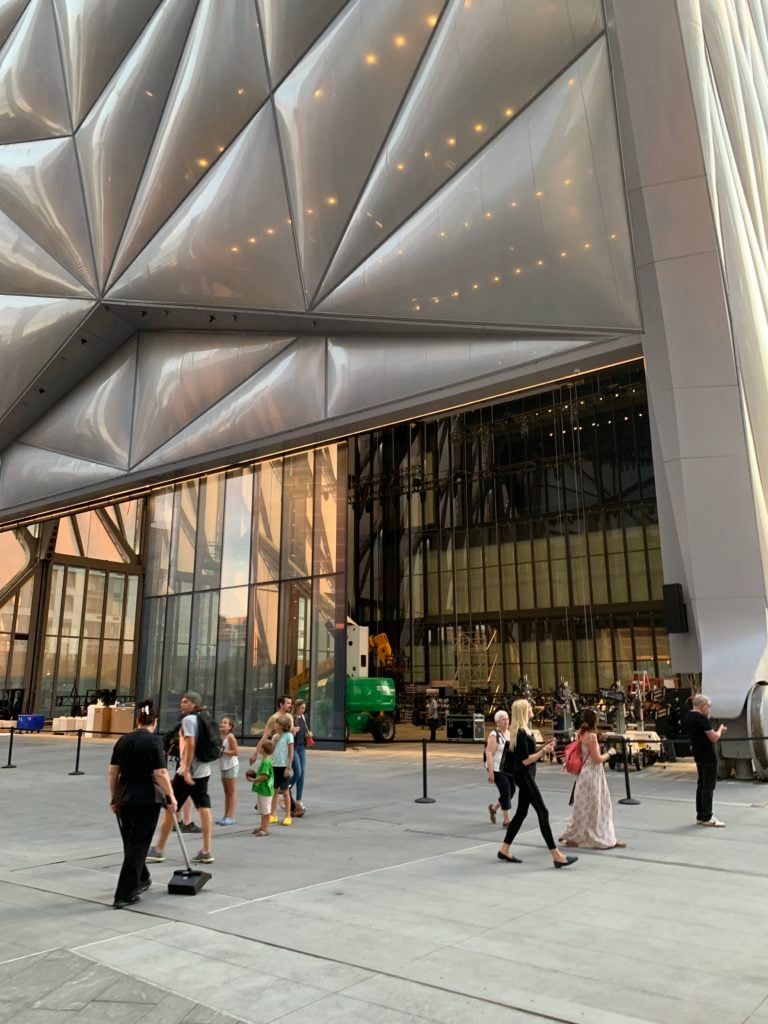
The Shed preparing for open air
performances. Photo by Sarah Cascone.
The Shed, a year-old,
extravagantly designed art space in Hudson Yards, declined to
comment for this story but issued a statement from COO Maryann
Jordan in late January, saying, “We welcome UAW Local 2110 and anticipate
forging a constructive relationship with their
representatives.”
Senior organizer Carlos
Vellanoweth, of AFSCME District Council 36 in Los Angeles, put it
bluntly: “Employers recognize the union when they get their back
against the wall.” AFSCME, which represents 16 museums
nationwide, worked with employees at MAF and is now coordinating
with those at MOCA Los Angeles.
Vellanoweth, who helped MOCA’s
union through the initial stages of the organizing process,
suspects that the protests at MAF contributed to MOCA’s
administration taking a different tack. “I think that they
have a lot more to lose than a private museum that is run by two
gentlemen,” he observed, referring to the Marciano
brothers.
Indeed, MOCA agreed to enter
contract negotiations right away. But when employees first announced their
unionization effort, MOCA released a statement to the
Los Angeles
Times, saying, “we do
not believe that this union is in the best interest of our
employees or the museum.” After more careful consideration, the
museum walked back that statement.
“We are, of course, aware of what is happening
in the field and the world more broadly,” a MOCA spokesperson told
Artnet News. “That said, MOCA’s decision to voluntarily recognize
the union was driven by the belief that it was the right thing to
do for our employees and is in alignment with our mission as a
civically minded institution.”
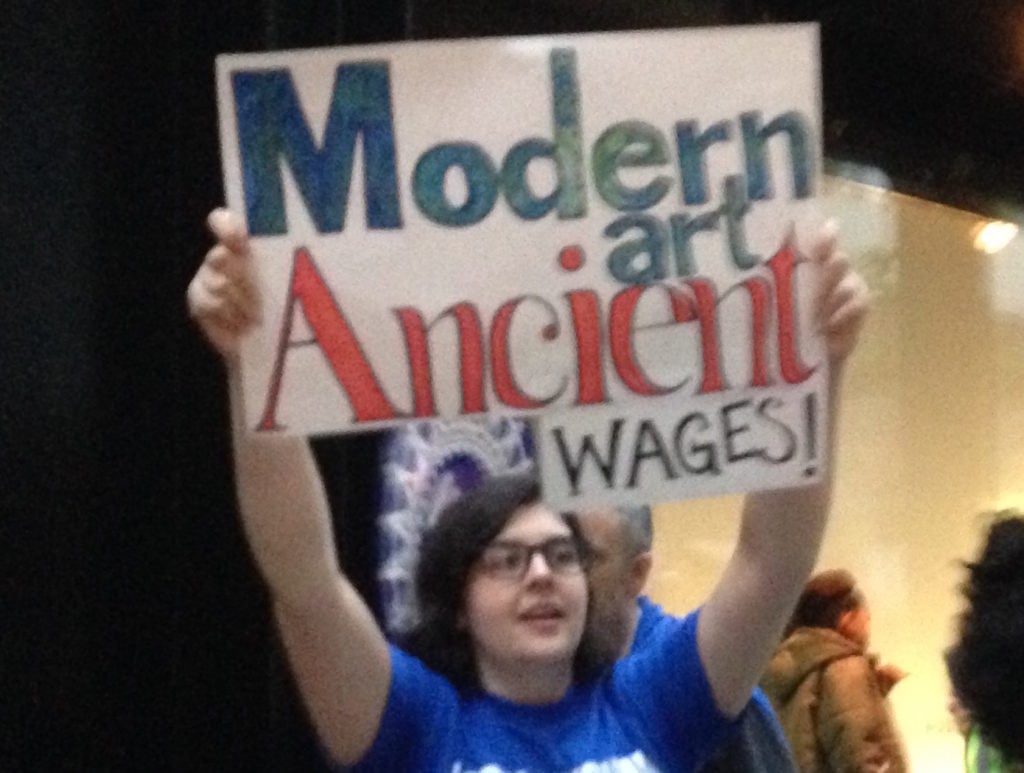
A union member protests outside MoMA’s
Party in the Garden on May 31, 2018. Photo by Sarah Cascone.
The spokesperson also pointed
out that MOCA began “the process of evaluating and improving issues
of Diversity, Equity, Accessibility and Inclusion (DEAI)” over
eight months ago, an effort helmed by Mia Locks, the newly
appointed Senior Curator and Head of New Initiatives.
The museum also brought in an
outside consultant to identify improvements to workplace structure
and culture.
“MOCA had met requests from our
frontline staff for internal negotiations this fall,” MOCA’s
spokesperson explained. “Following these discussions, wages were
increased prior to receiving any notice from the
union.”
Organizing committee member
Lauren Kelly acknowledged that, while some internal changes had
been made in response to employee concerns, “we were meeting with AFSCME before this.” She
explained that the unionizing effort at MOCA was, from the start,
about both pragmatic changes and ideals that went beyond the
museum’s walls.
“The issues we’ve encountered
ripple across many of these institutions, and we are asking for a
change on all fronts.”
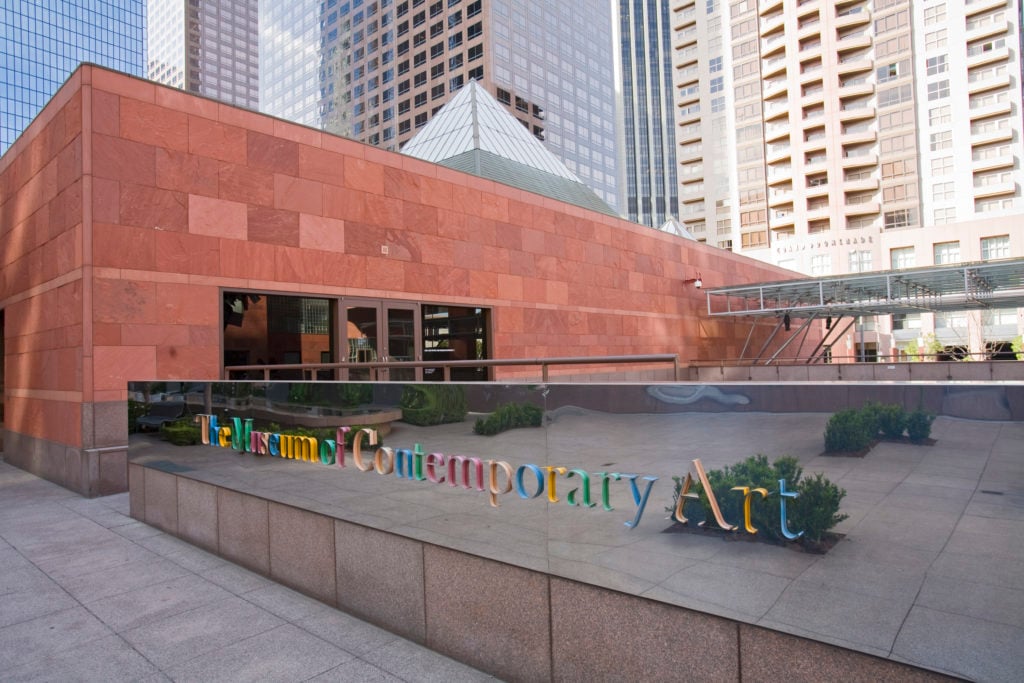
The Museum of Contemporary Art, Los
Angeles. Photo: Education Images/Citizens of the Planet/UIG via
Getty Images.
Committee member Junghun Lee
concurred. “We welcome the administration’s effort to make the
museum a better workplace, but we ultimately see our role within
the effort [as] more involved and direct,” he said.
Organizers pointed out that not
all employees have received wage increases, and that they are
interested in improving conditions for part-time museum workers at
MOCA too, as well as establishing clearer paths for workers to
reach full-time status and receive benefits.
They hope these changes can
ripple out across the wider industry. Certain part-time MOCA
employees work for more than one local museum, and some were among
those laid off from MAF.
Another MOCA organizer who
wished to remain anonymous further contextualized their
efforts.
“We felt that real change would
only come when the balance of power shifted towards those who see
the labor issues at the museum first-hand,” the person said,
explaining that the museum has a history of “reneging on promises
or moving at a glacial pace when it came to structural
changes.”
Unionizing is a way to ensure
that promises are kept, the person said.
“Ultimately, though, we are
combating the museum model. In the weird public/private hybrid
model of the museum, there is seemingly unlimited money made in
donations for the building and for artwork, but a millionaire or
billionaire is never going to swoop in to provide changes to wage
structure or employee safety.”
The post Museum Unions Aren’t Just Demanding Higher Pay.
They’re Also Fundamentally Questioning the Way Their Institutions
Work appeared first on artnet News.
Read more https://news.artnet.com/art-world/museum-unions-voluntary-recognition-1790097
Further reading


Leave a comment