
‘It’s Just About Being Obsessed’: How Fashion Designer Jonathan Anderson Finds Inspiration in Unexpected Artists
Jonathan Anderson is the art enthusiast’s fashion designer.
At the center of his already impressive career (at 34 years old,
Anderson helms not only his eponymous label, but the LVMH-owned
Spanish brand Loewe, making him the luxury giant’s youngest
creative director to date) is a lifelong passion for visual art,
which inspires so much of his work.
While other designers of the moment are now beginning to gain
real recognition for working in the liminal space between art and
design, Anderson has long vacillated between the two spheres,
showing collections of avant-garde clothes that nod to art while
also curating private exhibitions of photography, sculpture, and
painting in his spare time.
Yet unlike many designers, Anderson’s interest in art goes
beyond one-off projects meant to drum up excitement on social
media. Not only is Anderson a newly appointed trustee of the
Victoria & Albert Museum, he also has a private collection of more
than 300 works. On top of that, he’s made a real effort to
spotlight art in JW Anderson and Loewe shops, and, in 2016, he even
conceived the Loewe Craft Prize, an annual competition that awards
€50,000 to an emerging artist or artisan.
“I think we are living in a period when art and fashion are
informing each other,” Anderson tells Artnet News. “It’s a very
different time than we’ve experienced in the past. Creativity today
is defined by a lot of crossover, and I think it’s less elitist
when you don’t have segregation in creativity. For me, it’s all one
big message. It’s just about being obsessed.”
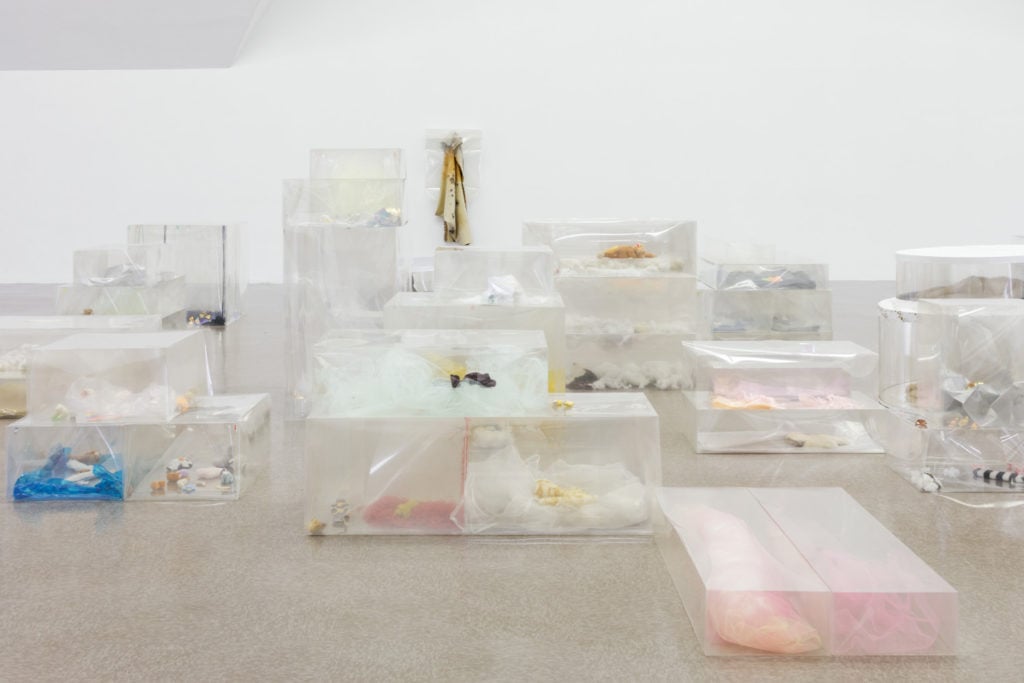
A view of Liz Magor’s exhibition
“Blowout” at the Renaissance Society in 2019. Photo courtesy of the
Renaissance Society.
Anderson grew up during the Troubles in Northern Ireland in the
1980s and spent his childhood rifling through stalls at flea
markets with his grandfather, hunting around for Georgian glass,
Delft pottery, and other ceramics. Those early experiences sparked
his collecting habit and his interest in visual art.
This fall, after seeing an exhibition titled “Blowout” by the
Canadian sculptor Liz Magor at the Carpenter Center for Visual
Arts at Harvard University, Anderson reached out to the artist to
suggest a collaboration for his spring 2020 collection for J.W.
Anderson.
“I was mesmerized by these cubes,” Anderson says of Magor’s
assemblages, which resemble plastic storage units used to stow away
off-season clothes. “I really liked what she was trying to say.
She’s talking about putting all your belongings on the street, and
blowing it all out. And I think in doing that, she takes things
that are no longer wanted and brings them into question, which I
think is incredibly important.”
Although Anderson’s collection was already completed by the time
he sought to include Magor, his clothes and her sculptures explore
similar themes. Alongside her enormous plastic boxes—many of which
preserve small, banal items such as stuffed animals and used
sweaters—Anderson showed canvas dresses with gaping holes outlined
in crystal embroidery, and drapey, hippie-ish layered garments,
some splotched with patterns resembling ink stains.
“I think there is something incredibly important about finding
new ways of looking at things, of reframing objects and fashion,”
he says.
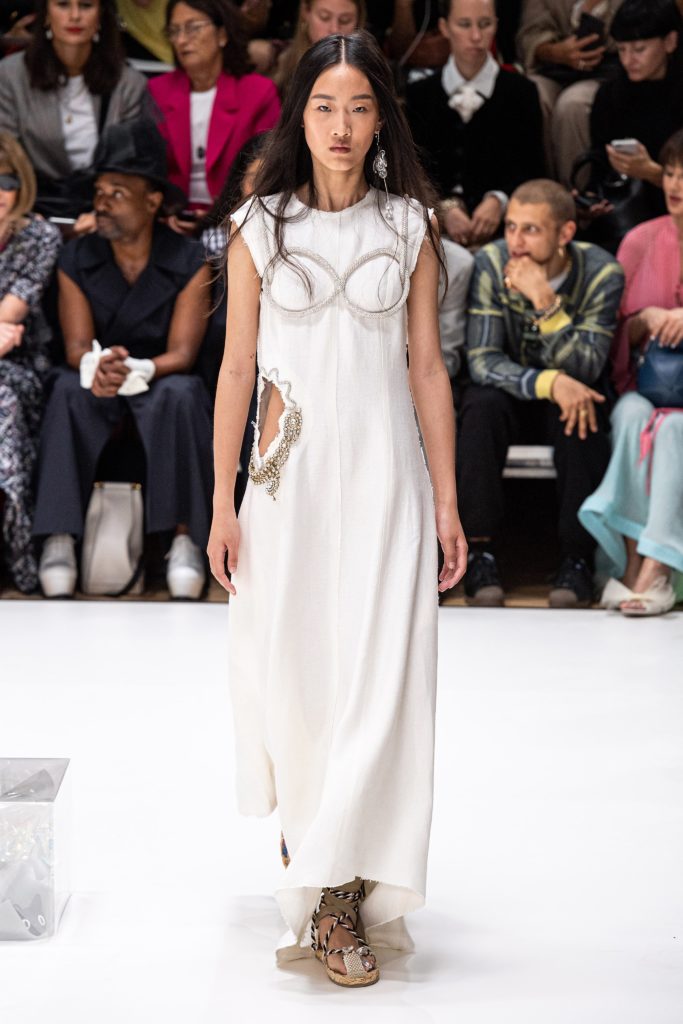
A dress from Anderson’s spring 2020
collection, which featured Liz Magor’s box sculptures on the
runway. Photo courtesy of J.W. Anderson.
In an age when fast fashion dominates the mainstream market and
designers at high-end brands are expected to produce a minimum of
five to six collections per year, Anderson remains focused on
creating clothes that his customers will want to hold onto. “It’s
important, at least for me, to create fashion that lasts,” he says.
“Maybe it goes out of style but you hold onto it, keep it in the
closet, and then bring it out 10 years later.”
Anderson wants his clothes—and the physical spaces they occupy,
in shows, stores, and pop-up shops—to convey an emotional
experience that transcends commercial value and relays something
essential. His collecting sensibility is not dissimilar. He doesn’t
buy art for its market value (though he has a fair number of
high-priced works, including ones by Cy Twombly, Rose Wylie, Lynda
Benglis, and Paul Thek). Instead, he looks for pieces that capture
seminal moments of transformation in the life of an artist,
memorializing their ascent.
Late last year, when asked about the most valuable artwork in
his collection, Anderson cited the ceramic works of British artist
Ian Godfrey. “It’s not the most valuable, but I have put together a
detailed body of [Godfrey’s] work,” he said. “I think it’s
sometimes about the discovery in people, which is where the value
comes from.”
These days, Anderson continues to fill his already art-laden
London townhouse with new works by artists such as Alvarro
Barrington, Magali Reus, Helen Marten, and Tau Lewis. “You know, I
just feel you have to force yourself to live with conceptualism,
which sometimes can be inspiring,” he says.
And does Anderson feel that artists legitimize fashion? “I don’t
really see it that way,” he says. “I think it’s about creative
dialogues, not trying to have one that eats the other. For me, it’s
about being able to have a conversation with a piece, and to be
able to say something about the people who made it.”
The post ‘It’s Just About Being Obsessed’: How Fashion
Designer Jonathan Anderson Finds Inspiration in Unexpected
Artists appeared first on artnet News.
Read more https://news.artnet.com/art-world/jonathan-anderson-1697154
Further reading


Leave a comment