
High-Octane Sales During the VIP Preview of Art Basel’s Second Online Fair Solidify the ‘New Normal’ of the Socially Distanced Art Market
June 17 was supposed to be slated for trawling the Messeplatz’s
meticulously assembled art-fair booths, nibbling white asparagus at
exclusive Swiss dinner spots, and sipping champagne at the Grand
Hotel Les Trois Rois.
But on Wednesday, many of the world’s top dealers, collectors,
curators, and advisors instead fired up their home computers and
smartphones to web browse the latest iteration of Art Basel’s
online viewing rooms.
While the atmosphere left several participants pining for the
IRL experience, respected galleries ended the opening day of the
virtual fair with a slew of five- and six-figure sales on their
books. By Thursday morning, however, deals struck for more than $1
million were rare, further reinforcing that online sales platforms
remain something of a glass-half-empty versus glass-half-full
proposition: yes, a price ceiling still seems to exist for most
galleries—but the ceiling is higher, and the space below it is
wider and more welcoming than many would have expected just a few
years ago.
Familiar faces abounded at the upper levels of the market.
Gladstone Gallery scored one of the day’s biggest wins by placing
an untitled dayglo painting by Keith Haring for $4.75 million. The
gallery also found success one rung lower on the price ladder,
selling an untitled 1991 painting by Carroll Dunham for
$475,000.
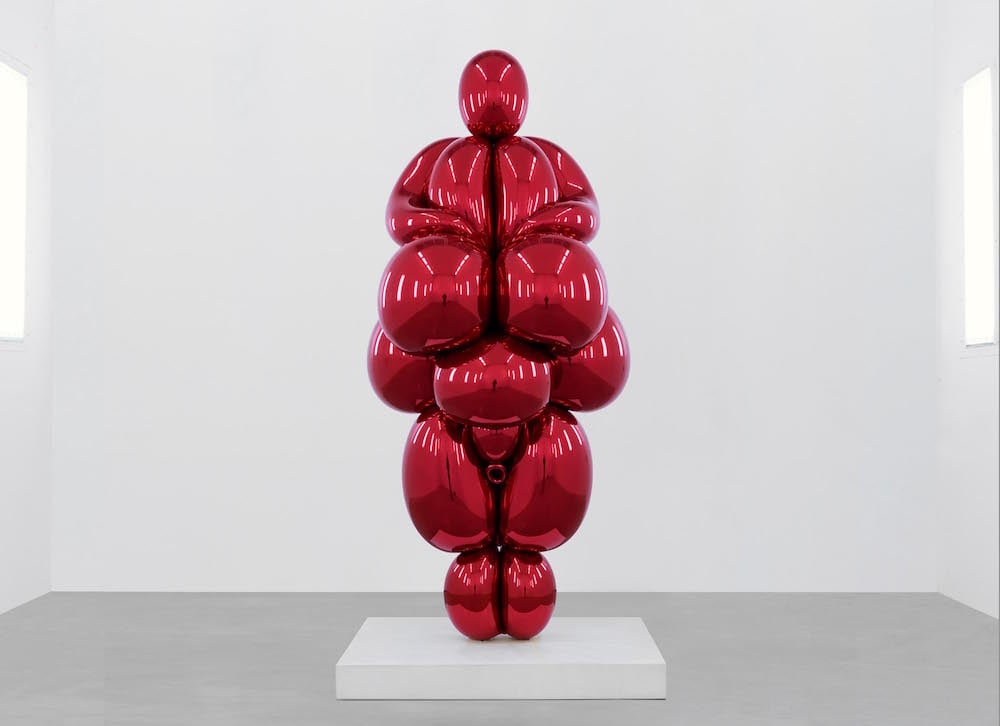
Jeff Koons, Balloon Venus Lespugue
(Red), (2013–2019)
© Jeff Koons. Image courtesy of David Zwirner
Mega-gallery David Zwirner made a splash with what is by far the
highest price we’ve ever heard of for an online transaction by a
private dealer: Jeff
Koons’s Balloon Venus
Lespugue (Red) (2013–19) sold for $8 million, a record
for any single online sale by the gallery. It was bought by a
private collector in Europe.
Hauser & Wirth was a close second in terms of new online
highs, reporting the sale of a
new work by Mark Bradford for $5 million. In all, the gallery
sold 20 works on
preview day, including numerous pieces that were placed with major
institutions.
Gallery president Iwan Wirth said that while there is no
substitute for being at Art Basel, which he called
“the art world’s largest energy-charging
station,” the gallery was nonetheless pleased to celebrate its
50th anniversary with important
sales.
Among the works that went to institutions are
two pieces by Simone Leigh, which are now promised gifts to major
American museums; a work by Rashid Johnson that was placed with an
important Latin American arts foundation; a Nicole Eisenman
painting, which is now with a European foundation; and a work by
Nicolas Party that went to a museum in
Asia.
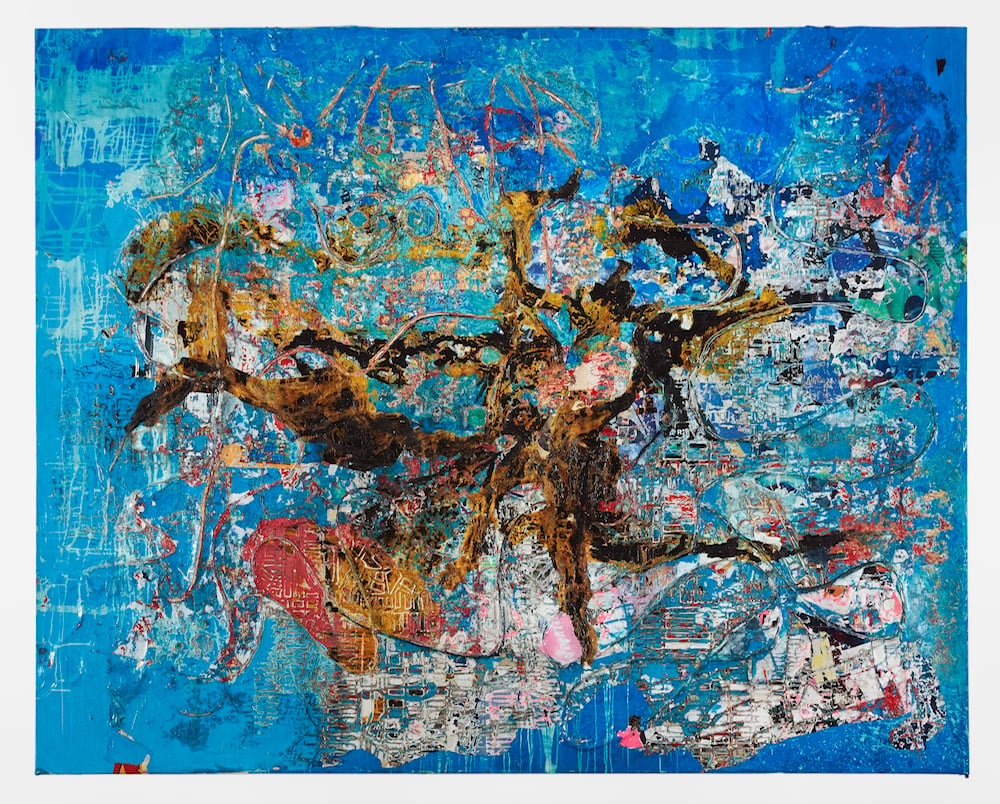
Mark Bradford, The Press of
Democracy (2020). Image courtesy of the artist and Hauser &
WIrth
Xavier Hufkens also cracked the $1 million mark on opening day.
His gallery reported eight sales by Wednesday evening, led by Paul
McCarthy’s White Snow
Cake (2017), a silicone
sculpture in eyeball-searing pink depicting Snow White and the
Seven Dwarves, at $1.2 million.
“Art Basel Hong Kong was a great
first experience,” Hufkens told Artnet News. But with the fair’s
latest virtual iteration, “the digital fair is reaching levels of
traction. It is clear to us that initial uncertainties about the
online art fair have now fully evaporated.”
Three more works placed by Hufkens were priced between $100,000
and half a million dollars: a Tracey Emin canvas for $490,000, a
whimsical Nicolas Party painting for $130,000, and a Thomas
Houseago bronze-and-oak sculpture for $110,000.
At the lower end of the market ladder, Hufkens also sold
an untitled Louise Bourgeois gouache for $85,000; a Michel
François mixed-media sculpture for $45,000; a Sterling Ruby
assemblage, REIF.
7263. (2020), for
$55,000; and a Katherine Bernhardt painting for
$50,000.
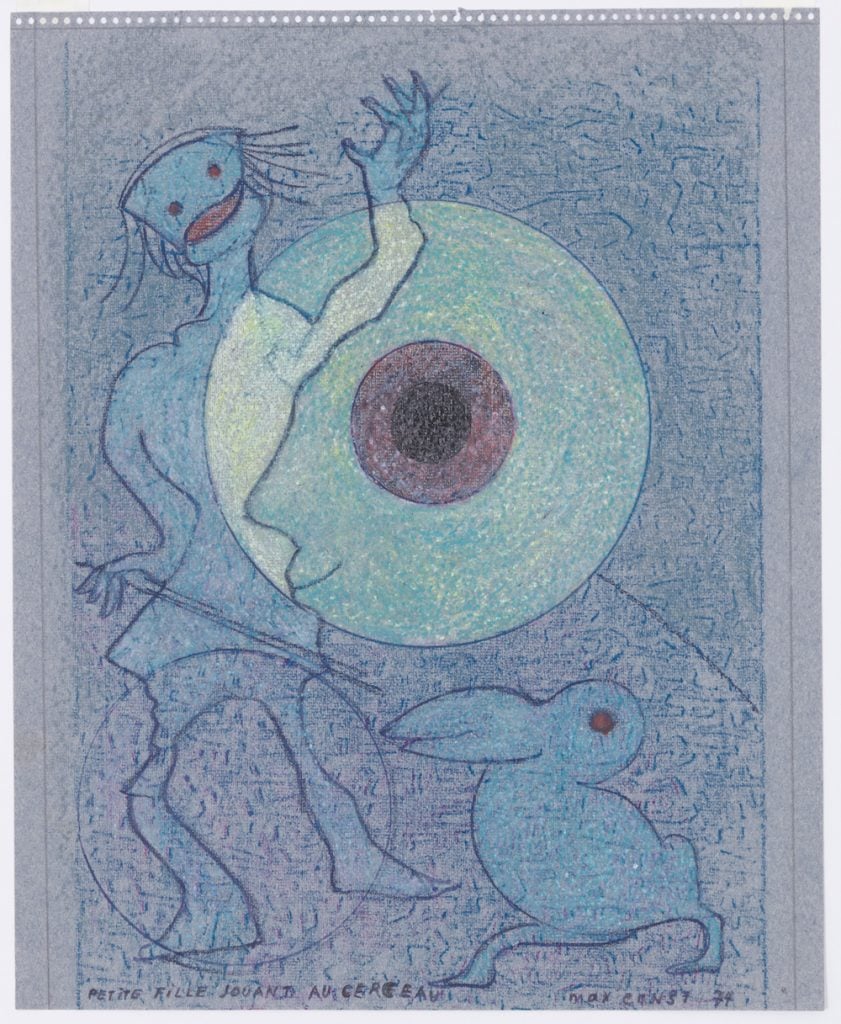
Max Ernst, Petite fille jouant
aux cercaux (1974). Image courtesy of Kasmin Gallery
Thaddaeus Ropac notched one of the day’s juiciest sales with
Georg Baselitz’s Elke in Frankreich II (2019), a
monumental canvas featuring one of the artist’s signature inverted
male figures, for €1.2 million (about $1.35 million). The
gallery also found buyers for works at the middle and lower tiers
of the market, including the Roy Lichtenstein collage Head
(Study) (1986) for $580,000 and the Jules de Balincourt
painting Park People Versus Forest People (2020) for
$45,000.
Meanwhile, Lévy Gorvy reported that it sold works by a
range of artists, including Pierre Soulages, Pat Steir, and Enrico
Castellani, for between $90,000 and $2.5 million.
Kasmin Gallery was upbeat about the results of its VIP
day. “It’s kicked off with a
real sense of enthusiasm. We’ve made sales to clients we know and
have had great inquiries from clients we don’t,” said gallery
director Eric Gleason.
Among the gallery’s sales were Lee
Krasner’s Untitled (circa 1979–80), a mixed-media
work on paper, for $240,000, and Max Ernst’s Petite fille
jouant aux cercaux (1974) for $115,000.
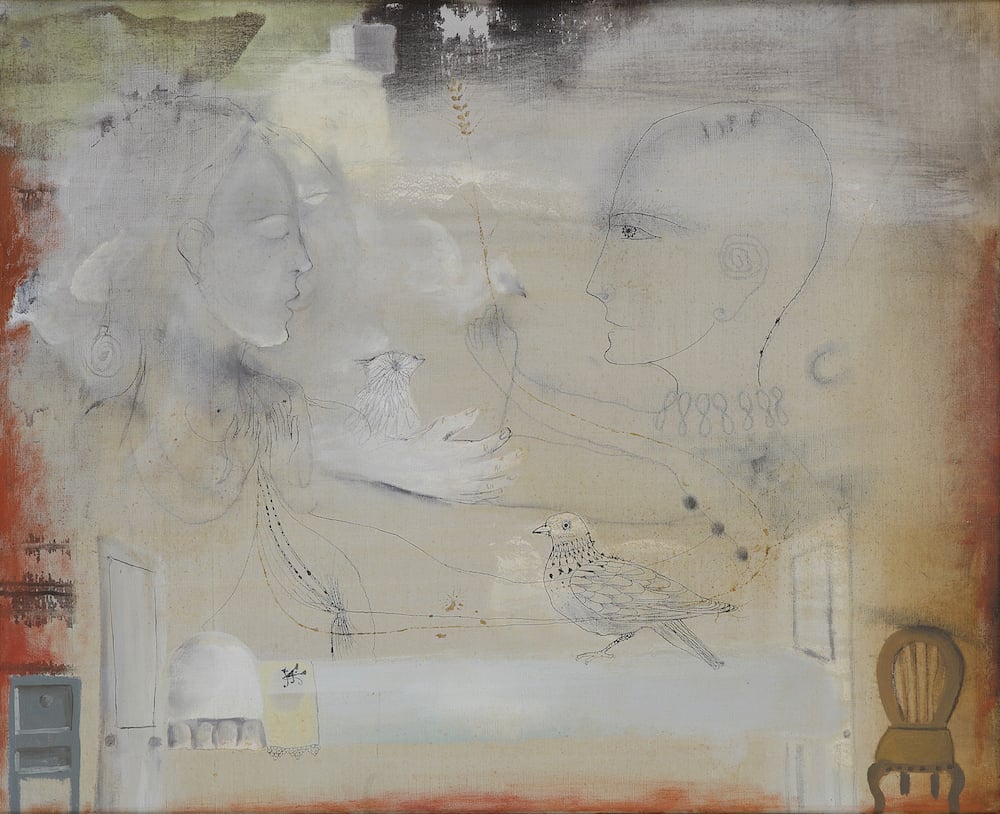
Antoni Tàpies, Galanteig 1952. ©
2020 Artists Rights Society (ARS), New York / ADAGP, Paris.
Expanding the Browser Window
Compared to what existed during Art Basel’s inaugural online
viewing room effort just three months ago, several more galleries
augmented their offerings by launching concurrent virtual
salesrooms on their own websites.
In some cases, these symbiotic projects added supplementary
information to the same works; in others, the dealers topped up the
pieces available through Art Basel with a few more objects; and in
still others, the galleries presented entirely separate portals
filled with works that were nowhere to be found in the stand-ins
for their Swiss “booths.”
And the expansions paid off quickly.
Zwirner, for instance, reported that 10 of 15
works presented on
its own website sold by the end of
Wednesday. And
Gagosian, which first arranged its own concurrent online viewing
room during Art Basel 2018, followed suit again this year.
By publication time, Gagosian said it had sold nearly as many
works on its in-house platform as it did through Art Basel. Among
those in-house sales was Heaven’s Gate (2020), a
signature Mary Weatherford piece combining neon and flashe on
canvas, which sold for $310,000. A Jennifer Guidi sand painting,
also made this year, found a buyer at $65,000, as did works by
Nathaniel Mary Quinn, Andreas Gursky, and Sterling
Ruby. (Among Gagosian’s Basel sales was a modestly
sized Jia Aili painting titled Mountain and Line
from 2020 that went for $350,000.)
Gagosian senior director Andy
Avini said the gallery “saw an opportunity to widen the spectrum of
the artists we show” via this simultaneous in-house
infrastructure.
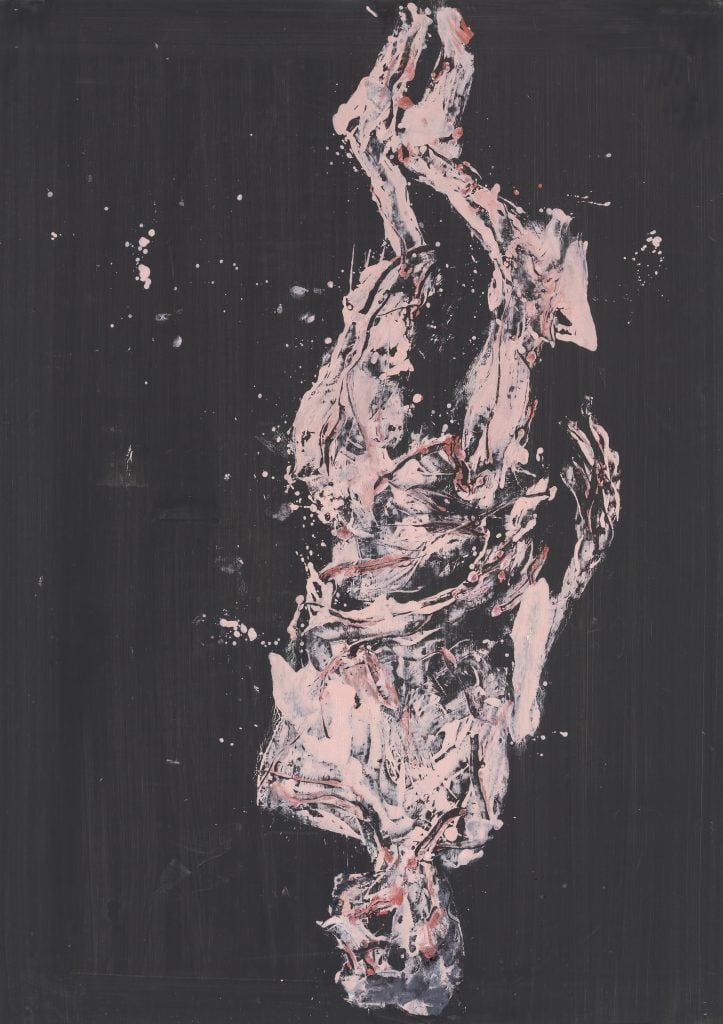
George Baselitz, Elke in Frankreich
II, 2019. Photo by Jochen Littkemann. Courtesy of Galerie
Thaddaeus Ropac.
Similarly, Gladstone also operated an expanded version of its
fair booth on its own website, featuring more works with more
context, plus a separate virtual salesroom devoted entirely to
watercolors by Ugo Rondinone. Its preview-day deals included a
painting by Elizabeth Peyton for $575,000 and a Rondinone sculpture
for $320,000, neither of which were featured at Art Basel.
Thaddaeus Ropac took a different kind of hybrid approach. With
galleries open again in the UK, the dealer installed several works
at his Ely House location in London to coincide with the opening of
Art Basel’s online viewing rooms, including the €1.2 million
Baselitz.
Yet despite sales success and improved digital capabilities, Art
Basel’s second virtual fair still left dealers wanting on one
level. One dealer even said that Art Basel’s online viewing room
was “a joke,” and wondered aloud if the server it ran on would go
down.
But Javier Peres of Berlin’s Peres Projects said he “found the
navigation to be overall fairly smooth,” though he added: “Of
course, we miss the fair and all the excitement, business, etc.,
that come with being in Basel. But all things considered, we are
expecting this [online viewing room] to be successful as well.”
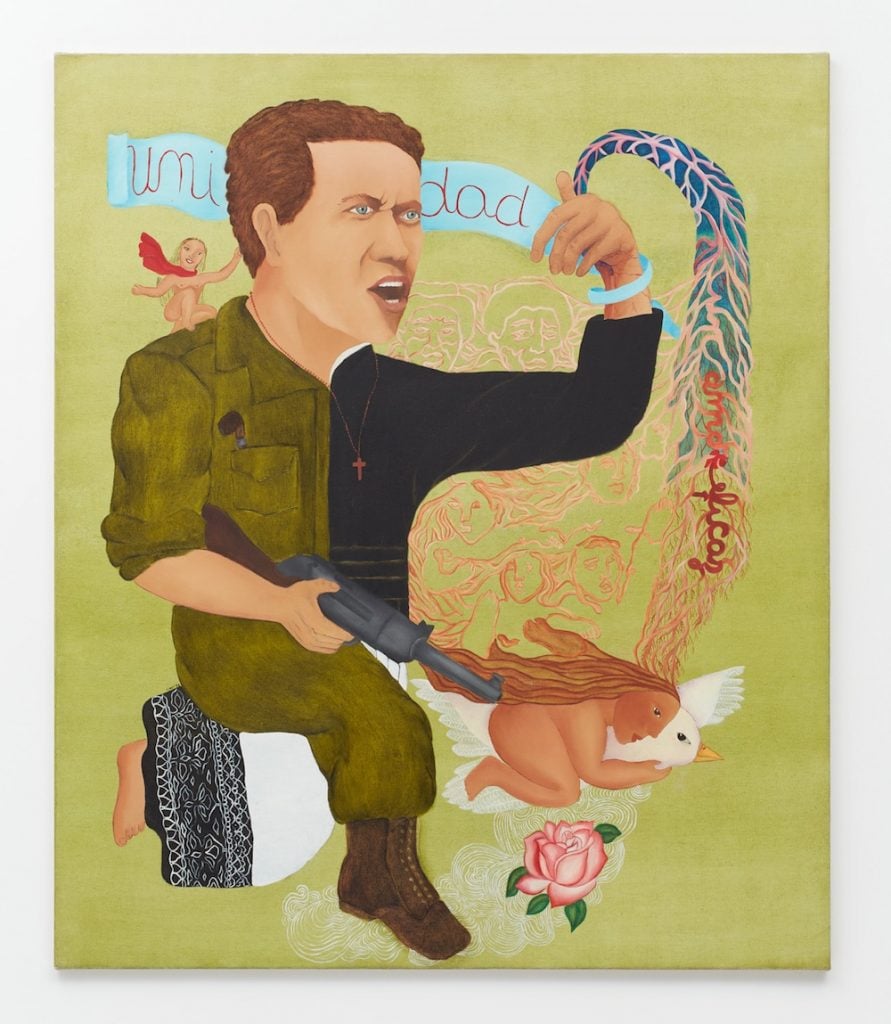
Cecilia Vicuna, Camilo Torres
(1978). Image courtesy the artist and Lehmann Maupin
Among other dealers, Di Donna Galleries sold a painting by
Antoni Tàpies with an asking price of between $300,000 and
$400,000.
Lehmann Maupin reported selling, within the first hour of the
fair, a historic 1978 Cecilia
Vicuña painting to a collector based in Korea for $375,000. This
work will be included in the upcoming 2021 Gwangju Biennale in
Korea, which opens in February.
And Marianne Boesky gallery reported primary-market sales of works by Jennifer
Bartlett for $600,000, Donald Moffett for $175,000, and Serge Alain
Nitegeka for $30,000. On the secondary market, the gallery placed a
Yoshitomo Nara.
“Given this new online format, we have been
engaged with our artists more than ever,” Marianne Boesky gallery
director Kelly Woods said.
—Additional reporting by Kate Brown
The post High-Octane Sales During the VIP Preview of Art
Basel’s Second Online Fair Solidify the ‘New Normal’ of the
Socially Distanced Art Market appeared first on artnet
News.
Read more https://news.artnet.com/market/art-basel-online-viewing-rooms-sales-2020-1887994
Further reading


Leave a comment