
David Hockney’s Brother Tells the Poignant Story Behind the Artist’s Celebrated Portrait of Their Parents
David is not a mean person. Quite the contrary, he is most
generous, but super-careful of his use of his time. Yesterday has
gone, tomorrow unknown, so now is the only time there is to make
choices. It applies to everything he does. Time is important.
“To laugh at something every day,” he says, keeps him going. “We
have to have humor in our lives”. He does not suffer fools.
Devotion can be costly. I have seen it in David. His cost is
that only a selfish person can be so devoted. I use the word
“selfish” not as a derogatory term, rather for David to achieve
what he needs to explore and pursue at any given time, it is
necessary for him to nurture every minute in that pursuit. Nothing
else matters—only
his art matters. Now is the only time there is, for David.
I have often wondered how, when we slept and played together,
brother David planned to reach for his stars. Only David knew his
ambitious inner self.
His has been an absorbing, independent, successful, but I
believe somewhat lonely life. There are people who have been
important to him. Many of his friends have died over the years.
Names I know and have met are Nick Wilder, Ossie Clark, Christopher
Isherwood, Henry Geldzahler, Mo McDermott, Norman Stevens
and Jonathan Silver and my sister’s partner, Ken Wathey. All and
many more were part of his life. He chatted with them, shared ideas
with them, and loved them.
Today, David probably has the best staff he has ever
engaged—knowledgeable, and workaholics when they need to be,
discovering through him their own skills and knowledge.
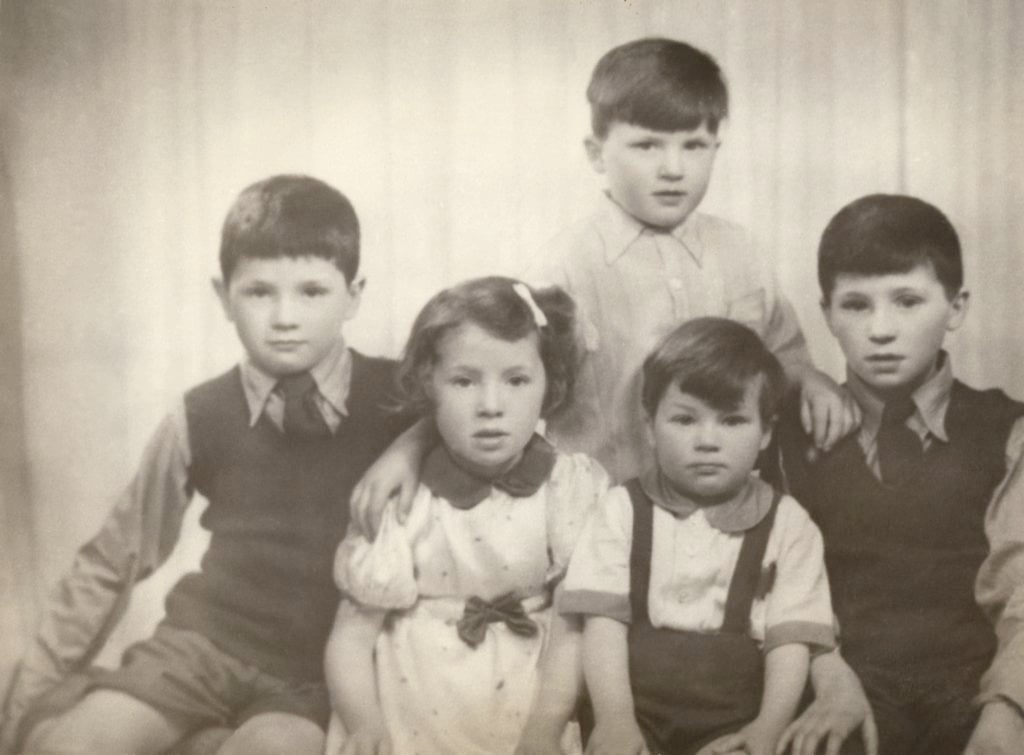
An early photograph of the Hockney
family. Courtesy of Legend Press.
In the late 1970s and early ’80s, I know David was sometimes
lonely when he asked me to go to Los Angeles at
Christmas. “I wished my arms stretched to Los Angeles, you need a
hug,” I would say. Devotion costs. It can be a lonely life, but if
it were different, David Hockney could not be who he is; not be the
person who is unselfish in passing on his knowledge and his
discoveries, because there is more knowledge to seek, to learn;
always
more to explore.
On my 74th birthday he sent me an email.
Dear John
I might as well confess I have come from a very, very, rich
family
Not having much money did not get in the way of our riches. We
did not have a failure of imagination. There were poor people
around, some of them very poor indeed, but we generally noticed
it was failure of imagination. What can be done about this?I sometimes pondered, open their eyes more I thought to
myself.
The unbelievable beauty around us could be pointed out.Children seemed to notice it more. They were richer.
Some of the poorest people were always trying to tell others
how
poor they were. They came up with what I personally thought
crackpot ideas about the total misery of the world.Their very poor eyesight was often not noticed, the blind
seemed
to lead the blind, and this made me sad at times. They got some
sort of enjoyment fighting and smashing things up and would
get encouragement from some other sad people who made them
bigger sticks and catapults. Some of the poor lived in a bigger
house, not so good really, more stairs to climb, further to walk
to
the fireplace, even daft bigger tables where they had to shout to
say
anything as each one was so far away.In the end I wasn’t sure these people could be helped other
than
perhaps some spectacles, or a large bottle of eye cleaner might do
it.I confess to not bothering too much but then thought of making
a
false window. I could with a brush make some signs on it to see
if
they might take notice, if they didn’t, why bother?I confess on the whole that’s been my motto. I’ve tried to
ignore
the shouters. I find it’s better.And, you can stay richer. They tended to make the air too hot,
not
so good for breathing. They even went on and on about burning
leaves, how bad they could be for you, but I noticed when they
were
just smoldering the smoke was very nice indeed, better than
the hot air they made which sometimes almost choked me. I have
found my motto to be quite useful. Perhaps it could help some
of
the poor, but if their eyesight is bad I’m not sure what one can
do.
I ponder it at times, especially sitting near the smoldering
leaves.
I find it helps.Avoid the shouters.
Laugh a lot it clears the lungs.
Love David H
Renting a flat in Powis Terrace, Notting Hill, David eventually
purchased the whole building, modernizing it to include a separate
studio. In the basement lived Mo McDermott, who had attended
Manchester Art School where Celia Birtwell and Ozzie Clark had
studied. It was Mo who introduced David to Celia and Ossie. The
Swinging Sixties became full of life, of enterprise. Art, fashion,
music, became creative talents, amidst the objections to war and
armaments. Life became bohemian in London. In the provinces like
Bradford there was change, but never like London. Energy, young
people’s energy, was everywhere.
The city burst with bohemia. Paul, my brother, helped David
acquire a one-man show at the Lane Gallery in Bradford owned by
Paul’s friend, Eric Busby. The Busbys had large department stores
in Bradford and Harrogate. The exhibition was a sell-out and the
name Hockney began to be recognized as that of a new and
upcoming artist.
In 1969 David must have been invited for dinner with Dickie
Buckle, a lifelong devotee of ballet. Cecil Beaton must have been
there too as my mother, reading Beaton’s diaries 1963-1974 (The
Parting Years Diaries 1963-1974), came across this piece she
wrote in her own diary:
After dinner at Dickie Buckles, David talked of the coming of
the
Golden Age. He had read many philosophers and has thought a
great
deal. In the next forty years all will change. The computer will do
away
with work: Everyone will be an artist. No need to worry, all the
leisure in
the world, everything will be beautiful.There will be no private property or need to own anything.
Everyone
will be ecstatically happy. It was marvelous to see this white
skinned,
champagne topped, dark glassed young man in pale pistachio
green,
with bronze boots, orange- yellow alternate socks holding forth
with such
vehemence. Midnight chimed without realizing that it was
bedtime.
David goes to sleep only when he is tired and wakes only when he
has
rested : never a question of a daily routine.
A few years later David was in his element. The picture he had
attempted to complete three times was at last going to be exhibited
publicly for the first time. He had struggled to paint My
Parents. Until this third and last picture, he was never
satisfied it truly represented who they were. I had driven Mum and
Dad to London on a
bright sunny morning. David was eager to begin their painting. His
studio was on the top floor where he had placed a two-meter square
canvas on an easel, allowing him to observe a drawer and shelf
unit, on which stood a mirror and a vase of flowers. Underneath the
drawers was an open shelf with a pile of books lying on their side.
Chairs placed at each end of the unit were ready for Mum and Dad to
sit. In another area of the studio was an unfinished painting of
Henry Geldzahler looking at a screen of pictures.
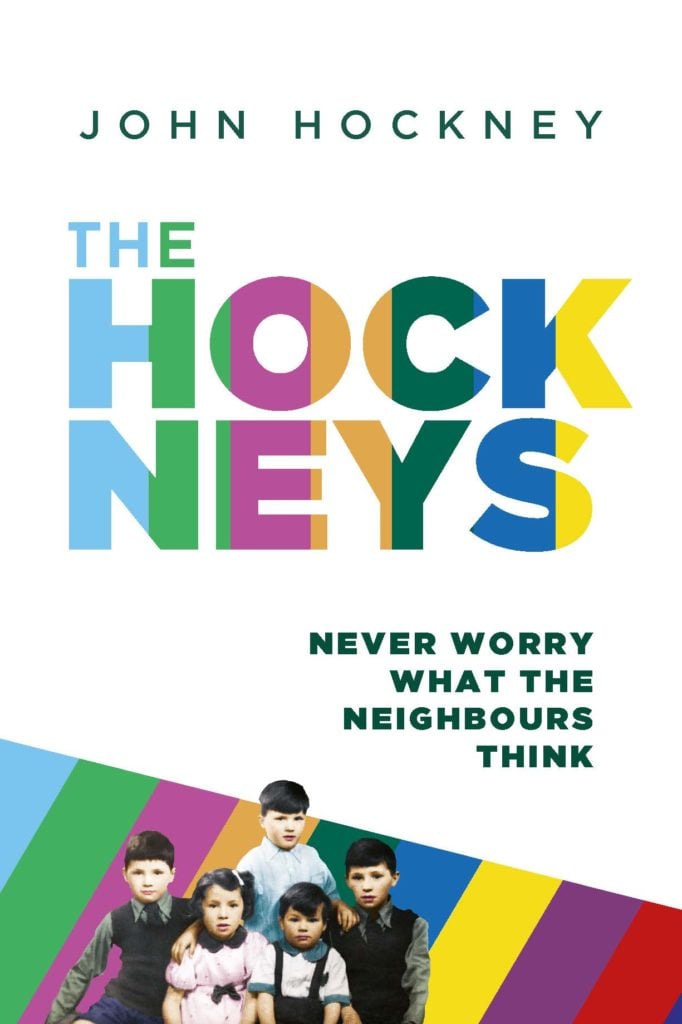
The Hockneys: Never Worry What the
Neighbours Think by John Hockney, courtesy of Legend Press.
They took their places, both sitting upright. David asked them
to relax a few minutes whilst he set up his palette. At that
moment, my father pulled his chair forward at an angle and took a
book from the bottom shelf. When David glanced up, he saw their
pose. Mum waiting patiently as she was told. My father busying
himself
reading. This separation is how they are. Mum waiting for Dad to
finish, but he never does as he is always busy.
David asked them to retain the pose whilst he painted them in
their chosen positions. When each of we siblings saw the picture,
we agreed it was honest. His rendition captured their situation
wonderfully—their likeness of course, but it was also full of love
and empathy. It is a truthful painting even though there is
separation; the connection is what is happening in the picture,
being themselves! Mum sat waiting for Dad to finish, but he never
did, not until he died.
In 1977 David was given a one-room space to present his work at
the Hayward Gallery. There were other artists who shared the
exhibition, who I recall created either minimalist or installation
art. I was able to attend the opening during one of my rare visits
to London.
The painting of My Parents made its debut at this
exhibition, with Mum and Dad attending. It was a proud moment. They
stood each side of the picture whilst David squatted on the floor
in front of his painting. My father painted from time to time,
copying from a photo or a magazine. He had recently made a very
good likeness of his hero, Sir Bertrand Russell, a man of
philosophy and a stalwart for world peace. David hung my father’s
picture in his exhibition as something he felt was inclusive and
made what he saw as a peaceful statement.
This excerpt is from The
Hockneys: Never Worry What the Neighbours Think by John
Hockney, published by Legend Press.
The post David Hockney’s Brother Tells the Poignant Story
Behind the Artist’s Celebrated Portrait of Their Parents
appeared first on artnet News.
Read more https://news.artnet.com/art-world/john-hockney-excerpt-1672480
Further reading


Leave a comment