
Black Lives Matter Co-Founder Patrisse Cullors Mourns Ahmaud Arbery in Her Latest Performance—and Offers Some Activist Advice for the Art World
Patrisse Cullors, the
performance artist and activist best known for co-founding Black
Lives Matter in 2013, unveiled a new work on Saturday in
collaboration with UCLA’s Fowler Museum. The performance piece,
A Prayer for the Runner, honors the life of Ahmaud Arbery,
a 25-year-old who was murdered in Georgia this year for the crime
of jogging while black.
Conceived during our era of
social distancing, A Prayer for the
Runner debuted on a Zoom webinar as a two-channel video.
On one side of a split screen, Cullors appeared in a candlelit
room, barefoot, dressed in a gauzy emerald robe and silver metallic
pants, the words “BLACK POWER” written across her black t-shirt.
Writing in black marker on a knee-high stack of blank paper, she
presented “LAPD BUDGET” to the viewer as a sacrificial offering,
then fed it through a shredder suspended from the ceiling. One by
one, as she shredded “JAILS,” “PRISONS,” and “POLICE,” the sheets
momentarily held their shape in midair as they fell out of the
machine, shattering to pieces as they landed on the growing mound
of shreds below. In the background, a pair of outstretched wings
hung on the wall.
“There’s a collective prayer,”
Cullors’s voice spoke out from the other half of the splitscreen,
flowing in a poet’s cadence. “And that prayer is grounded in the
idea and the belief that one day we will be free.” She invoked the
spirits of those recently lost to white supremacy by saying their
names aloud: Ahmaud Arbery, Breonna Taylor, and George Floyd. “You
did not deserve this,” she said, the words appearing and
disappearing in a hazy field of digital stars. The prayer repeated
several times, always ending not in an “amen” but an “ashe,” the
Yoruba invocation of power and energy.
A Prayer for the Runner
is a performative extension of the growing activist movement to
defund the police, an increasingly urgent call to governments at
all levels to abolish a historically violent institution. For an
art world still seeking ways to make meaningful contributions:
“We’re also calling on gallerists, and museum owners and
directors,” Cullors said in the post-performance chat with fellow
organizer Melina Abdullah. “Look at who you’re hiring as your law
enforcement and start breaking ties and breaking contracts. That is
what’s going to get us closer to freedom.”
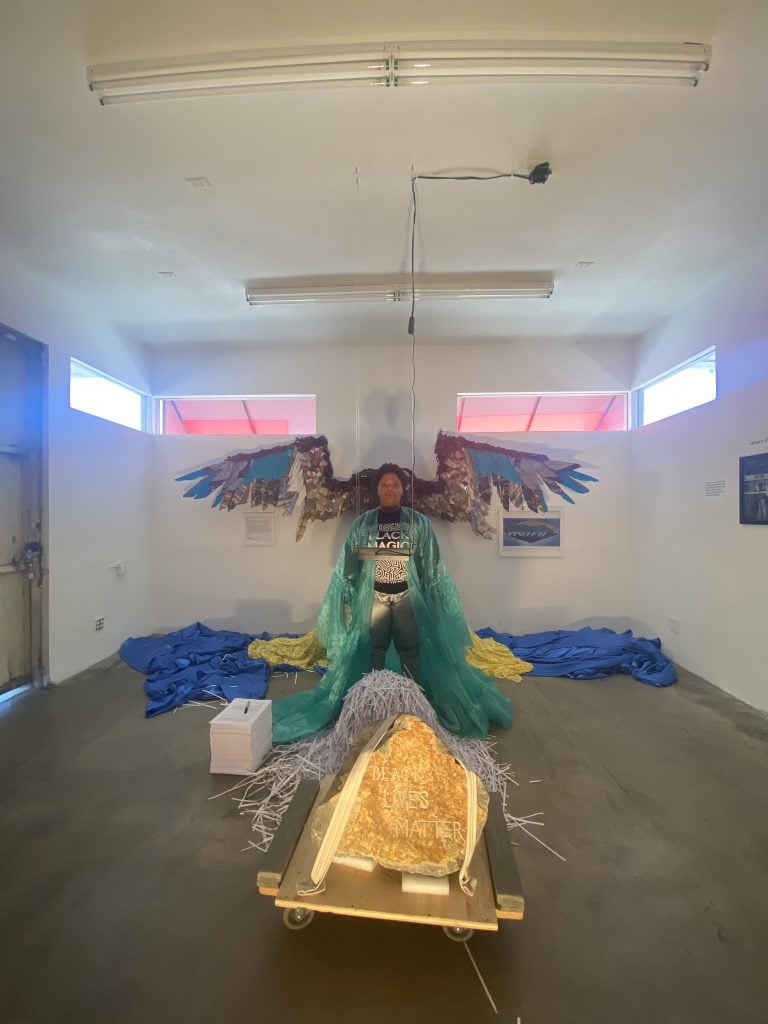
Post-performance portrait at Crenshaw
Dairy Mart. Courtesy of Patrisse Cullors
Cullors, an LA native,
identifies as a queer Black woman and prison abolitionist. She’s
spent the past 20 years navigating the intersection of those
spaces, merging art with activism. Before co-founding Black Lives
Matter, she formed the advocacy organization Dignity and Power Now
for incarcerated people, in 2012. And after graduating from the
University of Southern California’s MFA program, in 2019, she also
co-founded the Crenshaw Dairy Mart art space in Inglewood, Los
Angeles, and launched an MFA program of her own design at Prescott
College in Arizona. Titled Social and Environmental Arts Practice,
it dissolves the distinction between art and social
justice.
“The work that I do comes from a
Black arts tradition,” she said, citing Black artists of the 1960s
and ’70s, including Black Panther Party minister of culture Emory
Douglas, whose work was an inherent part of a larger movement. “The
Panthers understood that they needed to impact politics, the
economy, and culture.”
In her own practice, Cullors’s
adaptations of ritual elements in West African traditions
illustrate an overlooked aspect of Black Lives Matter as an
organization: its emphasis on spirituality as a restorative
mechanism, a counterbalance to the emotional toll of continuously
losing Black lives. “Every time someone is stolen from us[…], it’s
like a piece of me was stolen,” she said. “Both my political
practice and my artistic practice make me feel like I’m putting
parts of me together again.”
Her performances often center on
themes of reclaiming both physical and mental space, and make room
for Black joy in the face of relentless Black death. It calls back
to Audre Lorde’s description of the importance of self care to the
movement: “It is self-preservation, and that is an act of political
warfare.” Wellness ingredients and treatments find their way into
Cullors’s work: Her MFA thesis show, “Respite, Reprieve and
Healing: An Evening of Cleansing,” included Black performers,
dressed in white, washing one another’s hair with coconut milk and
honey, while Cullors’s body lay submerged in a tub of Epsom salt.
It contained the meditative repetition of sounds and gestures that
Cullors describes as important to her political and artistic
practices, “Mostly because you don’t get it the first time,” she
said. “I think when we repeat something, it means something
different, and it feels different each time.”
And that is the story of so many
progressive movements. Across the arc of history, they repeat
themselves countless times, and each successive generation carries
them forward slightly louder, moving in a slightly new
direction.
The day after Cullors’s
performance, in lieu of LA’s annual Pride
Parade, thousands
marched in solidarity with Black trans lives. The march
reverberated with the affects of both ritual and performance art:
costume, dance, the burning of Palo Santo. Demonstrators called
their invocations to George Floyd, Breonna Taylor, and to the many
others lost: Say his name. Say her name. Say their name. And it
hummed with the rhythmic repetition of a mantra that, after seven
years, has reached a new a critical mass, finally achieving
mainstream recognition as the definitive civil rights movement of
our time: Black lives matter. Black lives matter. Black lives
matter.
The post Black Lives Matter Co-Founder Patrisse Cullors
Mourns Ahmaud Arbery in Her Latest Performance—and Offers Some
Activist Advice for the Art World appeared first on artnet
News.
Read more https://news.artnet.com/art-world/patrisse-cullors-performance-ahmaud-arbery-1887902
Further reading


Leave a comment