
‘Becoming a Director Was About Getting Power’: Ja’Tovia Gary on How She Went From Art-School Outcast to Sought-After Experimental Filmmaker
Three and a half years ago,
American artist and filmmaker Ja’Tovia Gary was participating in a
summer residency in Giverny, the bucolic French commune where
Claude Monet spent the final 40 years of his life, when footage of
the murder of Philando Castile at the hands of a Minnesota police
officer began circulation online.
While protests over the killing
and other acts of police brutality erupted in her home country,
Gary took a walk through the famed French painter’s beloved garden
and considered the overlapping timelines of French
colonialism and the rise of Impressionism.
She then became acutely aware of certain “microaggressions,” she
told Artnet News: people staring at her, a black person, in a
predominantly white region, and men encroaching on her space
uninvited.
“I was a sore thumb standing
out,” she recalls. “This unruly, politicized black body in the
garden. I was thinking, how can I come here now and assert my
subjectivity?”
So she ran through Monet’s garden screaming, disrobed, and
lounged around in classical poses.
And she filmed it all, trying to
“fingerprint the psychological experience.”
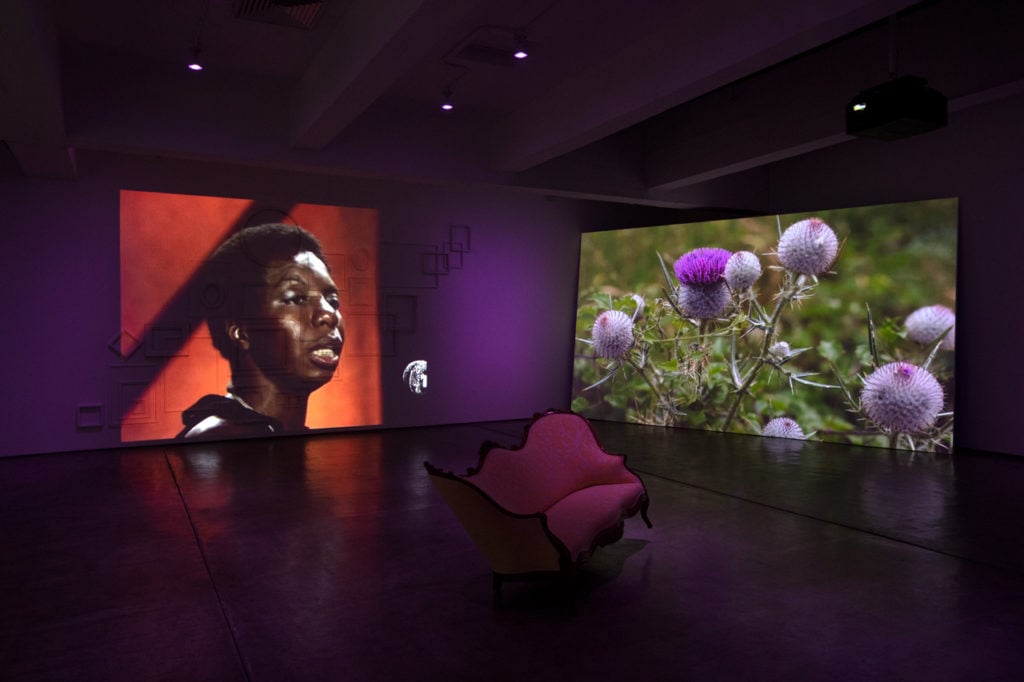
Ja’Tovia Gary, THE GIVERNY
SUITE, detail (2019). © Ja’Tovia Gary. Courtesy Paula
Cooper Gallery, New York. Photo: Steven Probert.
The resulting footage appears
throughout THE GIVERNY
SUITE (2019), a
three-channel video now on view in her
debut show at Paula Cooper and at the Hammer Museum in
LA.
The 40-minute film is a hypnotic
montage of images found and original. The shots of Gary in the
garden are rhythmically interspliced with footage of drone strikes
and an arresting performance by Nina Simone, while in other,
Cinéma
vérité-style sequences,
Gary asks women on the streets of Harlem if they feel safe in their
bodies.
As the film lulls you into a
kind of trance, the video of Castile’s death, live-streamed at the
time by his girlfriend, Diamond Reynolds, jolts you back into
reality. It’s edited so that Castile’s body remains unseen in an
explicit refusal to indulge in the fetishization of black
violence.
Sitting in Paula Cooper office
chairs while the show was being installed, Gary laid out the heady
mix of references she makes in the film, which nods to experimental
filmmakers like Jean Rouch, Fred Hampton’s theory of negro
imperialism, and the writings of activist Claudia
Jones.
If you didn’t know Gary had a
background as an actress, it wouldn’t take long to guess it based
on the way she tosses her scarf over her shoulder mid-sentence and
enunciates like she’s speaking to a room full of
people.
“A lot of people will ask,
‘Well, what does that mean?’ They want a simple definition in terms
of what the symbols and the references are doing,” she said. “I can
give you answers, but to me that doesn’t mean anything. I want to
activate you. I’m trying to move the molecules in the
room.”

Ja’Tovia Gary, Precious Memories
(2020). © Ja’Tovia Gary. Courtesy Paula Cooper Gallery, New York.
Photo: Steven Probert.
Sitting in the Director’s Chair
Gary was born in 1984 in Dallas,
where she lives now. A performer from an early age, she transferred
to the local Booker T. Washington High School for the Performing
and Visual Arts—a school famous for churning out artists
like Erykah Badu
and Norah Jones—in her junior year, and devoted herself to
theater.
Next was the leap to New York,
where she matriculated at Marymount Manhattan College on the Upper
East Side. But the move wasn’t easy.
“I was a leading lady in Texas,”
Gary said . “And in New York, I’m going to be a servant, maybe? It
went from me being Cassandra in the Trojan Women, delivering this gut-wrenching, snot-slinging
performance, to me going on MTV auditions and having them tell me,
‘Turn to the left, look forward. We wish you were five pounds
smaller.’”
That’s when she decided to move
behind the camera.
“Becoming a director was about
getting power—the power to fully flesh out blackness and the role
of black women in society, to talk about what has been taken from
us and what we are coming to reclaim,” she said. “It’s to enliven,
to breathe flesh into these tropes, to make them real. That’s what
I consider my project to be.”
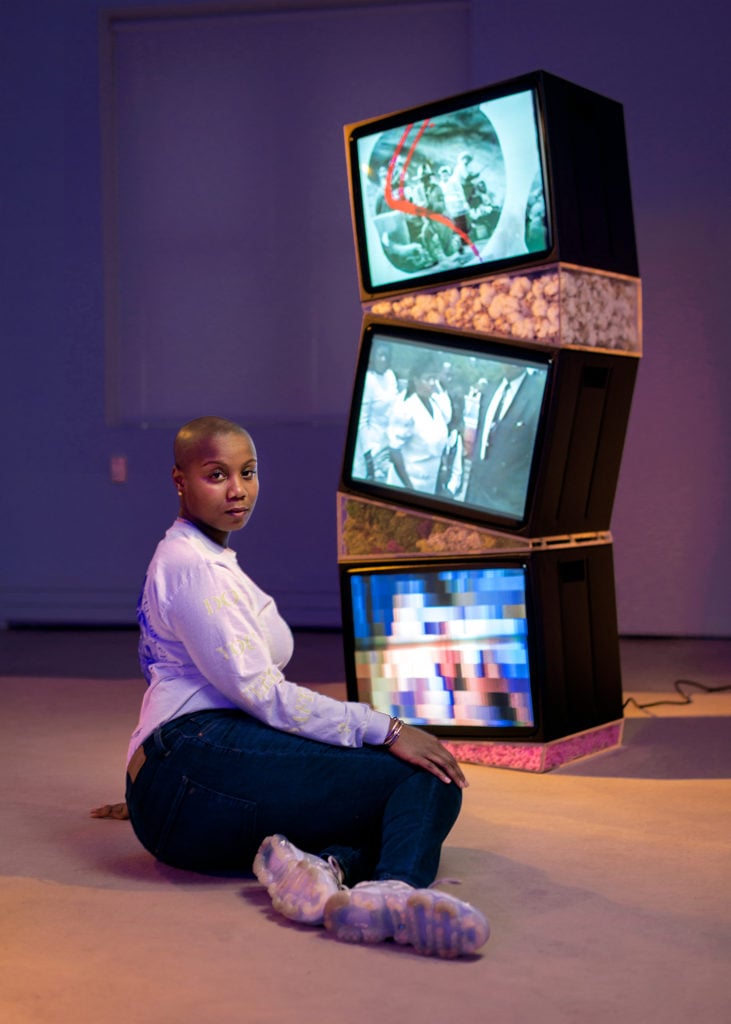
Ja’Tovia Gary, 2020. Photo: Taylor
Dafoe.
She dropped out of Marymount,
which was always an awkward fit, and after a couple of years
waiting tables, she went to get her degree in documentary film
production and Africana studies at Brooklyn College. After that,
she pursued an MFA in social documentary filmmaking at the School
of Visual Arts (SVA), where again she ran up against the strictures
of a conservative curriculum.
“I thought I was going to get
kicked out,” she said, explaining her penchant for adding archival
footage, direct animation, and other experimental flourishes to
otherwise simple assignments at SVA. “They said, ‘We didn’t ask you to do this.
You’re actually not following directions.’ And I was like,
‘Directions? Baby, this is art school. Those are
suggestions!’”
Her teachers didn’t get her
work, but others did. A couple of films she made in grad school,
including lyrical portraits of sculptor Simone Leigh
and rapper Cakes Da
Killa, gained exposure
online and went on to be screened at festivals. She also cut the
first version of An Ecstatic
Experience, a
six-minute short that put her on the art-world
map.
Featuring Stan Brakage-style
illustrations flickering over footage of actress Ruby Dee playing a
slave, the film hit dozens of festivals worldwide before being
shown in two exhibitions at the Whitney Museum in 2016 and 2017,
and again last year in Hilton Als’ James
Baldwin-inspired group show at David Zwirner.
It was at the latter venue that
gallerist Paula Cooper first saw Gary’s work.
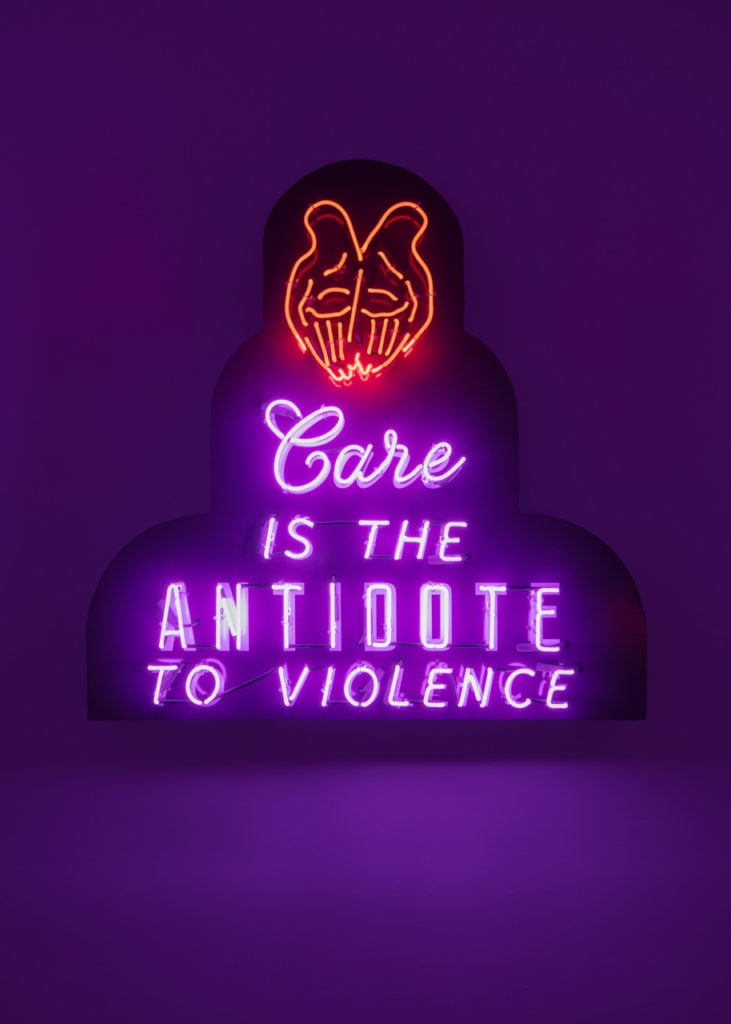
Ja’Tovia Gary, Citational Ethics
(Saidiya Hartman, 2017) (2020). © Ja’Tovia Gary. Courtesy Paula
Cooper Gallery, New York. Photo: Steven Probert.
The Archive is Alive
“We were profoundly moved by
it,” said Steve Henry, a director at the gallery, who brought
Cooper to see the show. Shortly thereafter, they invited Gary to
the gallery for a meeting that ended up lasting several
hours.
“We were immediately committed
to working with her after that,” Henry recalled, noting how
“incredibly rare” it is for Cooper to take on an artist so quickly.
“Ja’Tovia’s a visionary, I think. She has a remarkable way of
articulating her vision, both in conversation and in the
work.”
Despite several museum
appearances under her belt, the exhibition at Paula Cooper, titled
“flesh that needs to be
loved,” is Gary’s first solo
gallery show. As an installation, it’s her most realized effort to
date.
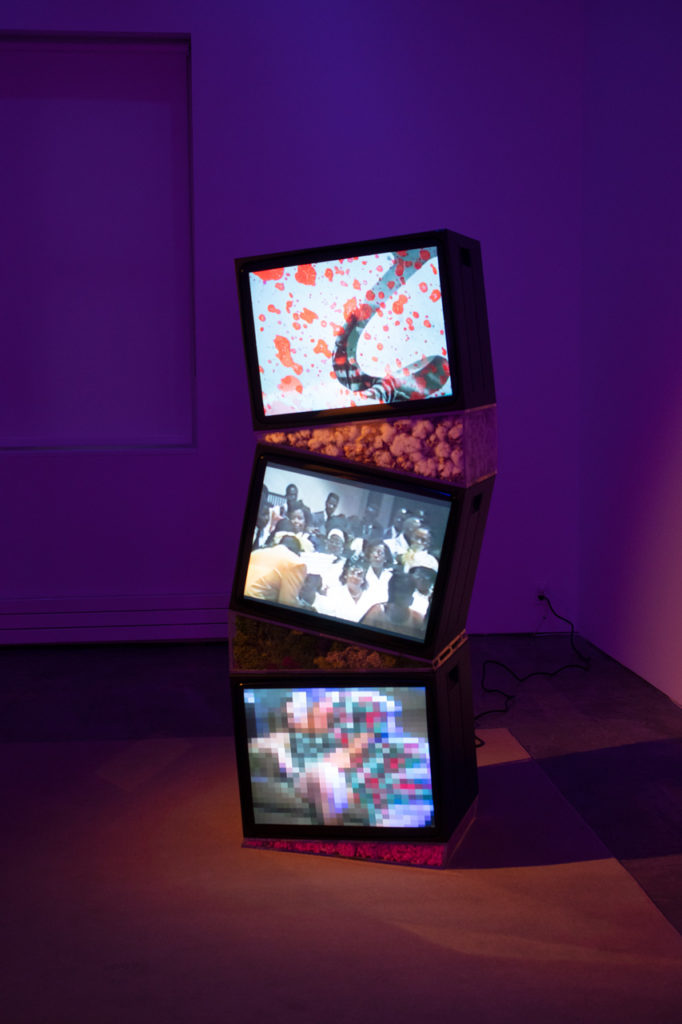
Ja’Tovia Gary, Precious Memories
(2020). © Ja’Tovia Gary. Courtesy Paula Cooper Gallery, New York.
Photo: Steven Probert.
At the gallery, a velvety,
purple light fills the space, like an abandoned black-light party.
A plush parlor couch sits akimbo in the middle of the main space,
two legs off the floor, while THE GIVERNY SUITE projects floor-to-ceiling onto three
surrounding walls. In a second gallery, there is
a makeshift living room
where a broken La-Z Boy is positioned before three TVs stacked like
crooked vertebrae. The whole thing is like a
Lewis Carrollian fever
dream projected through the lens of afrofuturism.
For Gary, it’s less about
sensorial disorientation, and more about social and historical
reality.
“What’s time to black person?
It’s just not the same,” she said, explaining her interest the
looping structures of blues and jazz and the West African Griot storytellers who
recount events non-linearly.
“My work deals with the past as
much as it deals with where we are now. The archive is alive and it’s a contested
space, just like today. I want that to be felt in the
work.”
The post ‘Becoming a Director Was About Getting Power’:
Ja’Tovia Gary on How She Went From Art-School Outcast to
Sought-After Experimental Filmmaker appeared first on artnet
News.
Read more https://news.artnet.com/art-world/jatovia-gary-interview-paula-cooper-1787904
Further reading


Leave a comment