
Archaeologists Just Discovered That Neanderthals Made String 50,000 Years Ago, Suggesting They Were Way Smarter Than We Thought
Archaeologists have unearthed more evidence that Neanderthals
were smarter than we previously believed.
According to newly unearthed materials, our human brethren were
making the world’s first string 50,000 years ago. The oldest-known
cord fragments prior to this discovery were found in Israel, and
were made some 19,000 years ago.
The find comes from an archaeological site called Abri
du Maras in southeastern France, where Neanderthals lived
between 90,000 and 42,000 years ago.
“The idea that Neanderthals were cognitively inferior to modern
humans is becoming increasingly untenable,” researchers say in an
article documenting their finds published in Scientific
Reports.
“We found many tools on the living floors left by Neanderthals
among bones of reindeers,” archaeologist Marie-Hélène Moncel, one
of the paper’s authors and the director of research at the National
Museum of Natural History in Paris, told the New York
Times. “On one of these tools there was a micro-residue of
vegetal fibers, twisted.”
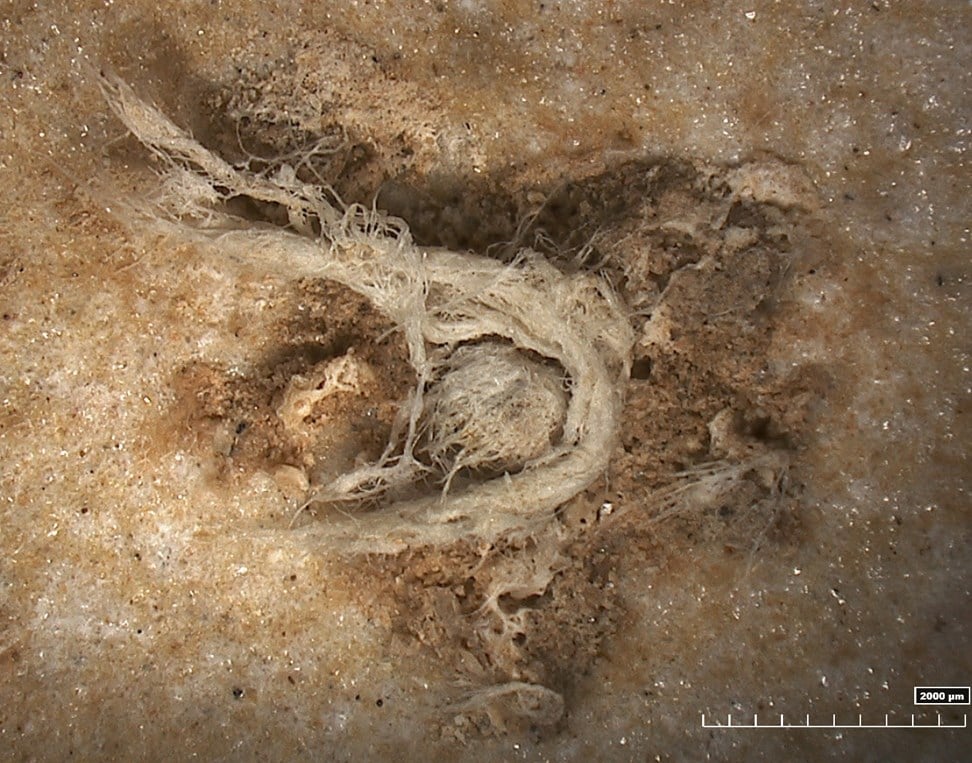
The world’s oldest-surviving string,
seen in this digital microscopy photo, was found at an
archaeological site in France. Photo courtesy of the Centre for
Research and Restoration of the Museums of France.
Experts are positing that the string could have been used to
produce utilitarian objects such as baskets, nets, mats, and bags,
as well as fabrics.
Under a microscope, the six-millimeter white fragment found on
the tool was revealed to be a three-ply cord made from the inner
layer of tree bark, likely a conifer.
Excavations at the site had previously turned up other potential
string fragments, but the possibility always remained that those
were stray bits of modern fibers from archaeologists’
clothing. But “nobody at the site was wearing their conifer pants
at the time” of the discovery, the paper’s lead author,
palaeoanthropologist Bruce Hardy told the NewScientist.
The bundles of fibers were made into yarn using a
counterclockwise “S-twist,” and then three strands of yarn were
bound together in a clockwise “Z-twist,” creating a durable
cord.
What makes the find even more remarkable is that the cord
suggests that Neanderthals had a mathematical understanding of
numbers.
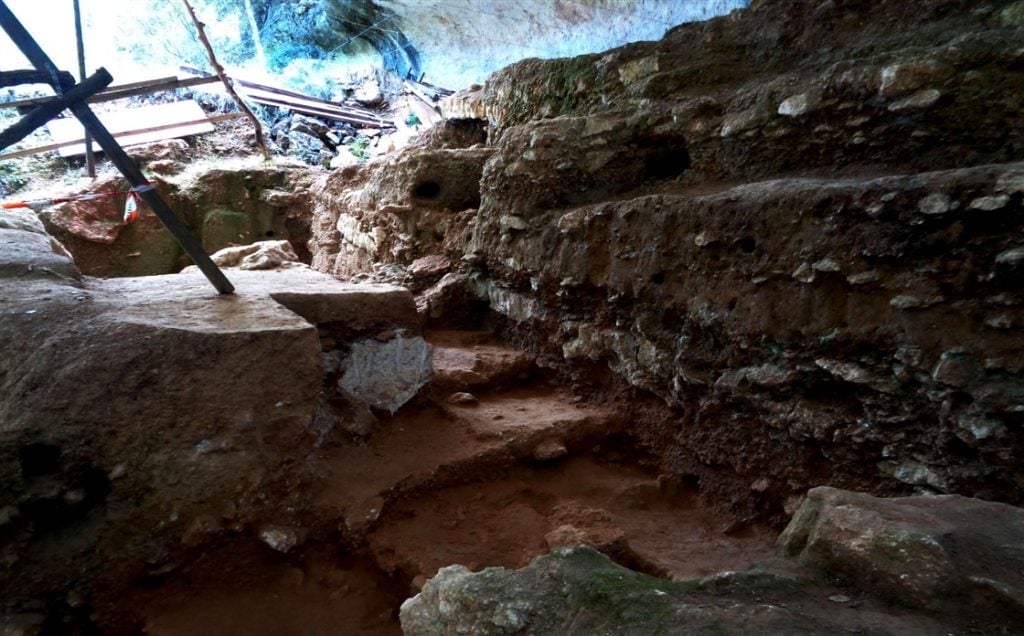
The world’s oldest-surviving string was
discovered by archaeologists at a Neanderthal rock shelter at Abri
du Maras in south-eastern France. Photo by Marie-Hélène Moncel.
Making such a cord requires “context sensitive operational
memory to keep track of each operation,” the paper says.
“As the structure becomes more complex (multiple cords twisted
to form a rope, ropes interlaced to form knots),” it demonstrates
that Neanderthals may have had “a cognitive complexity similar to
that required by human language.”
“This is just another piece of the puzzle that shows
[Neanderthals] really weren’t very different from us,” Hardy
told NBC News.
The post Archaeologists Just Discovered That Neanderthals
Made String 50,000 Years Ago, Suggesting They Were Way Smarter Than
We Thought appeared first on artnet News.
Read more https://news.artnet.com/art-world/neanderthals-string-discovery-1830864
Further reading


Leave a comment