
A New Discovery About Pre-Historic Rock Art Suggests Ancient People Had Technology We Are Only Now Beginning to Catch Up To
The rock art around Babine Lake
in the Canadian province of British Columbia positively pops with a
startling red hue. It’s hard to believe that the more than 150 rock
paintings have remained so well-preserved, in the open air, for
thousands of years. It’s also surprising to learn that researchers
haven’t studied how the ancient people achieved those red tones,
and why the vibrancy has persisted over time.
A team led by Brandi MacDonald, an assistant research
professor in the Archaeometry Laboratory at the University of
Missouri Research Reactor, has changed that, publishing a
study,“Hunter-gatherers harvested and heated microbial
biogenic iron oxides to produce rock art pigment,”
in the open-access mega-journal Scientific
Reports, which is overseen by the scientific
journal Nature.
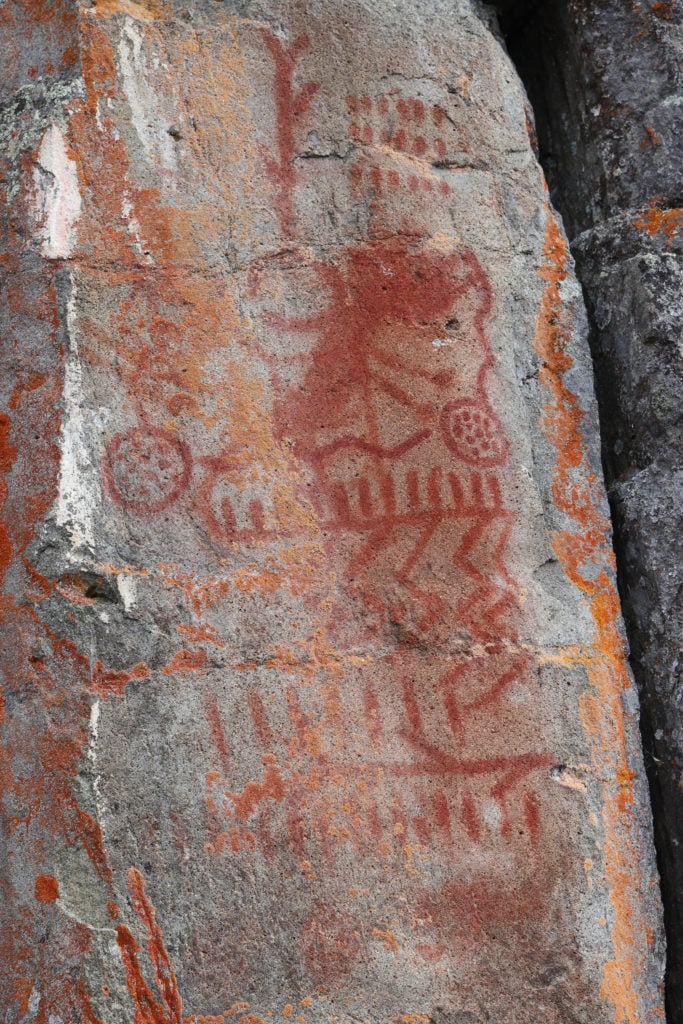
Babine Lake rock painting. Photograph
courtesy of Brandi MacDonald.
While MacDonald’s team focused on
the late-Holocene Pacific Northwest example of Babine Lake, their
work “bears broader relevance
for reconstructing key evidence for pyrotechnological innovations
and complex cognitive processes,” the study reads.
What does that mean, exactly? Well, it points to the fact
that the ancient people of Babine
Lake—the artworks haven’t been
conclusively dated, but MacDonald puts them at less than 5,000
years old—had figured out a way to
harvest a brownish, iron-oxidizing bacteria sediment called
Leptothrix ochracea from the lake. They
heated the sentiment up over open-hearth fires, reaching
temperatures between 750°C to 850°C,
transforming the ochre into the vibrant red hue still seen today.
MacDonald’s team performed a reconstruction of these ancient
techniques by placing a single grain of ochre under an electron
microscope and then heating it gradually while observing the
effects of the temperature change.
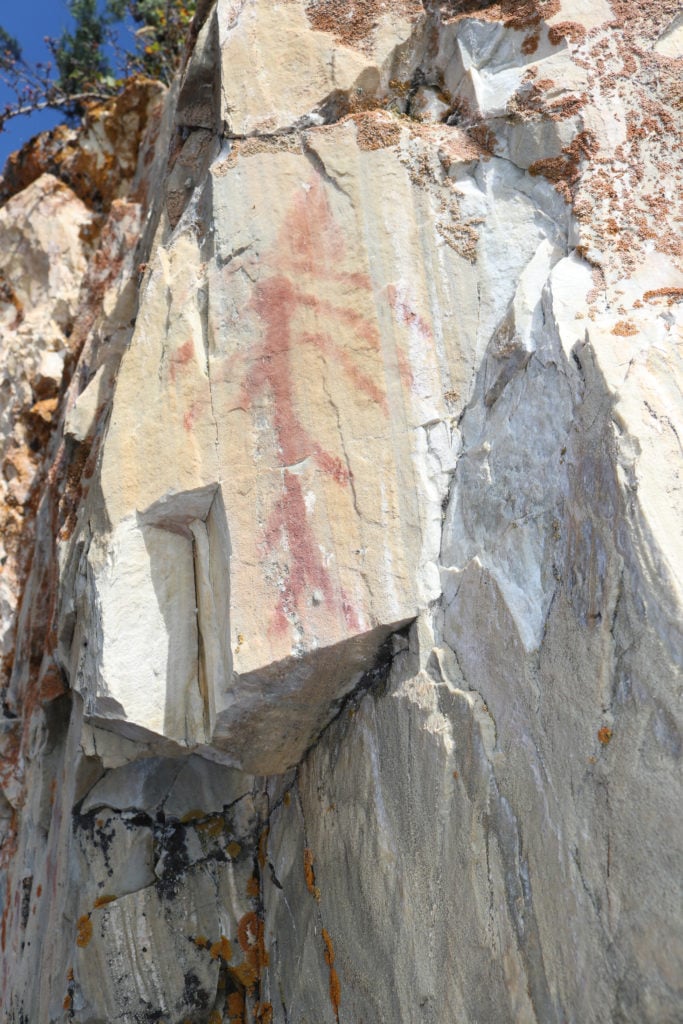
Babine Lake rock painting. Photograph
courtesy of Brandi MacDonald.
“Today, engineers are spending a lot of money trying to
determine how to produce highly thermo-stable paints for ceramic
manufacturing or aerospace engineering without much known success,
yet we’ve found that hunter-gatherers had already discovered a
successful way to do this long ago,” MacDonald told
Mizzou News, the campus newspaper at the
University of Missouri.
The post A New Discovery About Pre-Historic Rock Art
Suggests Ancient People Had Technology We Are Only Now Beginning to
Catch Up To appeared first on artnet News.
Read more https://news.artnet.com/art-world/babine-lake-prehistoric-red-paintings-1713738
Further reading


Leave a comment