
South Korea’s Gwangju Biennale Has Been Postponed Until Next Year, Adding to the Crush of International Shows in 2021
After more than a year of
planning, the organizers of the Gwangju Biennale in South Korea
have announced that the 13th edition of the exhibition will be
postponed from this fall until 2021. The news comes amid a slew of
cancellations and postponements in the global biennial calendar,
including the Lyon Biennale and the Liverpool Biennial.
The delay, or course, was due to
“the global struggle with COVID-19,” organizers said in a
statement, adding that they made the difficult decision to
prioritize the safety of the artists and other participants. The
exhibition is one of the most widely attended biennales in the
world, posing a particular risk of spreading disease. There have
also been numerous practical hurdles caused by the outbreak,
including the production of new site-specific commissions, as well
as logistical issues surrounding the transportation of artworks and
international travel.
The biennale, which was
originally scheduled to run September 4 to November 29, will now be
held from February 26 through May 9 in 2021. The president of the
Gwangju Biennale Foundation, Sunjung Kim, says in a statement that
the foundation will work to address “the various challenges and
variables that will arise in the production of this international
art event that involves artists from around the
world.”
While South Korea has been
praised for its efforts to contain the pandemic, concerns that
the country could be facing a second wave of the outbreak could
complicate the new date.
This year’s biennale had been
meant to coincide with the 40th anniversary of the bloody
Democratic Uprising in Gwangju. Its artistic directors, curators Defne Ayas
and Natasha Ginwala, had titled it “Minds Rising, Spirits Tuning,”
and the exhibition planned
to look at how the world has evolved alongside
technology.
“Despite the optimism brought by the timely
response to the pandemic in South Korea, some decisions have become
inevitable, as we are experiencing many challenges surrounding the
transportation of artworks and international travel,”
Ayas and Ginwala tell Artnet News
in a joint email.
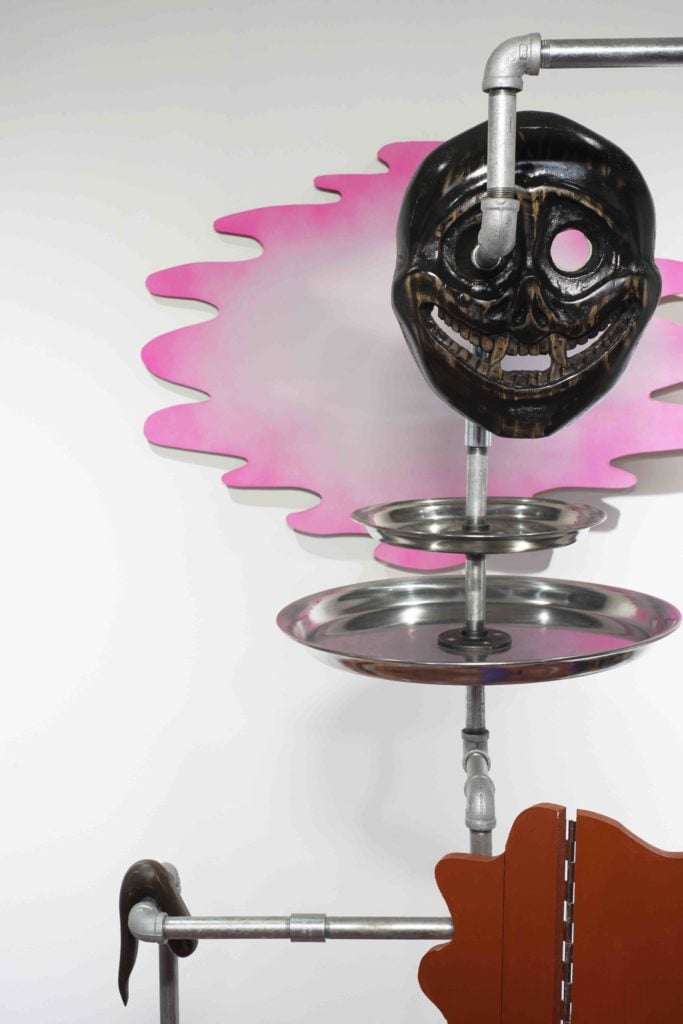
Sangdon Kim, You and I, New
Tribe (2017). Image courtesy of Gwangju Biennale.
Over the past couple of months,
the curators have faced many challenges. With a team spread around
the world from Sri Lanka to Italy, it has been difficult to adapt
to Korean institutional bureaucracy and daily planning operations
while working long-distance, they say. It has also been impossible
for artists to conduct the necessary site-based research for new
productions in Gwangju and the neighboring city of Jeju, which has
stalled progress on three projects from international
artists.
The curators say that they are
still committed to seeing their site-responsive and historically
conscious commissions for the biennale realized. “It remains
crucial for us to learn directly from artistic experiences at this
time—to observe with them how vulnerability, loneliness, narrative
building, and imaginative leaps are reshaping our present lives in
confinement and grief.”
In particular, they emphasize
how their exhibition concept takes different forms of intelligence
into view, which could prove useful in considering what sorts of
civic models and practices of care will emerge in the aftermath of
the virus. “Now, more than ever, the hierarchy of knowledge is
being shaken as planetary forces compel a rethinking toward the
‘communal mind,’” the curators say. “The need for learning from the
wisdoms of indigenous cultures, Shamanic practices, matriarchal
models of society is growing more than ever.”
The pair also hold close in mind
the memory of the Gwangju Uprising as a prism through which to
understand the urgent questions that solidarity movements ask
today. “We want to acknowledge and honor social justice movements
around the world that have been impeded by COVID-19,” they say. “We
know their spirit is very much alive.”
In the meantime, the curators
are launching a bilingual online journal, Minds Rising, which will be published every two months.
Laying out some of their research processes and artistic ideas,
they hope the journal can serve as an “extended mind” of the
biennale.
The post South Korea’s Gwangju Biennale Has Been Postponed
Until Next Year, Adding to the Crush of International Shows in
2021 appeared first on artnet News.
Read more https://news.artnet.com/art-world/gwangju-biennale-postponed-1859286
Further reading


Leave a comment