
Alfred Jarry’s ‘King Ubu’ Inspired Everyone From the Dadaists to the Beatles—and His Fascist Buffoon Is Now More Relevant Than Ever
A portrait of the French playwright and legendary bohemian
Alfred Jarry, with his long dark hair and manicured goatee that evokes
The Three Musketeers, appears alongside family photos in
Linda Klieger Stillman’s home in Potomac, Maryland.
In fact, art and memorabilia related to the proto-Dadaist and
inventor of “pataphysics” is scattered all over the house, though
some of it is missing now that Linda and her husband, Robert
Stillman, gave a significant gift of Jarry’s books and manuscripts
to the Morgan Library. Those objects are on view there now as part
in the new show “Alfred Jarry: The Carnival of Being,” through May
10.
On a recent visit to Potomac, Linda, who has been obsessed with
Jarry for more than 40 years, was wearing earrings, a ring, and
necklace in designs she associates with Jarry’s drawings, and the
same emblem appears on a purplish hand towel in one of her
bathrooms.
Stillman, who is part of the Collège de ‘Pataphysique, founded
in Paris in 1949, first became interested in Jarry early on in her
language and linguistics studies at Georgetown University. After
completing a project on the language in Jarry’s most famous play,
Ubu Roi (or King Ubu), her professor suggested
she write her dissertation on the subject.
“I’ve had this entire Ubuesque and Faustrollian and pataphysical
life ever since,” she says. (Dr. Faustroll was another Jarry
character, based on Faust.) “I think he was the launch pad of the
entire avant-garde of 20th-century Western culture,” she says.
Jarry’s grotesquely tyrannical King Ubu has recently reemerged
with surprising relevance to today’s politics. Critics including
Hal Foster and Charles Simic have described President Trump as
a modern-day King Ubu, “who was a buffoonish pretender to the
throne of Poland, a brutal and greedy megalomaniac who, after
killing off the royal family, starts murdering his own population
in order to rob them of their money,” Simic writes, noting that Ubu
is the only literary character he knows of who approximates the
president. Meanwhile, playwright Paula Vogel organized national
Ubu
“bake-offs” in 2018 to protest President Trump.
And what’s currently going in Ukraine and Russia is intimately
connected to what Jarry wrote about in the Ubu, Stillman says. (She
also believes Jarry’s writings anticipated some of Einstein’s
theories.)
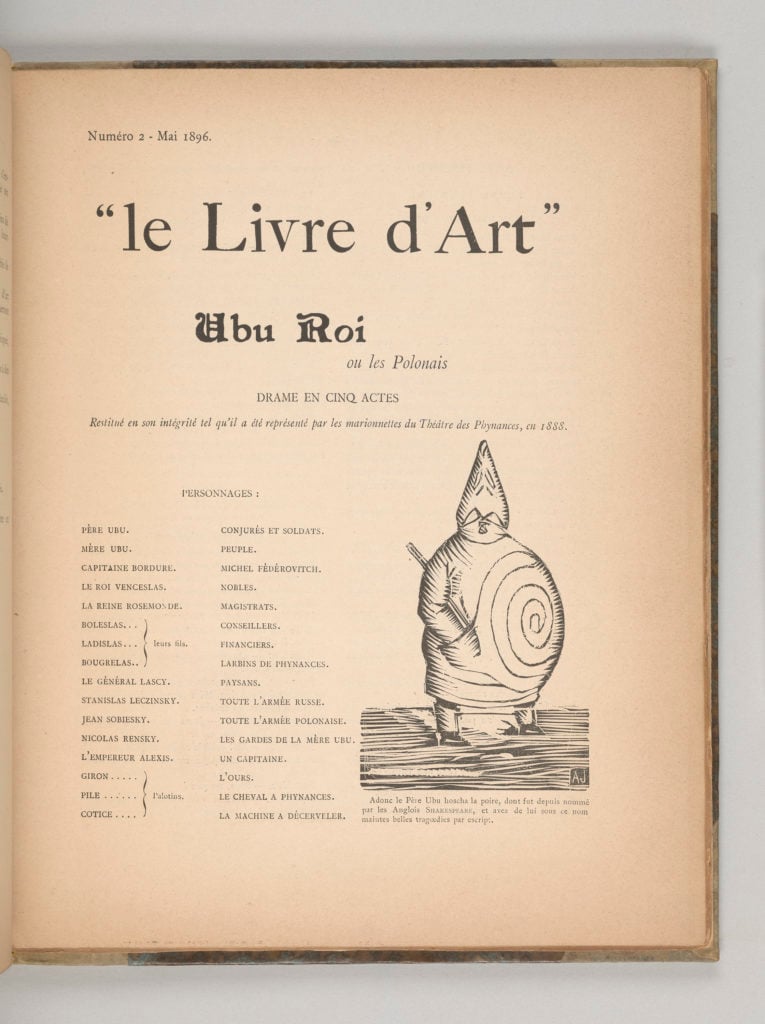
Alfred Jarry’s Ubu roi in
Livre d’Art no. 2 (April 1896). The Morgan Library & Museum. Photo:
Janny Chiu.
However, Sheelagh Bevan, the curator of the exhibition at the
Morgan, says that Jarry’s life was more one of the imagination than
of politics, and notes that the writer made very few political
statements in his lifetime. “Jarry was too much of a pure artist
and individualist to be nailed down by anything,” she says. “That
sort of pure artistry would be difficult in the contemporary
moment. It would be difficult to be that pure of an artist right
now.”
Despite this renewed relevance, Bevan has been surprised by the
public’s lack of familiarity with Jarry’s name, “even much less
what his work was really about, and I’m not sure how to account for
that,” she says. A museum director in France told her that even
French people who use the term Ubuesque to mean something
negative about power and authority don’t necessarily know that it
comes from Jarry’s play.
“It has just become a term,” Bevan says. “’We’re hoping that
this [show] will stimulate further scholarship and a broader
familiarity with just how important he was.”
Historically, Jarry had more success finding his way into famous
circles. Pablo Picasso and Pierre Bonnard both drew his portrait, and Paul
McCartney was reading Ubu Roi in 1968 while composing The
Beatles’ song “Maxwell’s Silver Hammer,” which opens with the lines
“Joan was quizzical / studied pataphysical science in the
home.”
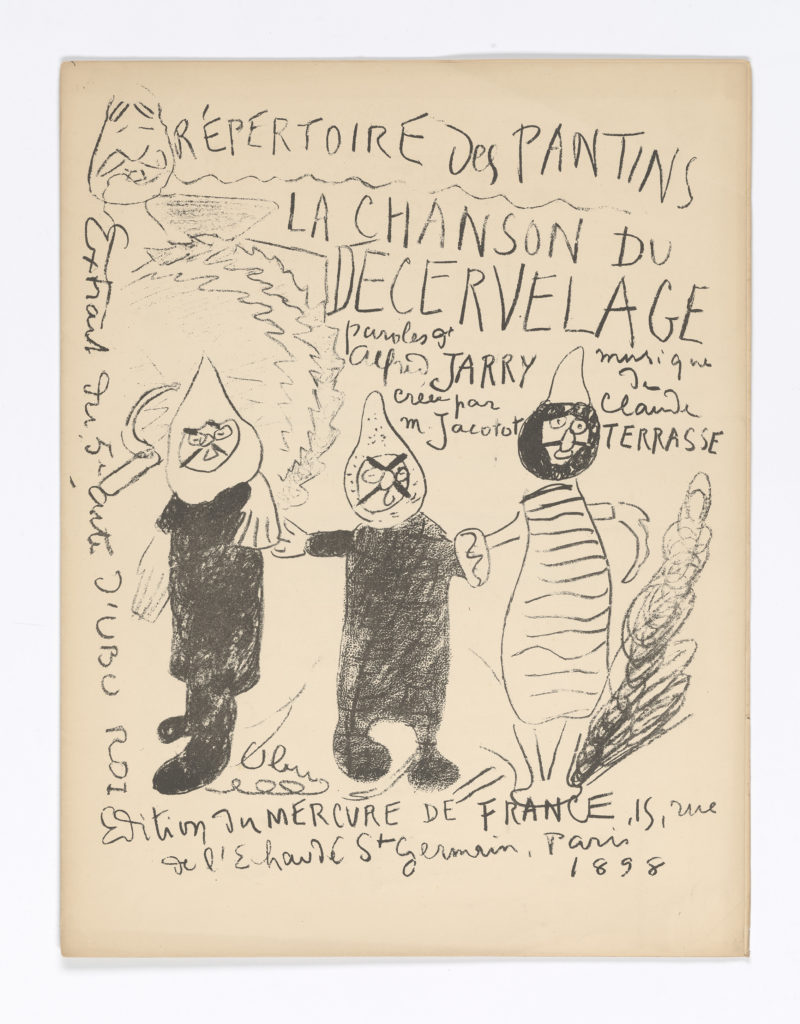
Alfred Jarry and Claude Terrasse,
Répertoire des Pantins: La chanson du décervelage (Paris:
Mercure de France, 1898). Photo: Janny Chiu.
Artists from the Surrealists to Dadaists saw Jarry as their
patron saint, which raises the question of how different modern and
contemporary art history would be without Jarry’s pataphysics.
(Certainly, there wouldn’t have been the rock band Pere
Ubu.)
Bevan first learned about pataphysics in her 20s, and Jarry’s
books, which she encountered in a Museum of Modern Art exhibition
about artists’
books in the mid-1990s, made a “huge impression” on her. But
his writings are difficult to read, and there are barriers in the
availability of translations.
Pataphysics, in one translation, is “the science of imaginary
solutions, which symbolically attributes the properties of objects,
described by their virtuality, to their lineaments.” On a first
read, that’s about as clear as mud. Merriam-Webster offers a
simpler, if rather dismissive, definition: “intricate and whimsical
nonsense intended as a parody of science.”
Performances are also tough to document, Bevan adds,
particularly given how Jarry’s life imitated his art. Jarry adopted
Ubu’s outlandish way of speaking. When describing his parents, for
example, he said, “Our father was a worthless joker—what you call a
nice old fellow. He no doubt made our older sister … but he cannot
have played much of a role in the confection of our precious
person. Our mother was a lady of Coutouly ancestry, short and
sturdy, willful and full of whimsey, of whom we had to approve
before we had a voice in the matter.”
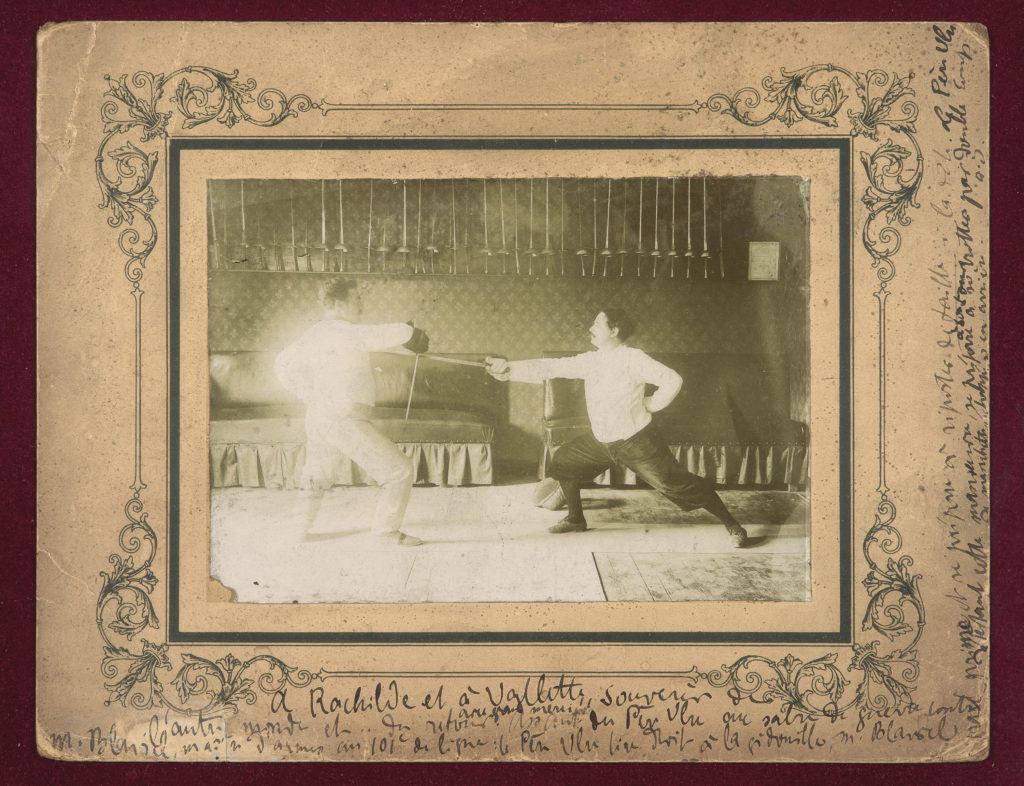
Alfred Jarry (at right) fencing with
Félix Blaviel in Laval, 1906, photograph. Courtesy of the Morgan
Library & Museum.
Jarry’s life was brief, dramatic, and filled with plenty of
controversy. In his short story “The Passion Considered as an
Uphill Bicycle Race,” Jarry, who was an avid cyclist, imagines
Jesus Christ bike-racing against some thieves and then wrecking on
a turn. Jarry’s blasphemy, wrote Roger Shattuck in his 1968 book
The Banquet Years, “transformed
religion into a sport, just as the mechanical idea of the athletic
record gave him the opportunity to victimize romantic love. … He
said categorically, ‘Screw good taste.’”
And when King Ubu premiered, the first word
uttered—merdre, a variation on the French word for
“shit”—caused a scandal by voicing a curse word in formal
theater.
A decade later, Jarry died, at just 34 years old, in part due to
his heavy drug and alcohol habit.
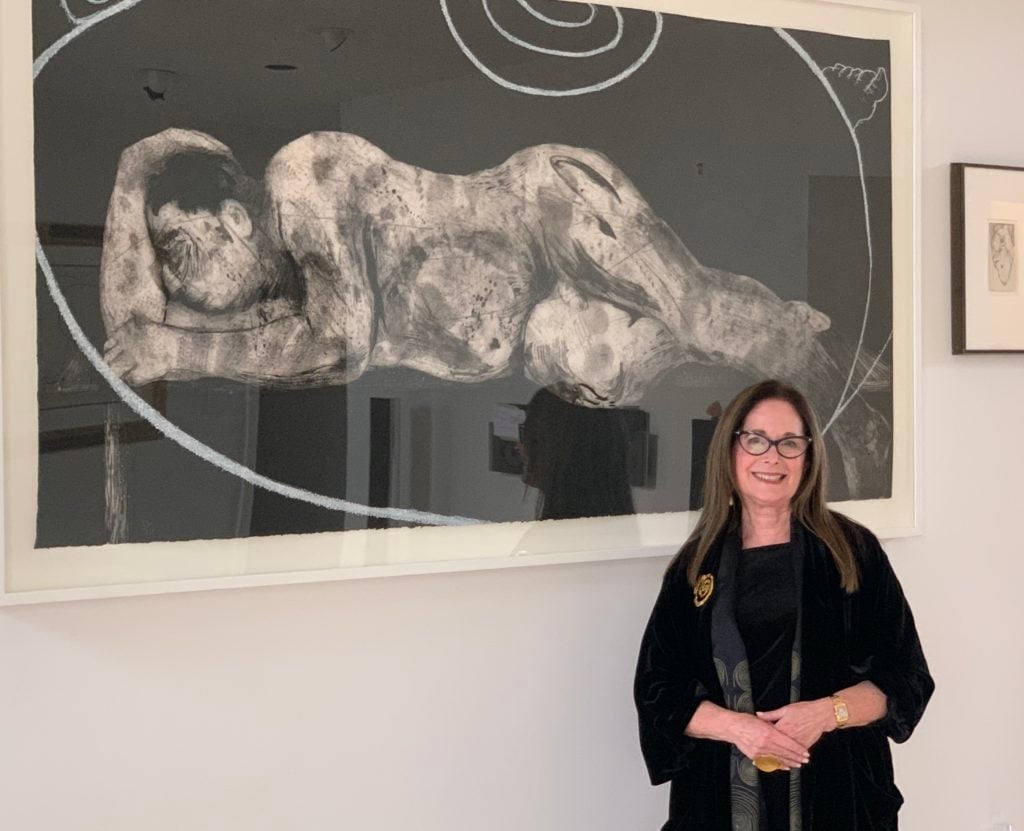
Stillman with Ubu Tells the Truth
by William Kentridge. Photo: Menachem Wecker.
The Morgan show is a corrective to Jarry’s better-known antics,
Bevan says, by focusing instead on printed books. Visitors will
discover Jarry’s collages, for example, which might juxtapose a
17th-century recipe for turning your hair green with a snippet of
his own writing. “He didn’t care about tempering the various
illustration styles,” Bevan says. “It’s an unorthodox approach to
authorship in general.”
Taken together, the books go beyond Ubu to offer a deeper and
more rounded look at Jarry’s oeuvre. “You just see so much more,
and you see the serious side of the comedy,” she says.
This duality is what initially drew South African artist William Kentridge, who played the character of
Captain Manure in his university’s production of King Ubu, to
Jarry’s work. “There’s something about the absurd and the political
absurd that intrigued me with Jarry which has stayed with me,”
Kentridge says. He, along with two other South African artists, has
since made Ubu-inspired etchings that explore “the
combination of the burlesque and the grotesque, and the violent and
the comic, that is the heart of the writing.” (Another painting
that Kentridge made about Ubu hangs in Stillman’s home.)
Initially, Ubu adaptations in South Africa satirized apartheid
rule, “but now it could also equally be done about the new rulers
in the South African political arena,” Kentridge says. He credits
Jarry with “understanding the absurd as a kind of political
critique rather than the foolish or just the joke or the funny” and
applying it as “a corrective, as a warning, as a demonstration of
what happens when self-love and self-pity become the motivating
factors of politicians.”
The post Alfred Jarry’s ‘King Ubu’ Inspired Everyone From
the Dadaists to the Beatles—and His Fascist Buffoon Is Now More
Relevant Than Ever appeared first on artnet News.
Read more https://news.artnet.com/exhibitions/alfred-jarry-morgan-library-1758372
Further reading


Leave a comment