
The Gray Market: Why Art Dealers Need to Focus on New Audiences or Risk Irrelevance (and Other Insights)
Every Monday morning, Artnet
News brings you The Gray Market. The column decodes important stories from the
previous week—and offers unparalleled insight into the inner
workings of the art industry in the process.
This week, reacting to
conversations instead of the news cycle…
CALL AND RESPONSE
Last Monday and Tuesday, the
eighth annual Talking Galleries Barcelona symposium rolled out at
the Museu d’Art Contemporani de Barcelona (MACBA). And while the
two-day think tank left me wrestling with plenty of issues about
the sector, questions about its audience struck me as the most
urgent of all.
It’s not a reality-warping
revelation to say that, thanks to the broader capitalist economy it
operates within, there is no art business if there is no paying
public to support it. But Talking Galleries highlighted this
less-discussed truth: nearly every aspect of what the art business
is (or can be) depends on the size, demographics, preferences, and
worldviews of its audience. Although the system is troubled by many
factors, I’m convinced that one of the most fundamental threats
proceeds from the fact that too many galleries are too focused on
too narrow a segment of the public—and the art market, if not art itself, is
suffering for it.
Let’s face facts: based on their
actions, most Western galleries want to engage genuinely new
audiences to roughly the same extent that diagnosable workaholics
want to keep personal relationships strong—enough
to talk about it publicly, but not enough to listen to what the
other party actually wants, let alone meaningfully change what
they’re doing in response.
What do I mean by “genuinely
new” audiences? Young people who weren’t born mega-wealthy. People
who aren’t so desperate to buy art from legacy dealers that they’ll
grovel for basic information or languish forever on (usually
rigged) waiting lists. People living outside the allegedly “global”
art world that, if most of us fess up, still pretty much just means
the US, UK, Hong Kong, and the handful of western European capitals
that regularly backdrop profile pics in a dating
app.
In short, people with genuinely
different thoughts and expectations about what art should be in the
21st century, rather than the same old economic profile and
priorities packaged in a different national
heritage.
This has led us into a scenario
where many dealers would rather fail by doing things the
traditional way than succeed by doing things radically differently.
After all, who can blame you for crashing and burning when everyone
knows the art world is
unfair? At least you
won’t look like some heathen-baiting art apostate at the next
dinner party.
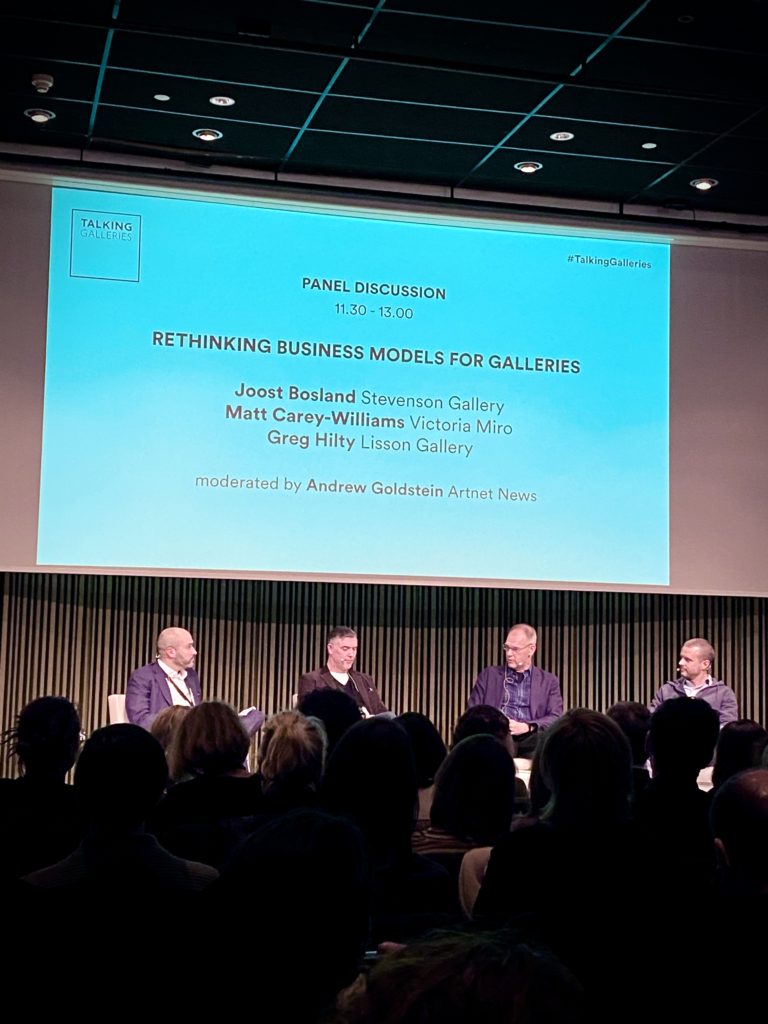
Artnet News’s Andrew Goldstein, Matt
Carey-Williams of Victoria Miro, Greg Hilty of Lisson, and Joost
Bosland of Stevenson Gallery at the 2020 Talking Galleries
Symposium in Barcelona.
BOUNDARIES OF THE BUSINESS
Now, I am in no way, shape, or
form arguing that everyone professionally involved in contemporary
art should react in some Pavlovian way to every whim voiced by
every pocket of the mainstream public. That would be just as
disastrous as refusing to acknowledge the desires of the wider
world at all. To paraphrase a surprisingly Buddha-like koan from
Harrison Ford, the secret to success is to never listen to what
anyone else thinks… but to also listen very
closely.
As of today, though, it’s
crucial to keep in mind that the art market still primarily
consists of buying and selling rare property—paintings, drawings, sculptures, and
prints—for at least the
price of a halfway decent used car, if not many times more. It
would be naive to pretend that galleries built on this foundation
have no opportunities to innovate, but it would be equally naive to
assume that it has no effect on their strategic
options.
This reality creates an
existential dilemma the further up the commercial hierarchy a
dealer climbs. To paraphrase one director at a top-line (but not
mega-) gallery between sessions at the symposium, where do you find
the time and energy to fundamentally restructure the outlook of a
gallery whose continued existence demands it turn over $70 million
in sales every year? To which I would add: especially when that
gallery is trying to close those sales with basically the same
clients as all its main competitors?
This state of affairs should
heavily influence where we look for solutions that could make
rank-and-file galleries more sustainable. Although it would be
unfair to say the biggest dealers never innovate, it’s also true
that the rarest business in any market is one that will
dramatically reshape its priorities and methods when it’s already
succeeding the way things are.
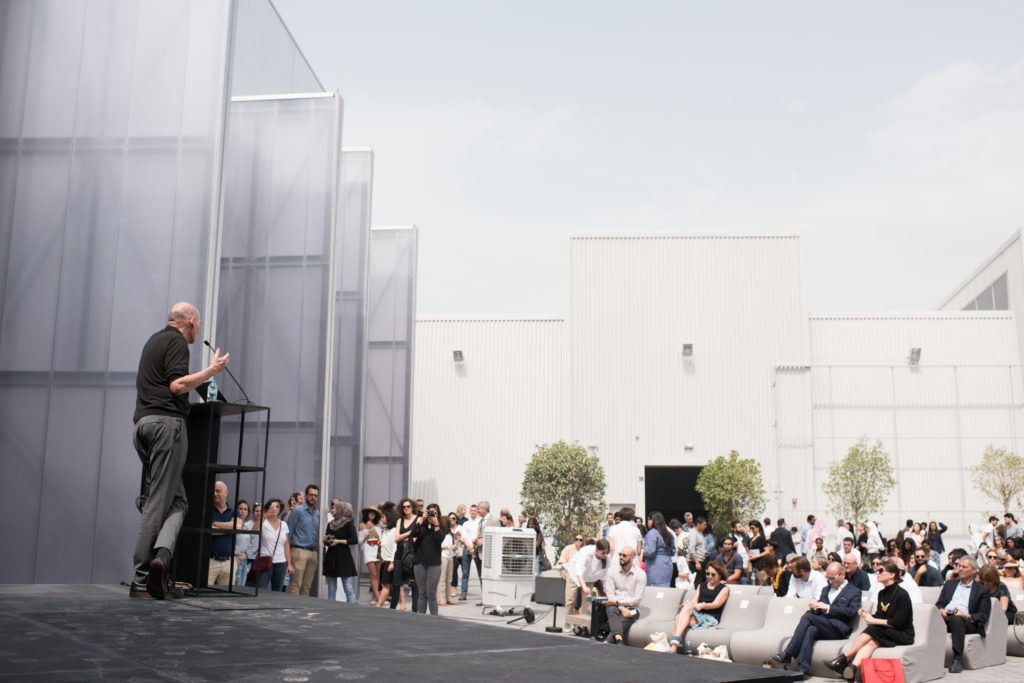
Architect Rem Koolhaas delivers a
lecture in front of Concrete at Alserkal Avenue in Dubai. Photo
courtesy Alserkal Avenue.
LOOK ALIVE
Instead, the most interesting
cases are likely to come from the places that aren’t consistently
grabbing headlines (which reinforces that this area is one where,
as a journalist, I too have to try harder to surface new ideas from
new sources).
Case in point: multiple
eye-opening details emerged from a session at Talking Galleries on
the (problematically defined, as the panelists discussed) Middle
Eastern art market. Vilma Jurkute, director of Dubai’s Alserkal
arts complex, pointed out that, unlike in the West, dealers in her
city do not need to consciously pivot toward the sometimes-markedly
different preferences of a younger audience. Why? Because the
median age of a Dubai resident is just 33.5 years
old.
According to Sunny Rahbar,
director of Dubai gallery the Third Line, a viable commercial art
market has also existed in the Emirate for less than 15 years,
meaning galleries there are often as fresh to the game as their
clients.
Combine these facts, and, as
Jurkute said, “we [in Dubai] don’t have much to unlearn.” That
situation perhaps positions galleries in the Emirates, as well as
in other less-discussed regions around the world, to be more nimble
and creative with their businesses than their counterparts in
traditional art-market hubs.
To be clear, if a dealer wants
to try to succeed by operating a white-cube gallery space fueled by
a roster of artists largely focused on creating rare, expensive
objects for IRL exhibition and sale to pedigreed collectors in the
year 2020, I completely respect that choice. But we should
recognize that it is a choice, and it will likely box in that gallery’s business
model in all the same ways it’s boxed in so many others content to
live and die by the old rules of the game.
Embracing a genuinely new
audience may not be the only option for breaking out of that box.
Nor will it be easy, since it will require galleries to do the hard
work of figuring out how to build on new preferences with vision
and integrity, not just allow public opinion to push them into a
swamp of reactionary, pseudo-artistic dreck. But until more dealers
start taking on that challenge, the gallery system will continue to
stagnate… and it won’t be
the public’s fault.
That’s all for this week. ‘Til
next time, remember the words of US Army general Eric Shinseki: if
you don’t like change, you’re going to like irrelevance even
less.
The post The Gray Market: Why Art Dealers Need to Focus on
New Audiences or Risk Irrelevance (and Other Insights) appeared
first on artnet News.
Read more https://news.artnet.com/opinion/gray-market-talking-galleries-1762398
Further reading


Leave a comment