
‘It Was a Question of ‘How Far Will They Go?”: Former Art Students Remember How Jeffrey Epstein Tested Their Boundaries
The summer of 1995 was poised to be a dream come true for one
group of recent graduates from the New York Academy of Art. They
were the select few who’d been chosen from their class to go on an
all-expenses-paid trip to New Mexico to study under the prestigious
painter Eric Fischl, to attend the debut of the newly launched Site
Santa Fe biennial, and to meet with a wealthy benefactor who wanted
to buy emerging artists’ work.
The patron was said to be building a vast mansion on his ranch
in New Mexico and, at the end of the trip, would commission one of
the students to paint a mural at the completed house.
“There was a feeling that someone
was going to come out of this an art star,” Ursula Ruedenberg, one
of the alumnae on the trip, told Artnet News.
There was just one problem: The patron was Jeffrey Epstein, the
convicted sex offender and pedophile who died in a New York City
jail in August. The encounter with Epstein on his ranch, detailed
to Artnet News by three of the alumnae (one of whom spoke on the
condition of anonymity), sheds fresh light on how Epstein exploited
the ambitions of aspiring artists by promising sales and
connections, all while testing their boundaries and, ultimately,
allegedly assaulting one of them, Maria Farmer, Epstein’s first
accuser.
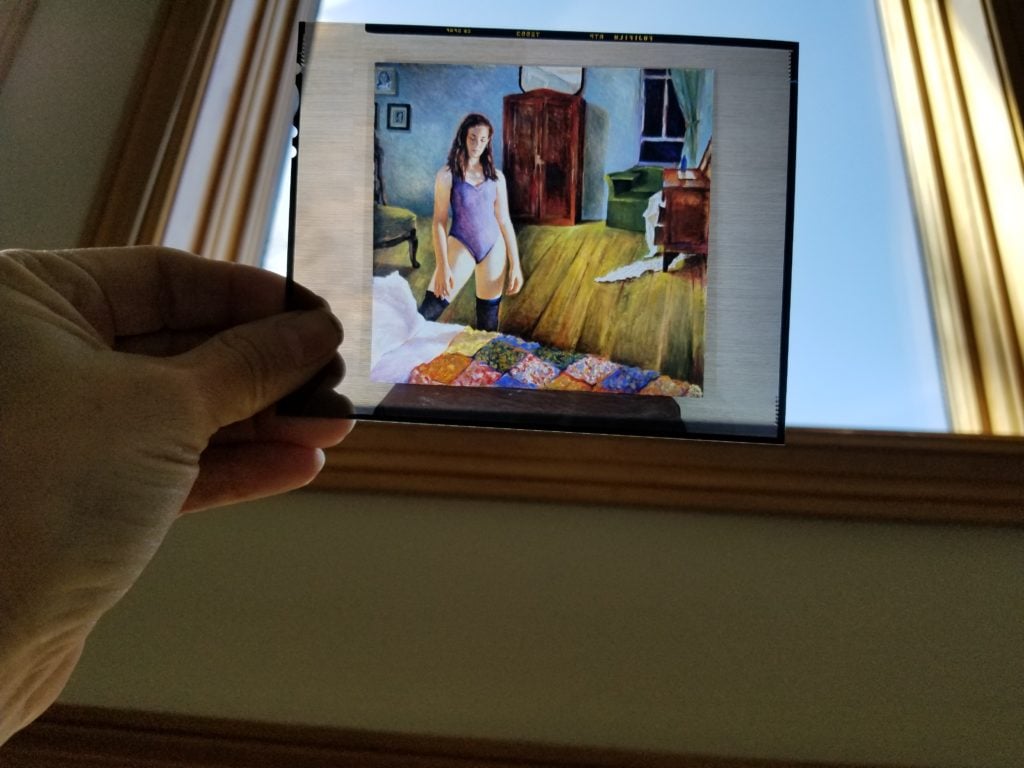
Maria Farmer holds an image of a
painting she made during the alumnae trip to New Mexico and gave to
Epstein.
Conflicting Memories
Epstein had purchased the 10,000-acre Zorro Ranch on a mesa
between Santa Fe and Albuquerque two years before the alumnae trip.
At the time the students arrived, he was in the process of building
a Wild West-style village on the property, complete with a saloon
and general store. This was where numerous women would later
say they were trafficked and raped, and where Epstein plotted to
mass-impregnate women and “seed the human race with his DNA,”
according to the New York
Times. But for now, his future mansion had yet to be built
and he was living in a temporary trailer on the land with his
accused co-conspirator Ghislaine Maxwell.
The alumnae say they were brought to the ranch by Eileen
Guggenheim, then dean of students at the New York Academy of Art
and now chair of its board, who was friendly with Epstein because
he had been an academy trustee for the past seven years. When
Artnet News first
reported Maria Farmer’s account of how Guggenheim
encouraged her relationship with Epstein, in part by bringing her
to the ranch, Guggenheim responded that the story was “a serious
mischaracterization. I have never been at Mr. Epstein’s home in
Santa Fe.”
However, earlier this month, a second alumna contacted Artnet
News to corroborate Farmer’s story—saying that she, too, had been
at the ranch that day and confirming that the meeting with Epstein,
Guggenheim, and the students did indeed happen. “Guggenheim’s
misrepresentation appears to aim at dismissing Farmer’s
concerns—but kind of raises new ones,” she wrote.
A third former student confirmed that the trip with New York
Academy of Art students to Epstein’s home occurred, and that
Guggenheim was present, but remembered few further details.
“There may be some confusion about my visit 25 years ago to Mr.
Epstein’s property,” Guggenheim told Artnet News when asked about
the additional accounts. “What I remember is visiting an
old-fashioned Western town that Mr. Epstein had apparently
purchased and was under construction. To the best of my
recollection, I did not visit any home there or have a meal
there.”
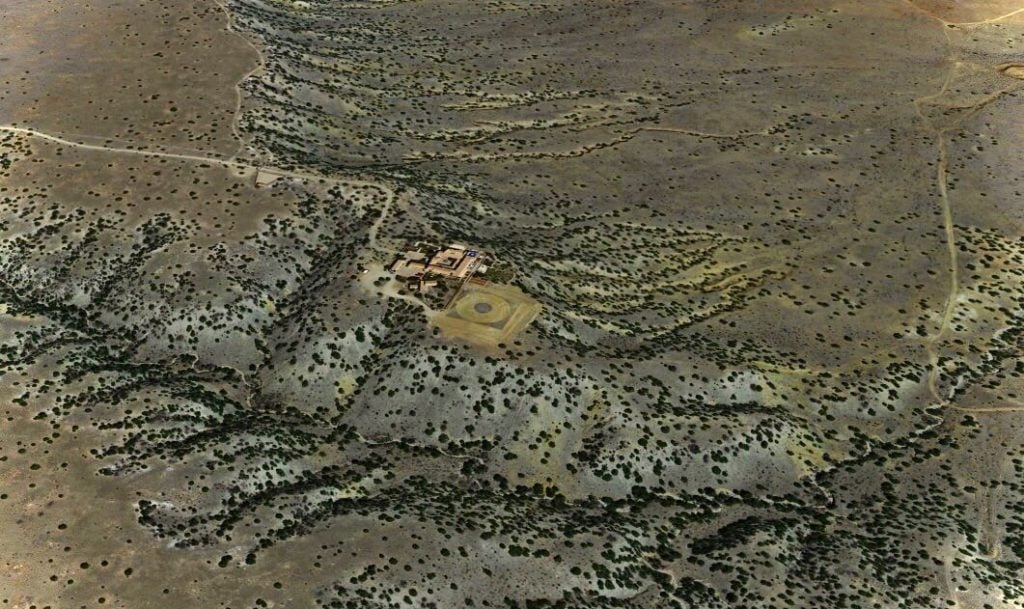
Jeffrey Epstein’s Zorro Ranch in New
Mexico, as seen on Google Earth.
A Day on the Ranch
Both Farmer and Ruedenberg say that they felt unsettled
from the moment they arrived on the property.
“It was a huge scary ranch on this big, ugly, dry desert,”
Farmer recalled in a recent conversation with Artnet News. When
Epstein gave them a tour of the grounds, he
kept pointing out how many deadly rattlesnakes lived on the land.
After they returned to the house, Maxwell instructed the
students to put their coats in the closet. When they opened the
door, they found a skeleton hanging inside.
“She was disappointed that we weren’t frightened by that,”
Ruedenberg said. “She thought that we would be afraid of a
skeleton—but as art students, all we do is look at skeletons.” For
the rest of the day, “they proceeded to pull pranks on us
all the time, to make us feel unstable,” Ruedenberg
recalled.
The odd stunts continued at supper, when Epstein and Maxwell
instructed their guests to close their eyes as they passed around a
bag of unknown objects, and to reach inside and guess what they
were. “One was what felt like pockets of jelly; it
turned out to be falsies, like you put in your bra,” Ruedenberg
said. “Then they demanded that we put
them on.”
Ruedenberg refused and immediately felt shunned for not playing
along. “I knew the commission was out the
window at that very moment,” she said. “I could see it was a
question of ‘how far will they go? Does this person have
boundaries?’”
“It was the weirdest
dinner party I’ve ever been to all my life,” she added. “I’ve been
around a lot of rich people in New York and many are misbehaved,
but this was another level.”
Farmer, who later went on to work for Epstein
in New York, says that this was a party trick he often liked to
play with sexual objects such as condoms. Maxwell’s role was to
“normalize” it, Farmer said. “She had a light-hearted delivery so
you never felt like—dun dun dun—you’re going to be
kidnapped and raped. You just thought they were quirky and they
love art.”
Ruedenberg says that Guggenheim and Maxwell
treated her like a “square” after she declined to play along. “That
dinner party should not have happened, it was
inappropriate. I feel like when you’re in a position of
responsibility to students and somebody acts the way they did,
that’s cause to step back and assess whether this is a professional
situation or not, and that definitely did not happen.”
Guggenheim says that she was not aware of any students taking
issue with the encounter. “Had any student expressed to me their
personal discomfort over actions by Mr. Epstein,” she told Artnet
News in an email, “I would have immediately addressed the situation
and offered my support. At that time, however, neither I nor anyone
at the New York Academy of Art had any knowledge of Mr. Epstein’s
predatory behavior.” (Epstein was first jailed for sex
crimes in 2008.)
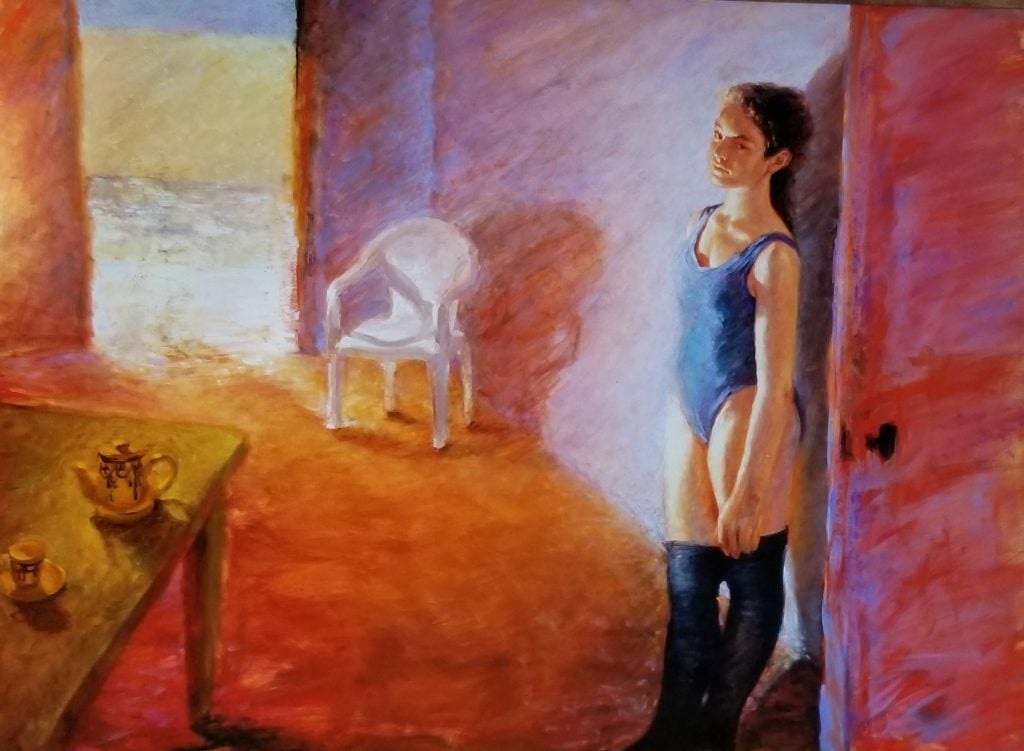
A painting Maria Farmer made during the
alumnae trip to New Mexico and gave to Epstein.
Dangling a ‘Plastic Carrot’
Epstein’s promise to buy one of the students’ work from their
summer class in Santa Fe, and then to commission them to create a
mural, was “part of the conversation throughout the day,”
Ruedenberg recalled.
“There was always that plastic carrot,” Farmer
said. But both women say that Epstein never bought
their work after the trip. Farmer says that she gave Epstein the
two paintings she made there at Guggenheim’s urging, but was never
paid for them. (Guggenheim previously told Artnet News that she has
“never forced an art sale by an Academy student.”)
After Farmer returned to New York, Epstein hired her as his art
adviser and she later traveled to Ohio to work on an art project at
the estate of his friend Leslie Wexner, the billionaire
businessman. That’s where Farmer claims that Epstein and Maxwell
sexually assaulted her. Around the same time, the pair allegedly
invited Farmer’s 16-year-old sister, Annie, to the New Mexico ranch
under the guise of a student trip. When she arrived, Annie said
nobody was there except Epstein and Maxwell, who allegedly assaulted
her, too.
Farmer says that Epstein and Maxwell threatened to ruin her
career if she spoke out about what happened. Instead, she moved
away from New York and, for a long time, stopped painting.
Ruedenberg, too, says that although she didn’t experience
anything like what Farmer went through, the experience with Epstein
soured her on the art world. “I was so fed up
with that whole scene, and [Epstein] was part of it,” she said. “I
left New York. I just thought, I don’t
want to paint for these people, and I stepped out of that
whole world.”
The post ‘It Was a Question of ‘How Far Will They Go?”:
Former Art Students Remember How Jeffrey Epstein Tested Their
Boundaries appeared first on artnet News.
Read more https://news.artnet.com/art-world/epstein-ranch-art-students-1760265
Further reading


Leave a comment