
‘Everyone Is So Afraid to Visit’: Curator Sheikha Hoor Al-Qasimi on How the Lahore Biennale Can Help Pakistan Overcome International Isolation
In
Lahore, art and cricket are helping to overcome Pakistan’s relative
isolation, but in a last-minute clash of dates there was only going
to be one winner. With a fortnight to go before the opening of the
2020 Lahore Biennale, its artistic director learned that the venue
for the opening day’s performances would be off limits due to
increased security for an international cricket
match.
Hoor
Al-Qasimi, the biennale’s pragmatic artistic director, takes
the news in her stride. “So,
I am reshuffling the performances for the 28th, the third day of
the opening week,” she tells Artnet News. “I keep
calm and smiling.”
Al-Qasimi, the founder and director of the
Sharjah Art Foundation in the United Arab Emirates, has organized
a far more international biennale than the inaugural event in
the eastern Pakistan city. Work by around 80 artists, including
some 20 new commissions, will go on show in venues across Lahore.
The British artist Barbara Walker will be creating a large wall
drawing in one of its historic markets, for
example. “I was very
happy she could make it,” Al-Qasimi says, adding: “Of course, I
wanted more women. It is around 50-50. I was hoping for
60-40.”
Many
artists from the West are reluctant to travel to Pakistan, put off
by warnings that foreigners may be targeted, and the threat of
terrorist attacks. However, Walker will be joined by fellow British
artist John Akomfrah, among others. “They don’t have many artists coming from outside
Pakistan because everyone is so afraid to visit,” the curator says.
The Pakistan cricket team plays most of its “home” games in the
UAE.
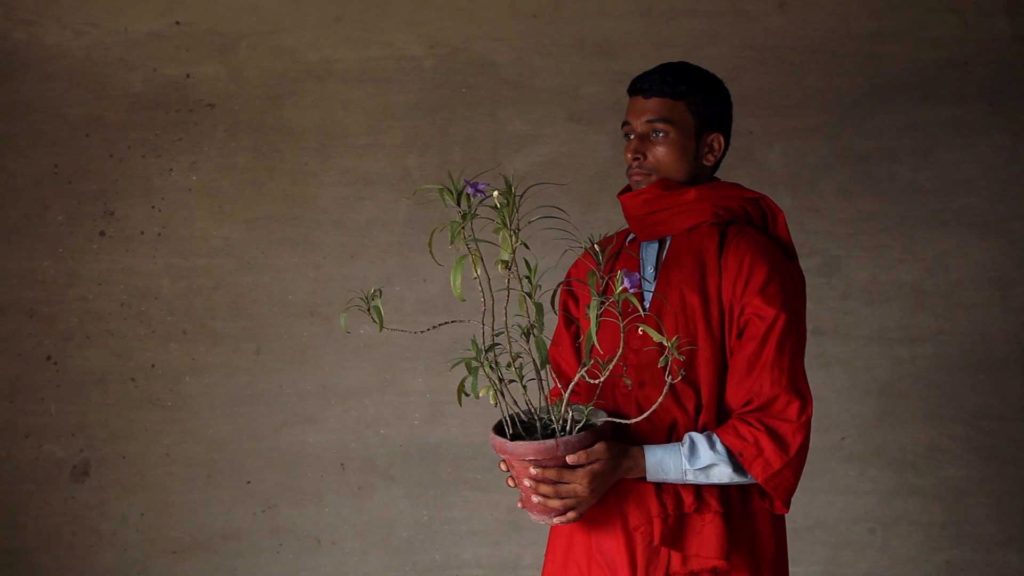
Basir Mahmood, film still from
Monument of Arrival and Return (2016). Copyright the
artist. Courtesy Lahore Biennale.
The
inaugural Lahore Biennale attracted 1.5 million visitors, according
to its organizers, a remarkable number for an exhibition that only
fran for a fortnight. Al-Qasimi proposed the second edition,
which launches at the weekend, and will run for three times longer,
through the end of February. She admits that the decision has
caused financial headaches, and involved lot of extra fundraising.
“The budget is really low for this biennial, and most of it has
gone to extending the show,” she says. Participating artists do get
a fee, and visiting ones are repaid their expenses.
Connecting the Global South
Having
relaunched the Sharjah Biennial in 2003, and put it on the art
world map, Al-Qasimi is aware of the pitfalls of showing
international contemporary art in a traditional society like
Pakistan’s. Religious, moral, and national feelings are easily
offended. “There are always sensitivities about the kind of work
that you can put in public space but that is the same in Sharjah or
anywhere else,” she says.
Lahore
and the richness of its cultural history are new to the curator,
which is one of the reasons why she accepted the
invitation to organize it from Qudsia Rahim, the
co-founder and director of the Lahore Biennale Foundation. “I was
very interested because there is a long history between Pakistan
and the Gulf. My image of Pakistan has always been through Britain,
and the UAE,” says Al-Qasimi, who studied at London’s Slade School
of Art.
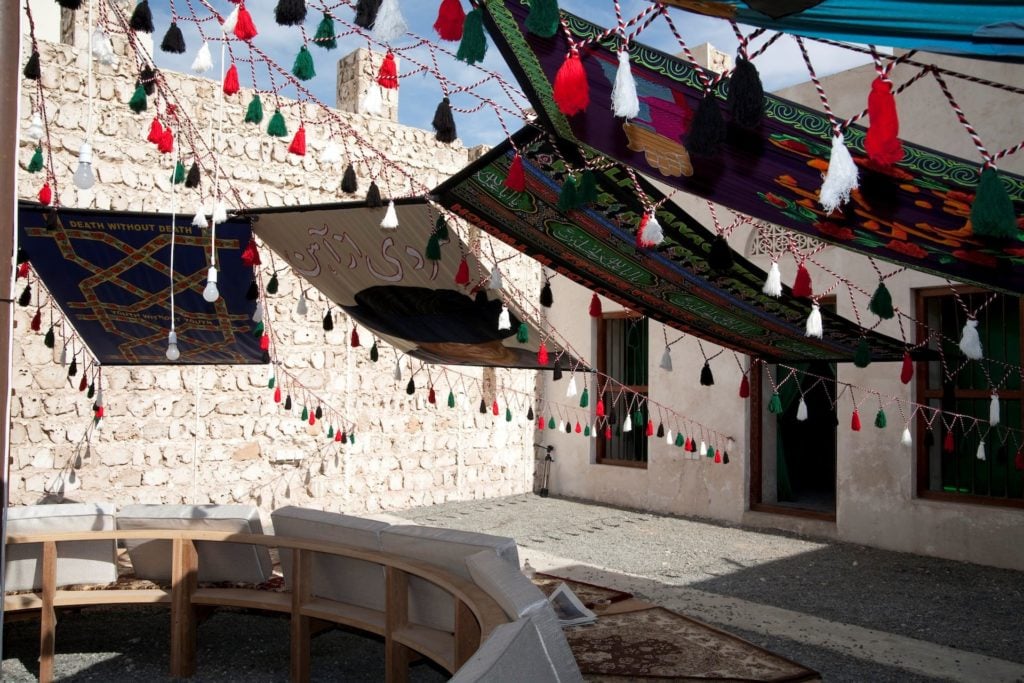
Slavs and Tatars, Friendship of
Nations (2011) installation. Copyright Slavs and Tatars.
Over a
series of flying visits she has discovered a city with a wealth of
historic sites, like the colonial-era market, as well as
interesting modern buildings. “Originally, I had the whole city but
then I had to cut it down,” she says of picking various venues.
They include Lahore’s cricket ground, the Gaddafi Stadium, which is
named after the former Libyan dictator, and the nearby academy
where the players train. However, the city’s planetarium, which is
run by Pakistan International Airlines, was her biggest
coup.
With
Rahim’s help, “and a lot of negotiations,” the curator persuaded
the airline to open the planetarium’s doors to a new commission. An
immersive project created by the
Berlin-based, Kazakhstan-born artist Almagul Menlibayeva was inspired by the astronomical discoveries
made by Islamic scholars in ancient Samarkand. It will include
site-specific performances
by the Amsterdam-based sound artist German Popov and Russian artist
Inna Artemova.
The
celestial work fits the title of the
biennale, “Between the
Sun and the Moon,” although the exhibition’s main focus will be on
planet earth, in particular the “Global South,” the curator’s
longstanding area of interest. “I
wanted to do something about identities and connecting cultures
because of the diaspora of British Asians, and the South Asians in
the Gulf, and how historically we are all connected through
migration,” Al-Qasimi explains. Rahim suggested the curator also included the
links between Pakistan and Central Asia, hence the reference to
Samarkand in Uzbekistan.
Remembering Okwui Enwezor
Another work close to the curator’s heart
touches on Pakistan and India’s fraught political relationship,
which dates back to the bloody birth of both nations as the British
pulled out in 1947, leaving the subcontinent partitioned. The
biennale takes place against a backdrop of renewed tension along
long-disputed border. A new
film by the Kuwaiti-Puerto Rican artist Alia Farid
considers the legacy of partition.
She focuses on the Indus river and its tributaries in the province
of Punjab. After partition exploiting its water became one of many
flashpoints between Pakistan and India.
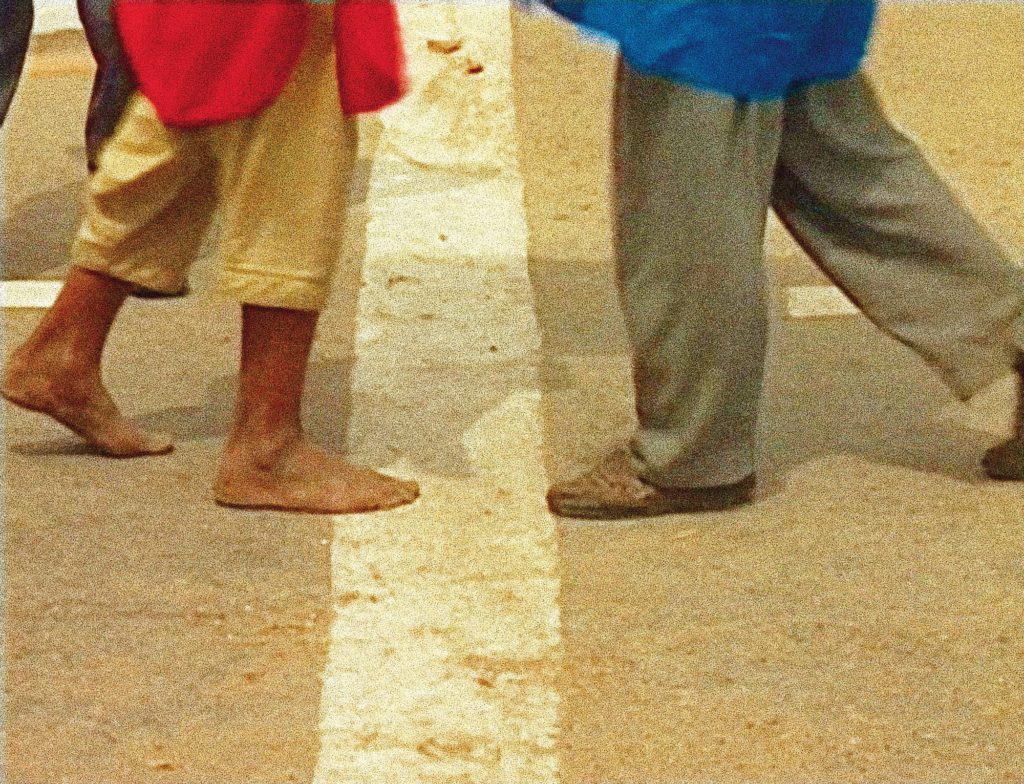
Amar Kanwar, film still from A
Season Outside (1997). Copyright the artist. Courtesy of
Lahore Biennale.
“I
have an older film by Amar Kanwar,” Al-Qasimi says. Showing the
Indian artist’s poetic meditation on cross border links between the
two countries, A Season
Outside (1997) is also a
tribute to her friend, the late curator Okwui Enwezor.
“I was telling him about my project for Lahore
and he said you must show this film. So I asked Amar and he said,
‘Of course.’
She
will be paying bigger tribute to Enwezor next year when she helps realize the Nigerian
curator’s vision for the 2021 Sharjah Biennial, which he agreed
to organize before his untimely death in 2019. Including [Kanwar’s]
film is so special because of the conversation behind it,”
Al-Qasimi says.
“Between the Sun and the
Moon,” 2020 Lahore Biennale, January 26 through February 29,
various venues, Lahore, Pakistan.
The post ‘Everyone Is So Afraid to Visit’: Curator Sheikha
Hoor Al-Qasimi on How the Lahore Biennale Can Help Pakistan
Overcome International Isolation appeared first on artnet
News.
Read more https://news.artnet.com/exhibitions/lahore-biennale-hoor-al-qasimi-1758936
Further reading


Leave a comment