
Centre Pompidou Rolls the Dice on Cultural Diplomacy, Opening a Partner Location in Shanghai
The French President Emmanuel
Macron is in Shanghai this week for the opening of the Centre
Pompidou’s first venue in China. The joint venture with the city’s
developing West Bund district means that the Paris institution
finally gains a foothold in the country to flex its soft power. But
the deal comes with strings attached: All the art on show has to be
“pre-approved” by the Chinese authorities.
Called the Centre Pompidou
x West Bund Museum Project, the waterfront institution opens to the
public on Friday, November 8, against a backdrop of pro-democracy
demonstrations in Hong Kong, and a simmering trade war between the
US and China. The main reason for Macron’s second state visit to
China in two years is to discuss trade and climate with Chinese
President Xi Jinping. At the inauguration of the Pompidou, Macron
celebrated the opening after taking a tour of the museum: “Long
live the friendship of China and France.”
The Centre Pompidou has been one of France’s most
entrepreneurial art institutions, sending loan shows across the
globe. It recently opened a franchised space in Malága in Spain
while planning another in Brussels for 2023. But a Pompidou in
Shanghai raises the stakes of its brand expansion and
the new franchise in China by
a European museum has inevitably raised a few eyebrows,
particularly considering China’s tightening censorship of art with
political messages, however indirect.
The president of the
Pompidou, Serge Lavignes, said in a statement that the new
institution will have “sufficient freedom” to work in China,
although he has admitted that a handful of works destined for the
inaugural show were “edited” at the request of the authorities for
“various” reasons.
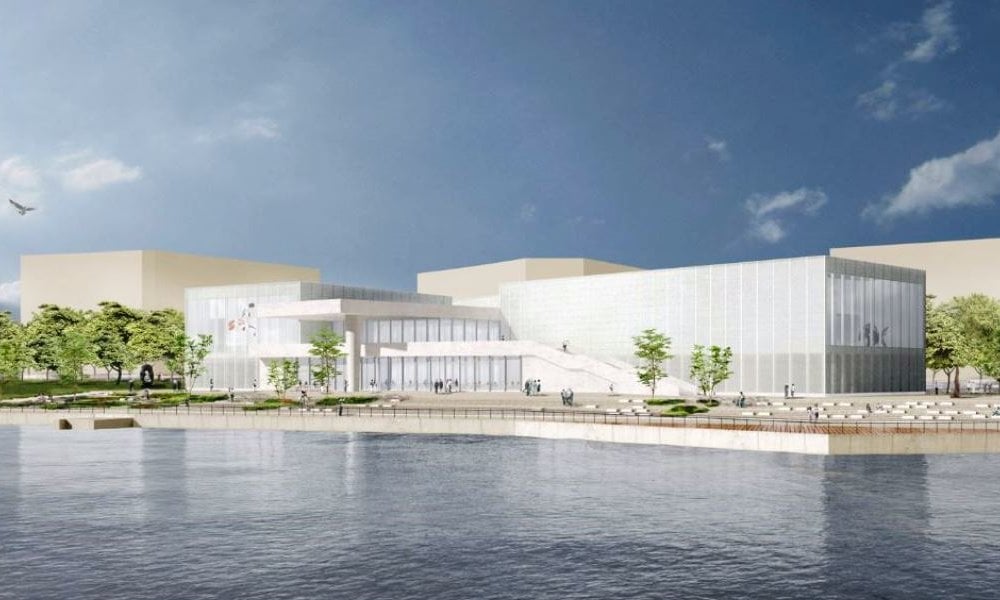
West Bund Art Museum, Shanghai.
Rendering © David Chipperfield Architects.
Museum Mile
The Shanghai satellite of
Paris’s Modern and contemporary art museum is housed in a massive
venue designed by the British architect David Chipperfield. The
opalescent building is the latest addition to the city’s West Bund
“museum mile” on the banks of the Huangpu River. The project is a
partnership with the West Bund Group, a Chinese state-owned
development corporation.
In total, the West Bund
Group has invested $3 billion into creating a cultural art hub at
the new waterfront area that spans about 7
miles. The former
industrial district on the city’s waterfront is already home to the
Long Museum West Bund, the Yuz Museum, and the Shanghai Center of
Photography, among other cultural institutions. The new museum’s
unveiling coincides with the West Bund Art & Design fair, which
opens on November 7 with several Western heavyweight exhibitors,
like Spruth Magers and Gagosian.
Ringing in 27,000-square-feet of
exhibition space, the three galleries, linked by an outdoor atrium,
will see a series long-term exhibitions take place over the next
five years that draw from the collection, in addition to two
temporary exhibitions each year. Another room called “The Box” will
host multi-media installations, while the “Gallery 0” will host
smaller projects by emerging artists.
Lavignes said that one of the
goals of the Chinese collaboration is to export France’s
“savoir-faire,” and to help train Chinese museum professionals. He
added that the venue also provides the French institution with a
“great observation post” to take in Chinese contemporary art. The
Pompidou collection currently comprises 200 works by nearly 120
artists who are Chinese or were born in China—a strong number, but
one that looks bound to grow. Lavignes said the goal of
the West Bund Museum Project includes exploring “non-Western forms
of Modernity” at the Pompidou in general. This
summer, the Paris museum showed a solo presentation by the Chinese
artist Cao Fei.

French President Emmanuel Macron at the
inauguration of Centre Pompidou West Bund Museum in Shanghai on
November 5, 2019. Photo: Hector Retamal POOL/AFP via Getty
Images.
The Trade-Off
While the Pompidou’s mandate is
promoted as a cultural one, it is not without its financial
benefits. In addition to covering the construction and running
costs of the museum, West Bund Group has agreed to also pay the
Pompidou around €2.75 million ($3 million) a year, on top of an
annual €1.4 million ($1.55 million) for the use of its
brand.
There is also the ambition to
grow Chinese audiences back in Paris, which the Pompidou hopes will
be a side effect of the cross-pollination. Currently, Chinese
tourists form only 1 percent of its audience, with the majority
heading straight to the Louvre and Musée d’Orsay.
Despite Lavignes’s assurances that the Centre Pompidou’s
artistic freedom will not be compromised, already, local
officials had requested that a few works in the first show be
replaced. Called “The Shape of Things,” the inaugural
exhibition includes around 100 works from the Paris museum’s
collection, organized by Marcella Lista, the Pompidou’s chief
curator of its new media collection. On show are famous
paintings, such as Picasso’s The Guitar Player from 1910,
alongside works by contemporary Chinese artists like Zhang Huan, as
well as world-famous Chinese abstract painter Zao Wou-Ki. Lavignes
admitted to the New York Times that there were edits
requested by the Chinese authorities of “under five works.” Playing
down the issue, he said there were “various” reasons that were “not
only political.”
Lavignes touched on the dilemmas
involved in working in China in a statement. He asked: “Ultimately,
do we serve democracy better by ignoring China, or by being there,
forging ties, providing access to Western culture and talking with
partners, artists, and visitors?”
The post Centre Pompidou Rolls the Dice on Cultural
Diplomacy, Opening a Partner Location in Shanghai appeared
first on artnet News.
Read more https://news.artnet.com/art-world/centre-pompidou-shanghai-2-1692880
Further reading


Leave a comment