
The Indonesian Economy Is Poised to Boom. Can Art Jakarta Capitalize on Its Potential?
The fairground of Art Jakarta was buzzing last week as crowds of
collectors and art professionals from nearby and abroad filtered
into the newly refurbished Jakarta Convention Center in the heart
of the Indonesian capital.
The latest edition of the event, now in its 11th year, breathed
new life into the fair, which closed on Sunday. In a new and bigger
venue, 39,000 visitors came out to see booths from 70 exhibitors,
up from 50 last year. Of the presenters, 30 were from Indonesia
while almost all of the rest—including Tokyo-based ShugoArts,
Atelier Aki from Seoul, and Sullivan+Strumpf, which has locations
in Sydney and Singapore—came from the region. Los Angeles-based
Baik+Khneysser travelled the longest distance to participate in the
fair.
But fairground chatter was also concentrated on the presence of
representatives from Gagosian and Hauser & Wirth at the gala dinner
of the Museum of Modern and Contemporary Art in Nusantara the night
before the fair’s vernissage. Auctioneer Phillips, which hosted a
charity sale for the institution, also ran a booth at the fair as
an exhibitor, showing works available for private sale.
“I don’t know if [international players] come [here] because
they want to find a new China,” said Tom Tandio, the fair’s
director. “But they are definitely exploring new potential
markets.”
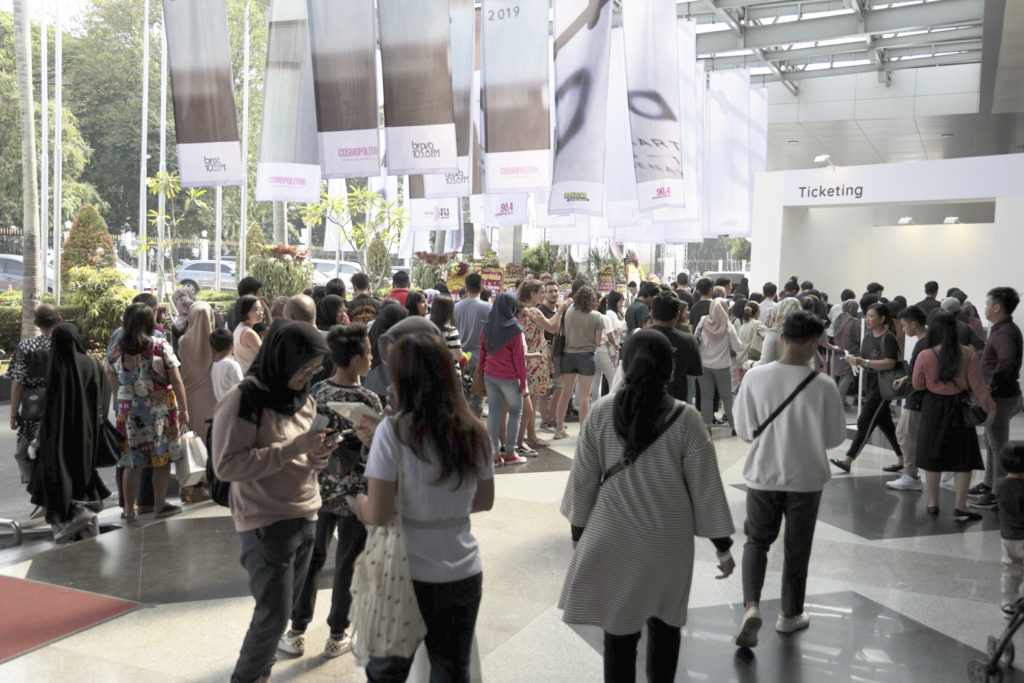
A view of the fairground at Art Jakarta.
Courtesy Art Jakarta.
An Economy Rich in Potential
Tandio’s positive outlook hinges on more than just wishful
thinking. Auction houses such as Sotheby’s and Christie’s have been
cultivating their client bases in Southeast Asia, while the China
Guardian auction house in Hong Kong said spending from Southeast
Asian collectors rose sixfold between 2012 and 2018.
Statistically, Indonesia boasts great untapped potential. The
country has a population of more than 264 million, making it the
world’s fourth-biggest nation. The population is also largely
young, with a median age of 28.6. And although there has been
political unrest since its independence in 1945, democracy looks to
be setting roots.
But the country’s economic situation is especially noteworthy.
The World Bank estimated that Indonesia would have a GDP growth of
5.1 per cent in 2019 and 5.2 per cent in 2020. Accounting firm
PricewaterhouseCoopers predicts it will become the world’s
fourth-largest economy by 2050.
“The growing economy [in Indonesia] means that there are more
young professionals who have higher disposable income,” Tandio
said. “More companies are also utilising art as a platform to have
a dialogue with audiences.”
All this stands in contrast to the situation in China, where the
economy is retracting, democratic institutions are nowhere present,
and an escalating trade war with the US haunts the landscape.
As one Hong Kong-based gallerist put, “people are looking for a
new China.”
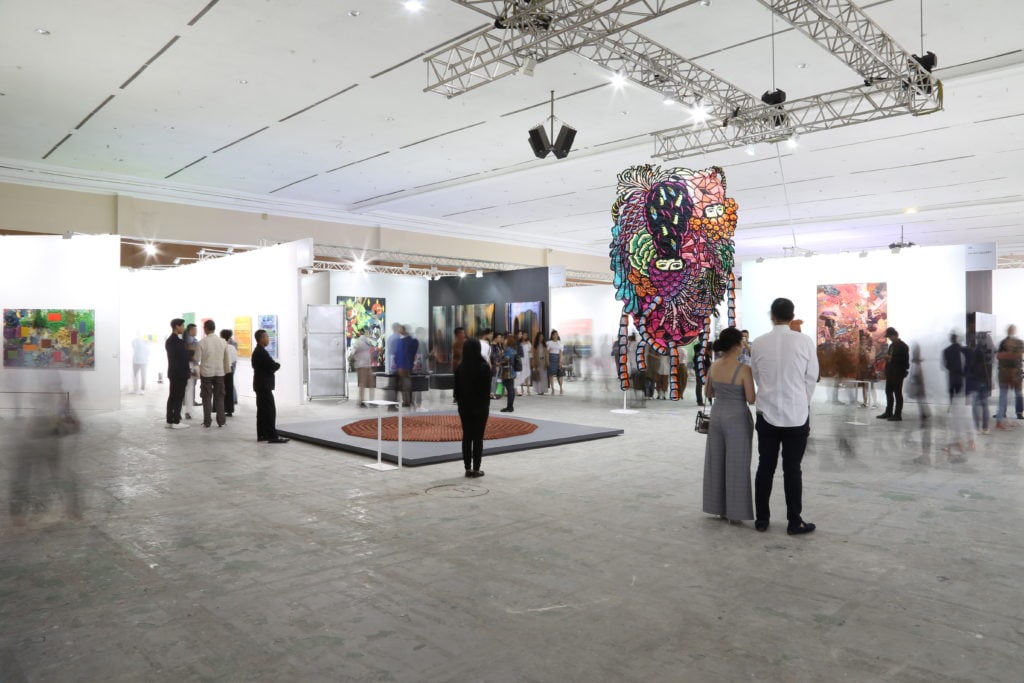
A view of the fairground at Art Jakarta.
Courtesy Art Jakarta.
A Look at the Scene
Among the familiar faces at Art Jakarta were those of Nicole
Berry, executive director of the Armory Show; June Yap, curatorial
director of the Singapore Art Museum; Mami Kataoka, chief curator
of the Mori Art Museum; and Pauline J. Yao, lead curator of M+ in
Hong Kong. Taiwanese collector Rudy Tseng and Belgian collector
Alain Servais also attended.
Servais spent a week in the country, visiting not only the fair,
but also artists’ studios in Yogyakarta. “It’s an immensely complex
country, but understanding it helps me enormously in understanding
the art,” he said. “Indonesia is a sleeping giant, with a massive
economy and a very young public. Art is an extension of society,
not a luxury object. I feel that Indonesia is finding its identity,
figuring out how to position itself. But there will be very good
art coming from Indonesia.”
Servais, who said the best work was available for $50,000 or
less, said he was considering chartering a container to bring home
the 10 artworks that he acquired during the week.
As far as local collectors are concerned, Tandio said
familiarity was essential. “They just don’t buy unless they are
familiar with the artist,” he said. “There are not that many
foreign artists being shown in Jakarta, not even in the region.” He
said collectors still tend to collect paintings but some have begun
to take an interest in installations.
“I want this to be an Asian-centric fair,” Tandio said. And for
young collectors like Nathan Gunawan, that local community and
network are major draws.
“Lots of our parents did not collect,” said Gunawan, who sits on
the board of young collectors of Art Jakarta. He said many young
art buyers were educated in the west, and upon returning to
Southeast Asia were eager to build bridges across the region.
So will Jakarta become the next art hub in the region? Despite
all the optimism, Jakarta is still lacking in infrastructure. Its
subway system—the only one in Indonesia—only opened in March. On
top of that, imported art is also subject to a 17 percent tax,
though Art Jakarta made arrangements with the local government that
mandated payment only if an artwork was sold.
Regardless, the hub idea doesn’t appeal to Tandio.
“I’m focused on creating a unique fair that can attract people from
overseas to come and visit.”
The post The Indonesian Economy Is Poised to Boom. Can Art Jakarta
Capitalize on Its Potential? appeared first on artnet
News.
Further reading


Leave a comment