
We Decoded All the Ingenious Art-Historical References in the Horror Movie ‘Midsommar,’ From Hilma af Klint to Judy Chicago
Once you get to the end of the sinister plot twists in the
recent thriller Midsommar it becomes clear that
director Ari Aster has laid a trail of artistic breadcrumbs that,
upon closer consideration, reveal how the dark final scene was
there from the start.
The art “saturates the film with prophetic details,” Aster told
artnet News of the film, which came out in a new director’s cut
last week.
The story follows a grief-stricken young woman named Dani
(played by Forence Pugh), who, after enduring a grisly family
tragedy, joins her callous boyfriend Christian and
his ragtag group of
grad-school buddies on a summertime jaunt to a Swedish
village. They arrive just in time to take part in the
traditional midsommar celebration, which only
comes once every 90 years.
Against the sunlit backdrop of the village, the creepy blond
inhabitants wear permanent smiles and ornate floral crowns. Toward
the end, Dani regains her sense of agency while seated for dinner
at a long triangular tablescape that, upon reflection, looks a
lot like Judy Chicago’s feminist classic The Dinner
Party—a sly bit of foreshadowing if you know the
ending.
Then there’s the wreath that Dani wears while seated there,
which looks like something out of Mika Rottenberg’s occasionally
phantasmagoric video art, especially when the flower buds open
their pursed lips and start to breathe.

Director Ari Aster on the set of
Midsommar. Image courtesy of A24.
Particularly influential, Aster said, were artists associated
with theosophy and occultism, such as Hilma af Klint, František
Kupka, and Rudolf Steiner—figures whose work often features
repeated symbols and colors that coincide with a certain spiritual
lexicon.
But it was just a happy accident that the Guggenheim was in the
midst of its “Hilma af Klint: Paintings for the Future” show,
probably the most popular museum exhibition of the year,
when Aster returned to New York from filming in
Sweden. The Swedish artist’s The Ten
Largest series of paintings, which reflect different
stages of life cycles, was “a connection made after the script was
written,” Aster said.
Other artists who inspired the film include native Swedes such
as the illustrator John
Bauer, who is best known for dreamscapes that blur fantasy and
mythology, often with a dark undercurrent, and the watercolorist
Carl Larsson, as well as the French painter Pierre Puvis de
Chavannes, and the macabre photographer Joel Peter Witkin, who is
known to have used real corpses to inspire his nightmarish
tableaux. Aster also took cues from theater, with Antonin
Artaud’s Theatre of Cruelty “a particularly important
reference.”
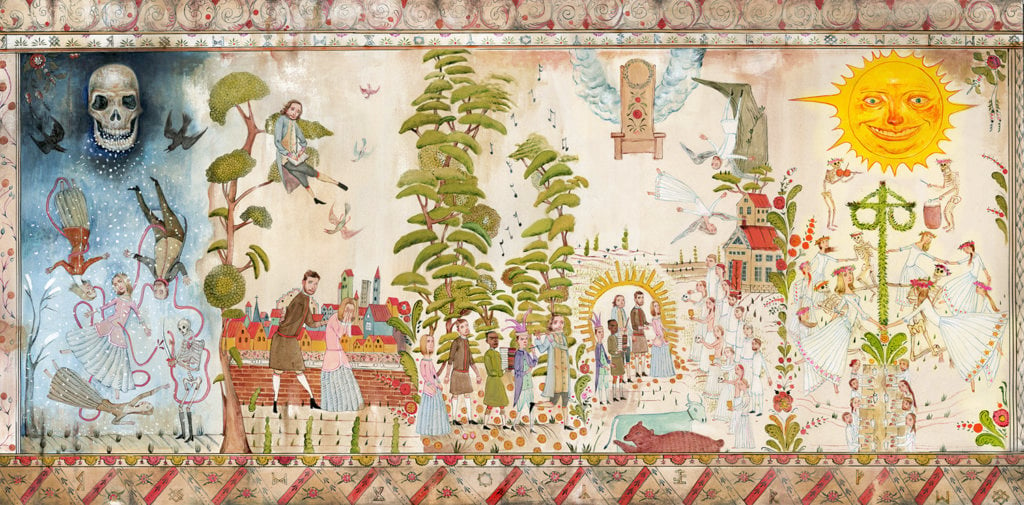
Mu Pan’s mural for Midsommar
(2019). Courtesy of the artist.
One of the first images viewers see when the film begins is an
intricate mural inspired by the New York-based artist Mu Pan, who
Aster has described as a contemporary Hieronymus Bosch. When
Aster’s production crew reached out to the artist about making a
work for the film, “I
didn’t hesitate to say, ‘yes,’” Mu Pan told artnet News. “I am a
big fan of Hereditary,” Aster’s previous
film.
“The main idea was to create a painting in my style that
captured Ari’s ideas, and all of the symbols of the film. I do have
a lot of influence from Bosch, Bruegel, Indian miniatures, Tibetan
tanka,illuminated manuscripts, and Eastern scroll
paintings,” Mu Pan said.
Below, we’ve rounded up some of the most fascinating artistic
references we spotted in the movie, with the film stills above them
for comparison—because while it might be closer to latesommar than
midsommar, it’s always a good time for prestige art-inflected
horror!
Mika
Rottenberg’s Cosmic
Generator (2017)

Top, a still from Midsommar;
below, Mika Rottenberg’s Cosmic Generator (2017), ©Mika
Rottenberg.
Pierre Puvis de
Chavannes’s Death and the
Maidens (1872)
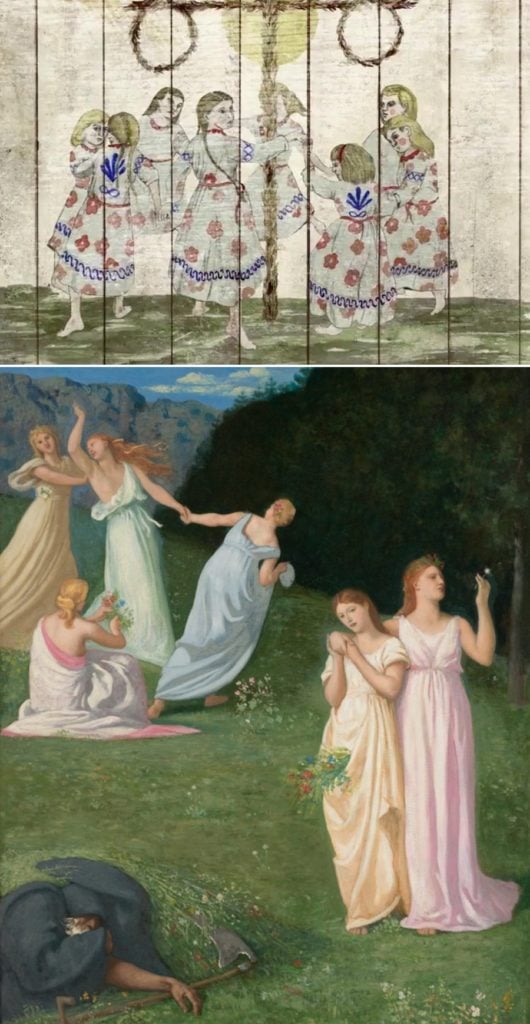
Top, a still from Midsommar;
Pierre Puvis de Chavannes, Death and the Maidens (1872),
courtesy of The Clark Art Museum.
John Bauer’s Lucia
(1913)
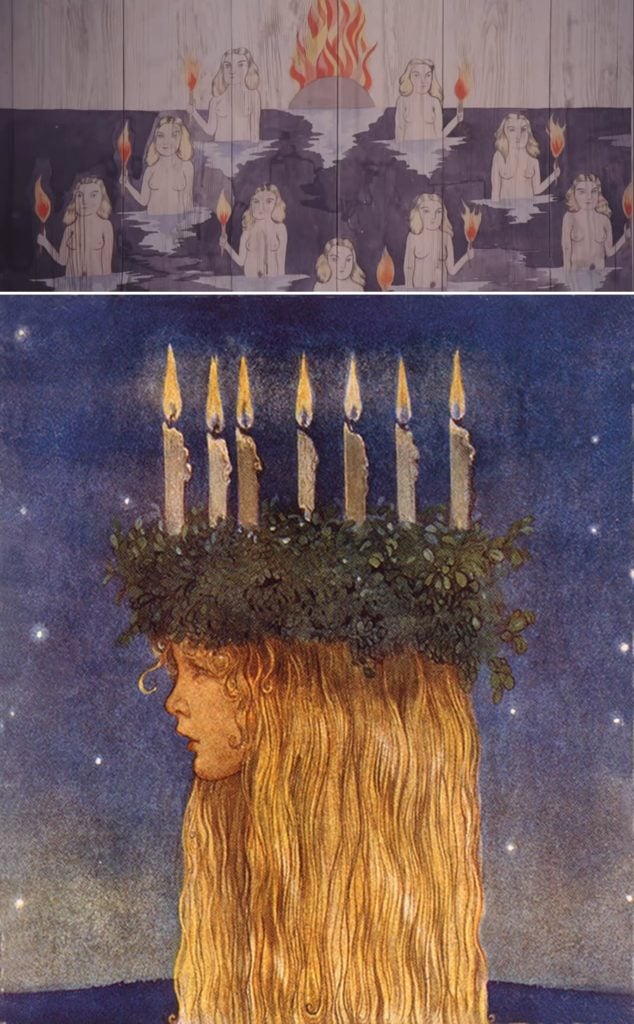
Top, a still from Midsommar; John
Bauer’s Lucia (1913).
19th-century illustration
by John Bauer

Top, a still from Midsommar; John
Bauer’s illustration, courtesy of Wikimedia.
Joel Peter
Witkin’s Myself as a Dead Clown
(2007)
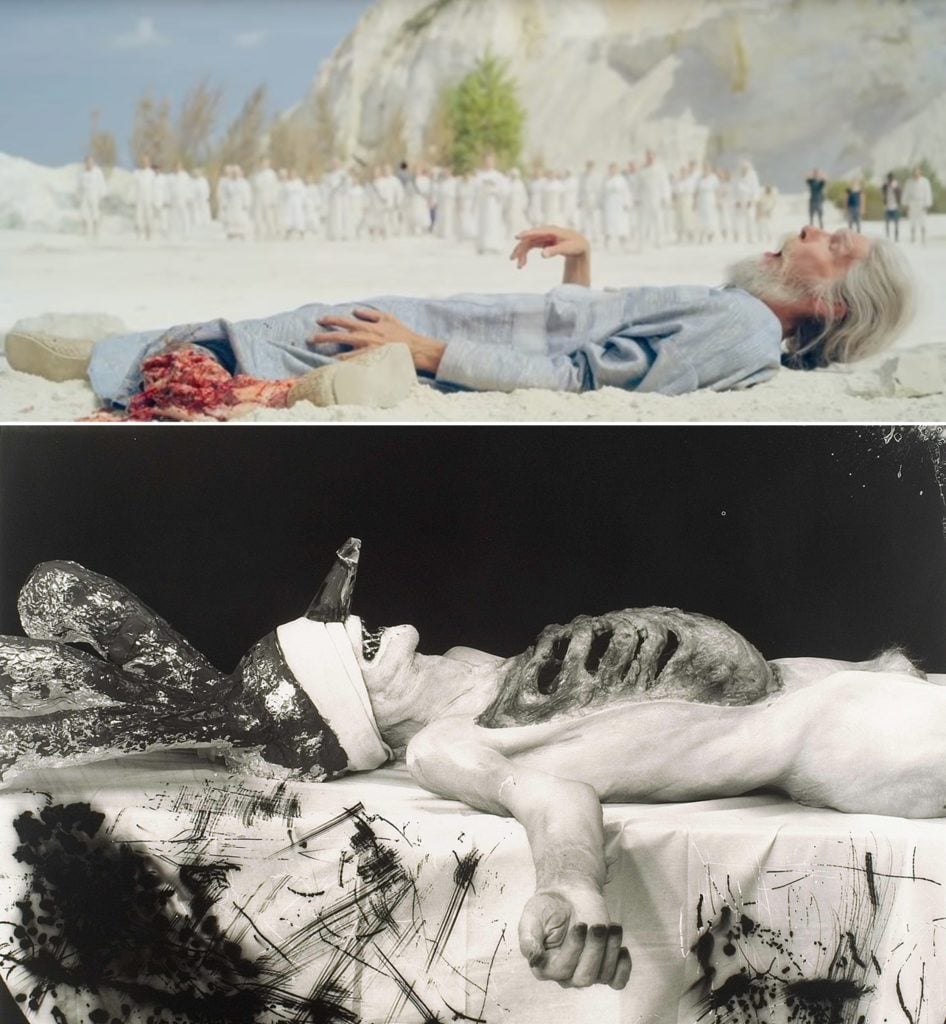
Top, astill from Midsommar,
courtesy of A24 (2019); Joel-Peter Witkin’s Myself as a Dead
Clown (2007). ©Joel-Peter Witkin.
Hilma af
Klint’s Group 1, Primordial Chaos
No.16 (1906-07)
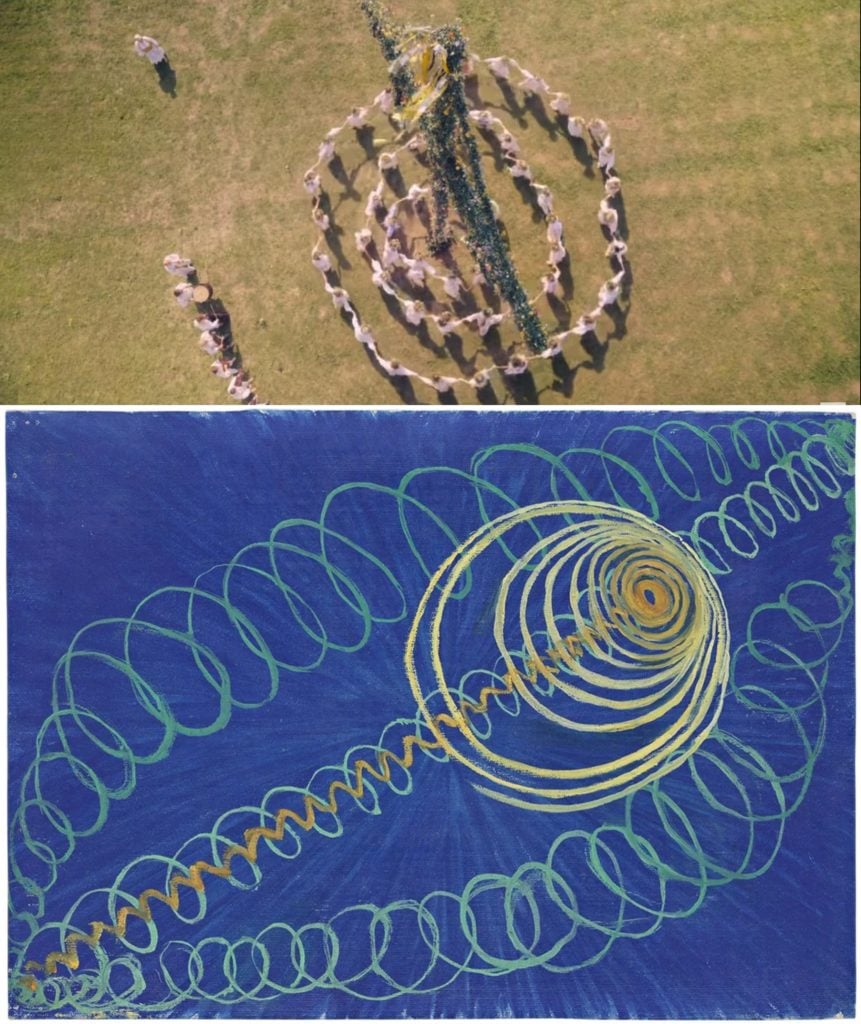
Top, an aerial shot from
Midsommar; Hilma af Klint’s Group 1, Primordial Chaos
No.16 (1906-077). Courtesy of the Guggenheim.
The post We Decoded All the Ingenious Art-Historical
References in the Horror Movie ‘Midsommar,’ From Hilma af Klint to
Judy Chicago appeared first on artnet News.
Read more https://news.artnet.com/art-world/midsommar-art-references-1633975
Further reading


Leave a comment